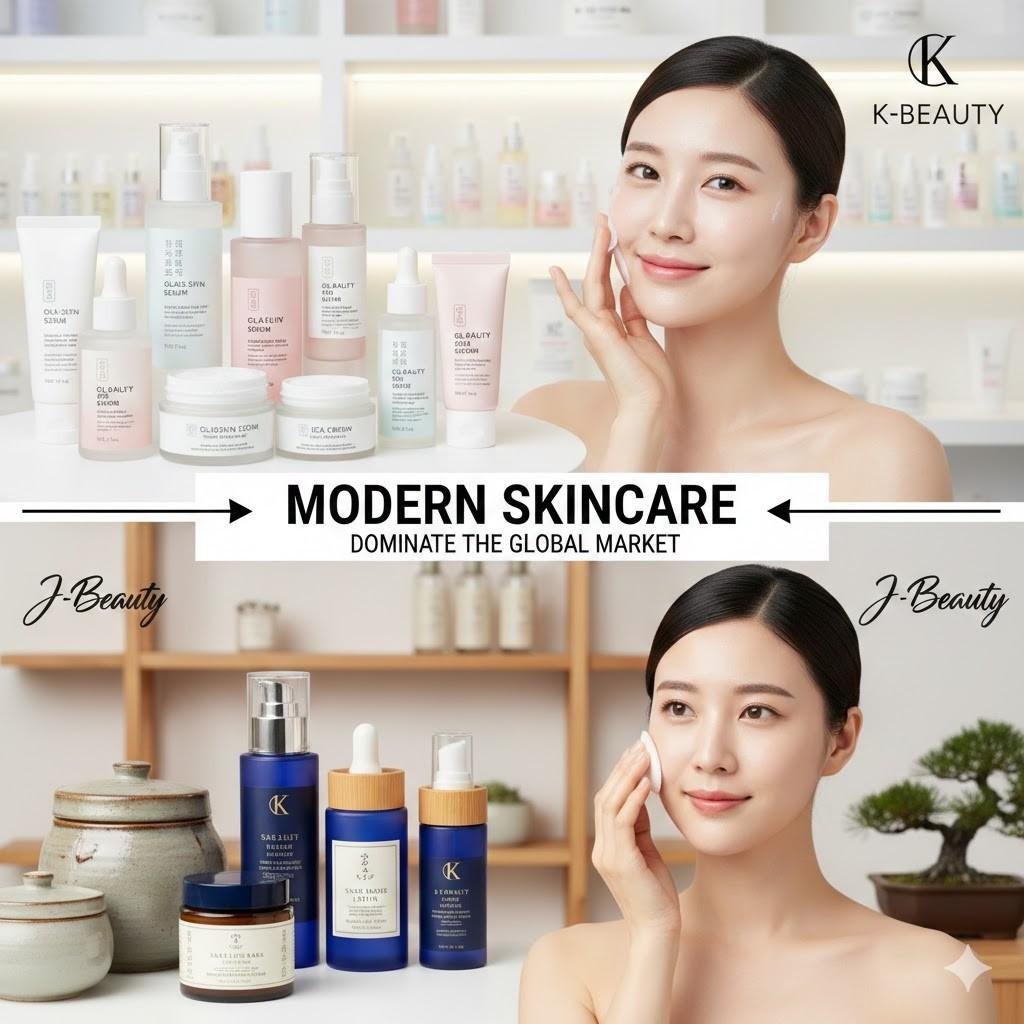
Over the past two decades, the global beauty industry has undergone a remarkable transformation. Once dominated by Western brands and ideals, the skincare and cosmetics world is now heavily influenced by Asian beauty philosophies—particularly K-Beauty (Korean Beauty) and J-Beauty (Japanese Beauty). These two movements have not only introduced innovative products and routines but have also reshaped how people think about skincare, self-care, and beauty as a whole.
K-Beauty and J-Beauty are more than trends; they represent distinct cultural approaches to skin health, aging, and daily rituals. From multi-step routines and glass skin to minimalist elegance and prevention-first care, Korean and Japanese beauty philosophies have left an undeniable mark on global consumer behavior, product development, and industry standards.
This blog explores the origins of K-Beauty and J-Beauty, their core principles, key differences, and their lasting influence on the global beauty industry.
Understanding K-Beauty: Philosophy and Origins
K-Beauty originates from South Korea, a country known for its advanced skincare research, fast-paced innovation, and deep-rooted cultural emphasis on appearance and self-care. Korean beauty philosophy centers on healthy, hydrated, and youthful-looking skin, viewing skincare as a long-term investment rather than a quick fix.
At the heart of K-Beauty is the belief that prevention is better than correction. Instead of covering imperfections with heavy makeup, K-Beauty focuses on nourishing the skin so that makeup becomes optional rather than essential.
The Iconic Multi-Step Routine
One of the most recognizable aspects of K-Beauty is the 10-step skincare routine, which includes cleansing, exfoliating, toning, treating, moisturizing, and protecting the skin. While not everyone follows all ten steps daily, the routine emphasizes customization and layering lightweight products for maximum hydration and absorption.
This approach introduced the global market to products such as:
- Essences
- Ampoules
- Sheet masks
- Sleeping masks
- Cushion foundations
These innovations quickly became staples beyond Korea, influencing product launches worldwide.
Key Ingredients and Innovation in K-Beauty
K-Beauty is renowned for its experimental yet effective ingredient choices. Korean brands are often early adopters of novel ingredients, combining traditional herbal knowledge with cutting-edge science.
Popular K-Beauty ingredients include:
- Snail mucin
- Centella asiatica (cica)
- Propolis
- Fermented ingredients
- Hyaluronic acid
Korean brands are also known for their speed-to-market model, responding quickly to trends and consumer feedback. This fast innovation cycle has pushed the global beauty industry to become more agile and experimental.
Understanding J-Beauty: Tradition Meets Minimalism
J-Beauty, rooted in Japanese culture, takes a more understated and minimalist approach to skincare. Japanese beauty philosophy emphasizes simplicity, consistency, and prevention, with a strong focus on maintaining skin health over a lifetime.
Rather than layering many products, J-Beauty encourages using fewer, high-quality formulations that are gentle, effective, and time-tested. This philosophy aligns closely with broader Japanese cultural values such as mindfulness, discipline, and respect for tradition.
The Importance of Ritual in J-Beauty
In J-Beauty, skincare is considered a daily ritual rather than a chore. Gentle cleansing, careful application, and patience are central principles. The focus is not on transformation but on preservation—keeping the skin balanced, protected, and resilient.
Sun protection plays a particularly important role in Japanese skincare. Sunscreen is viewed as a daily essential from an early age, contributing significantly to Japan’s reputation for youthful-looking skin across generations.
Key Ingredients and Formulations in J-Beauty
Japanese skincare relies heavily on gentle, skin-friendly ingredients with a long history of use. Many formulations are fragrance-free, alcohol-free, and designed for sensitive skin.
Common J-Beauty ingredients include:
- Rice bran (komenuka)
- Green tea
- Camellia oil
- Seaweed extracts
- Hyaluronic acid
J-Beauty products are often rigorously tested and refined over decades, prioritizing reliability and safety over rapid trend cycles.
K-Beauty vs. J-Beauty: Key Differences
While K-Beauty and J-Beauty share a commitment to healthy skin, their approaches differ significantly.
K-Beauty emphasizes:
- Innovation and experimentation
- Multi-step routines
- Trend-driven product launches
- Immediate glow and visible results
J-Beauty emphasizes:
- Minimalism and consistency
- Long-term skin health
- Prevention and protection
- Timeless, refined formulations
These differences allow consumers to choose routines that align with their lifestyle, skin type, and personal preferences.
Global Influence on Skincare Routines
K-Beauty popularized the idea that skincare is a layered, customizable process rather than a one-size-fits-all routine. Western consumers began adopting double cleansing, essence application, and regular masking—practices that were once uncommon outside Asia.
J-Beauty influenced the global shift toward gentle cleansing, lightweight textures, and daily sunscreen use. The emphasis on prevention has encouraged consumers worldwide to start skincare routines earlier in life.
Together, these philosophies have elevated skincare from basic hygiene to a form of self-care and wellness.
Impact on the Global Beauty Industry
The influence of K-Beauty and J-Beauty extends beyond consumer habits to the core of the beauty industry itself.
Product Development
Global brands now routinely incorporate Asian-inspired elements such as:
- Lightweight gel and essence textures
- Skin-first makeup products
- Innovative delivery systems
Packaging and Branding
K-Beauty introduced playful, approachable packaging, while J-Beauty influenced clean, minimalist design. Both styles have reshaped how beauty products are marketed and perceived.
Inclusivity and Skin Positivity
Asian beauty philosophies emphasize healthy skin at every age, contributing to a broader acceptance of natural beauty and skin diversity. This shift has encouraged brands to move away from unrealistic beauty standards.
The Role of Social Media and Pop Culture
Social media platforms, beauty influencers, and pop culture have played a major role in spreading K-Beauty and J-Beauty globally. K-pop idols, Korean dramas, and Japanese lifestyle content have showcased skincare routines and beauty rituals to international audiences.
Tutorials, reviews, and before-and-after content have made these routines more accessible, helping consumers understand not just the products but the philosophy behind them.
The Future of K-Beauty and J-Beauty
As sustainability, skin barrier health, and science-backed formulations gain importance, both K-Beauty and J-Beauty are evolving.
K-Beauty is shifting toward:
- Skin barrier repair
- Simplified routines
- Sustainable packaging
J-Beauty continues to focus on:
- Prevention and longevity
- Eco-conscious practices
- Refinement rather than reinvention
The future likely lies in a hybrid approach that combines Korean innovation with Japanese minimalism.
Choosing Between K-Beauty and J-Beauty
Rather than choosing one over the other, many consumers blend elements of both. For example, using a K-Beauty essence for hydration alongside a J-Beauty sunscreen for daily protection.
The best routine is one that suits your skin type, lifestyle, and values—not one dictated solely by trends.
Conclusion: A Lasting Global Legacy
The influence of K-Beauty and J-Beauty on the global beauty industry is profound and enduring. These movements have redefined skincare as a holistic, preventative, and deeply personal practice.
By prioritizing skin health, consistency, and mindful routines, Korean and Japanese beauty philosophies have empowered people worldwide to approach beauty with intention rather than excess. As trends come and go, the core principles of K-Beauty and J-Beauty—care, patience, and respect for the skin—are likely to remain central to modern beauty for years to come.
Ultimately, the global embrace of K-Beauty and J-Beauty reflects a broader shift toward self-care, wellness, and sustainable beauty—one thoughtful step at a time.
Frequently Asked Questions
What is the main difference between K-Beauty and J-Beauty?
The main difference lies in their approach. K-Beauty prioritizes innovation and layered routines for visible results, while J-Beauty focuses on minimalism, consistency, and prevention. Both aim for healthy, balanced skin.
Why are K-Beauty and J-Beauty so popular worldwide?
Their popularity comes from effective formulations, unique skincare philosophies, and strong cultural influence through social media, pop culture, and global beauty communities. Both approaches emphasize skin health rather than heavy makeup.
Are K-Beauty and J-Beauty suitable for all skin types?
Yes. Both K-Beauty and J-Beauty offer products for various skin types, including sensitive, oily, dry, and acne-prone skin. The key is choosing products that match your individual skin needs.
Can I combine K-Beauty and J-Beauty in one routine?
Absolutely. Many people mix both approaches—for example, using a K-Beauty essence for hydration and a J-Beauty sunscreen for daily protection. A hybrid routine often works best.
Do K-Beauty routines really require 10 steps?
No. The 10-step routine is a guideline, not a rule. K-Beauty encourages customization, and many people use fewer steps based on their lifestyle and skin concerns.
Why is sunscreen so important in J-Beauty?
J-Beauty strongly emphasizes daily sun protection to prevent premature aging, hyperpigmentation, and skin damage. Sunscreen is considered an essential step in maintaining long-term skin health.
How have K-Beauty and J-Beauty influenced Western skincare brands?
They have influenced Western brands to focus on skincare-first makeup, lightweight textures, innovative ingredients, gentle formulations, and preventative skincare practices.
Will K-Beauty and J-Beauty remain popular in the future?
Yes. While trends evolve, the core principles of K-Beauty and J-Beauty—skin health, prevention, and mindful routines—are expected to remain influential in the global beauty industry.
Also Read: