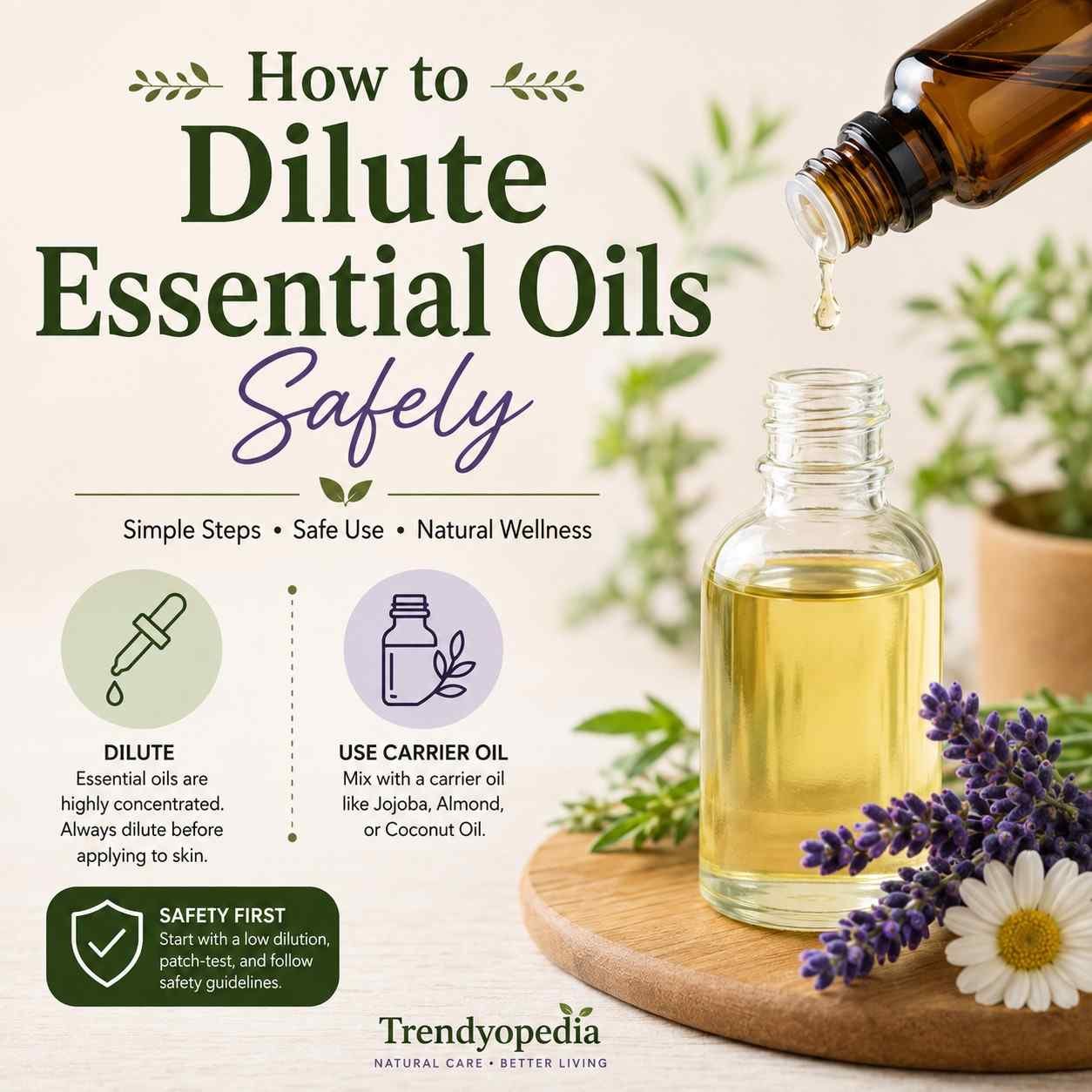
How to Dilute Essential Oils: Essential oils are highly concentrated plant extracts commonly used in aromatherapy, personal care, massage, and beauty routines. Because they are concentrated, applying them directly to the skin can increase the risk of irritation and allergic reactions.
One of the most important safety practices for topical use is proper dilution with a suitable carrier oil.
Carrier oils such as Jojoba Oil, Almond Oil, Coconut Oil, Avocado Oil, and Olive Oil help reduce the concentration of essential oil before it is applied to the skin.
This guide explains how essential-oil dilution works, common dilution percentages, how to calculate a dilution, safety precautions, and common mistakes to avoid.
What Does Essential Oil Dilution Mean?
How to Dilute Essential Oils: Dilution means mixing a small amount of essential oil with a larger amount of carrier oil or another suitable base.
For example, a 1% dilution means that essential oil makes up 1% of the final mixture, while the remaining 99% consists of the carrier or other ingredients.
The purpose is not to make an essential oil ineffective. Instead, appropriate dilution can help reduce the concentration applied to the skin and lower the risk of adverse skin reactions.
Why Should Essential Oils Be Diluted?
Essential oils are much more concentrated than the plants from which they are extracted.
Using them undiluted on the skin can increase the risk of:
- Skin irritation
- Burning or stinging
- Redness
- Allergic reactions
- Skin sensitization
Tisserand Institute specifically advises against applying undiluted essential oils to the skin.
Dilution is therefore an important part of responsible topical essential-oil use.
What Is a Carrier Oil?
A carrier oil is generally a plant-based fatty oil used to dilute essential oils.
Popular options include:
- Jojoba Oil
- Sweet Almond Oil
- Coconut Oil
- Avocado Oil
- Olive Oil
- Grapeseed Oil
- Sunflower Oil
- Rosehip Oil
How Much Essential Oil Should You Use?
How to Dilute Essential Oils: There is no single dilution that is appropriate for every situation.
The ideal concentration depends on:
- The specific essential oil
- The body area
- The intended use
- The user’s age
- Skin sensitivity
- How frequently it will be used
- Any specific safety restrictions for the oil
Tisserand Institute describes different general dilution ranges for different applications, rather than treating one percentage as appropriate for everyone.
For general adult topical use, lower concentrations are often a sensible starting point, particularly for the face and sensitive skin.
Common Dilution Guidelines
How to Dilute Essential Oils: These are general examples rather than universal rules:
| Dilution | Common Context |
|---|---|
| 0.2–1% | Very sensitive or compromised skin |
| 0.5–1.2% | Facial cosmetics and sensitive areas |
| 1–3% | Body oils and lotions |
| 2–4% | Certain bath or wash-off products |
The appropriate concentration can be lower or higher depending on the particular essential oil and its safety limits.
Important: Some essential oils have specific maximum dermal concentrations that are lower than these general ranges. Always check the safety information for the individual oil.
How to Calculate Essential Oil Dilution
How to Dilute Essential Oils: The basic formula is:
Essential Oil Volume ÷ Total Blend Volume × 100 = Dilution Percentage
Example
If you are making a 10 mL blend at 1% dilution:
0.1 mL essential oil + 9.9 mL carrier oil = 10 mL total blend
This gives approximately a 1% dilution.
Using milliliters or weight is more precise than counting drops because drop size can vary between bottles and oils.
Why Counting Drops Isn’t Always Exact
How to Dilute Essential Oils: Many DIY recipes use drops, but drops are not a standardized measurement.
Drop size can vary depending on:
- Bottle design
- Dropper opening
- Oil viscosity
- Temperature
- How the bottle is held
For more precise formulations, measuring by weight or volume is preferable.
If you use drops at home, treat them as an approximate measurement rather than an exact laboratory measurement.
Best Carrier Oils for Dilution
Jojoba Oil
How to Dilute Essential Oils: Jojoba Oil has a lightweight feel and is widely used in skincare and massage blends.
Sweet Almond Oil
Sweet Almond Oil has a smooth texture and is commonly used for body care and massage.
Coconut Oil
Coconut Oil can also function as a carrier oil and is commonly used in body and hair-care routines.
Avocado Oil
Avocado Oil has a richer texture and can be used in moisturizing body and hair-care formulations.
Rosehip Oil
Rosehip Oil is popular in facial skincare and can be used in suitable topical formulations.
How to Make a Simple Diluted Essential-Oil Blend
How to Dilute Essential Oils: For a basic adult topical blend:
- Choose an appropriate carrier oil.
- Select an essential oil suitable for your intended use.
- Determine an appropriate dilution.
- Measure the ingredients accurately.
- Combine them in a clean container.
- Label the blend with the ingredients and date.
- Store it properly.
- Patch-test before broader use.
Do not assume that a recipe suitable for one essential oil is automatically suitable for another.
Essential Oils for Facial Use
How to Dilute Essential Oils: Facial skin can be more sensitive than skin on many other areas of the body.
If using essential oils in facial products, a lower dilution may be appropriate. Tisserand Institute lists approximately 0.5–1.2% as a general range for facial cosmetics, while noting that individual oils may have different restrictions.
Avoid:
- Applying essential oils close to the eyes
- Using undiluted essential oils
- Using excessive amounts
- Applying oils to irritated or damaged skin
If you have persistent acne, eczema, rosacea, or another skin condition, consult a dermatologist instead of relying on essential oils as treatment.
Essential Oils for Body Massage
How to Dilute Essential Oils: Body oils and massage blends commonly use somewhat higher concentrations than facial products.
Tisserand Institute gives a general 1–3% range for body oils and lotions, but the appropriate concentration still depends on the individual essential oil and user.
A lower concentration is often a reasonable starting point if you’re new to topical essential oils.
Essential Oils for Hair and Scalp
How to Dilute Essential Oils: Essential oils are sometimes added to carrier oils for scalp and hair-care routines.
Common carrier oils include:
- Coconut Oil
- Jojoba Oil
- Almond Oil
- Avocado Oil
However, essential oils should not automatically be considered treatments for hair loss, dandruff, or scalp disease.
Important Essential-Oil Safety Rules
Never Assume “Natural” Means Safe
How to Dilute Essential Oils: Essential oils are concentrated substances. Natural origin does not eliminate the possibility of irritation or allergic reactions.
Don’t Apply Undiluted Essential Oils
Undiluted topical application can increase the risk of skin reactions.
Avoid the Eyes
Essential oils should not be placed directly in the eyes. Undiluted oils can cause serious eye injury.
Don’t Ingest Essential Oils Without Professional Guidance
Tisserand Institute advises against ingesting essential oils unless specifically advised by an appropriately qualified practitioner.
Check for Photosensitivity
How to Dilute Essential Oils: Some essential oils, particularly certain citrus oils, can create additional concerns with sun exposure.
Always check the specific oil’s safety information before applying it to exposed skin.
Essential Oils and Sensitive Skin
How to Dilute Essential Oils: People with sensitive or reactive skin should be especially cautious.
Start with a low concentration and patch-test a small area.
Stop using the product if you develop:
- Redness
- Itching
- Burning
- Swelling
- Rash
- Persistent irritation
Dilution lowers risk but does not eliminate the possibility of an allergic reaction.
Essential Oils for Children
How to Dilute Essential Oils: Children should not simply use the same essential-oil dilution as adults.
Age, the particular essential oil, concentration, application area, and health status all matter.
Use age-specific professional guidance rather than copying an adult recipe.
For babies and young children, avoid experimenting with concentrated essential oils without professional advice.
Essential Oils During Pregnancy
How to Dilute Essential Oils: Pregnancy requires additional caution because safety varies between individual essential oils and applications.
If you’re pregnant or breastfeeding, consult your healthcare professional before using essential oils topically.
Do not assume that a blend is safe simply because it is natural or diluted.
Common Dilution Mistakes
Mistake 1: Using Essential Oil Directly on Skin
How to Dilute Essential Oils: This can increase the risk of irritation and sensitization.
Mistake 2: Adding Too Many Drops
More essential oil does not automatically mean greater benefit.
Higher concentration can increase risk without necessarily providing additional benefit.
Mistake 3: Using the Same Dilution for Every Oil
Different essential oils have different safety limits.
Mistake 4: Confusing a Ratio With a Percentage
For example, “1 part essential oil to 4 parts carrier oil” is a 20% essential-oil concentration, not 1%.
Percentages should always be calculated based on the total final mixture.
Mistake 5: Ignoring Product Instructions
If you’re using a commercially prepared essential-oil product, follow the manufacturer’s directions.
How to Store a Diluted Essential-Oil Blend
How to Dilute Essential Oils: After preparing a blend:
- Use a clean, suitable container.
- Keep the bottle tightly closed.
- Store it away from direct sunlight.
- Keep it away from excessive heat.
- Label the ingredients.
- Include the preparation date.
- Keep it away from children and pets.
Discard the blend if its smell, appearance, or texture changes noticeably.
Can You Dilute Essential Oils With Water?
How to Dilute Essential Oils: Simply mixing essential oil with water does not create the same type of dilution as mixing it into an appropriate carrier.
Essential oils do not naturally disperse evenly in water.
For baths or water-based applications, a suitable dispersing system may be required rather than simply adding drops of essential oil to water.
Carrier Oil vs Essential Oil
How to Dilute Essential Oils: A carrier oil and essential oil have different roles.
Carrier Oil:
Used to dilute essential oils and can provide moisturizing or conditioning properties.
Essential Oil:
A concentrated aromatic plant extract used in small quantities for applications such as aromatherapy and appropriately diluted topical products.
FAQs
What is the safest dilution for essential oils?
There isn’t one universal safe dilution. The appropriate concentration depends on the essential oil, application, age, skin condition, and intended use.
Can I use essential oils directly on my skin?
Undiluted topical use can increase the risk of irritation and sensitization. Proper dilution is generally recommended for topical application.
What carrier oil is best?
Jojoba, Almond, Coconut, Avocado, Olive, and other plant oils can serve as carrier oils. The best choice depends on the intended use and individual preference.
Is 1% essential-oil dilution safe?
A 1% dilution is within some general guidance ranges for certain applications, but it should not be assumed to be appropriate for every essential oil or every person.
Can I use essential oils on my face?
Some essential oils can be used in properly formulated facial products, but facial skin requires extra caution and lower concentrations are often used.
Can I use essential oils on my scalp?
Some people use diluted essential oils in scalp-care routines. However, irritation is possible, and essential oils should not be treated as a substitute for medical treatment of scalp conditions.
Can I mix different essential oils together?
Yes, different essential oils can be blended, but the total concentration and the safety limits of individual oils still need to be considered.
Can I use coconut oil as a carrier oil?
Yes. Coconut Oil can function as a carrier oil for appropriate topical blends.
How long does a diluted essential-oil blend last?
Shelf life depends on the carrier oil, essential oils, packaging, storage conditions, and formulation. Check the ingredients and store the blend appropriately.
Conclusion
Learning how to dilute essential oils safely is an important part of responsible topical use. Essential oils are concentrated substances, and using them undiluted can increase the risk of skin irritation and sensitization.
A suitable carrier oil can help reduce the concentration of essential oil in a topical blend. However, there is no single dilution that works for every essential oil or every person.
Start with appropriate, conservative concentrations, check the safety information for the specific oil, patch-test new blends, and seek professional guidance when necessary.
For more information, explore our Flaxseed Oil, Pomegranate Seed Oil, Onion Oil guides on Trendyopedia.
Author
Hitasha is a beauty, nutrition, and wellness writer at Trendyopedia. She creates reader-friendly, research-informed content covering natural oils, skincare, hair care, nutrition, and healthy lifestyle topics.
Disclaimer
This article is for informational purposes only and is not a substitute for professional medical advice. Essential oils can cause skin irritation, allergic reactions, sensitization, eye injury, and other adverse effects when used incorrectly. Always check the safety information for the specific essential oil and consult a qualified healthcare professional when appropriate.