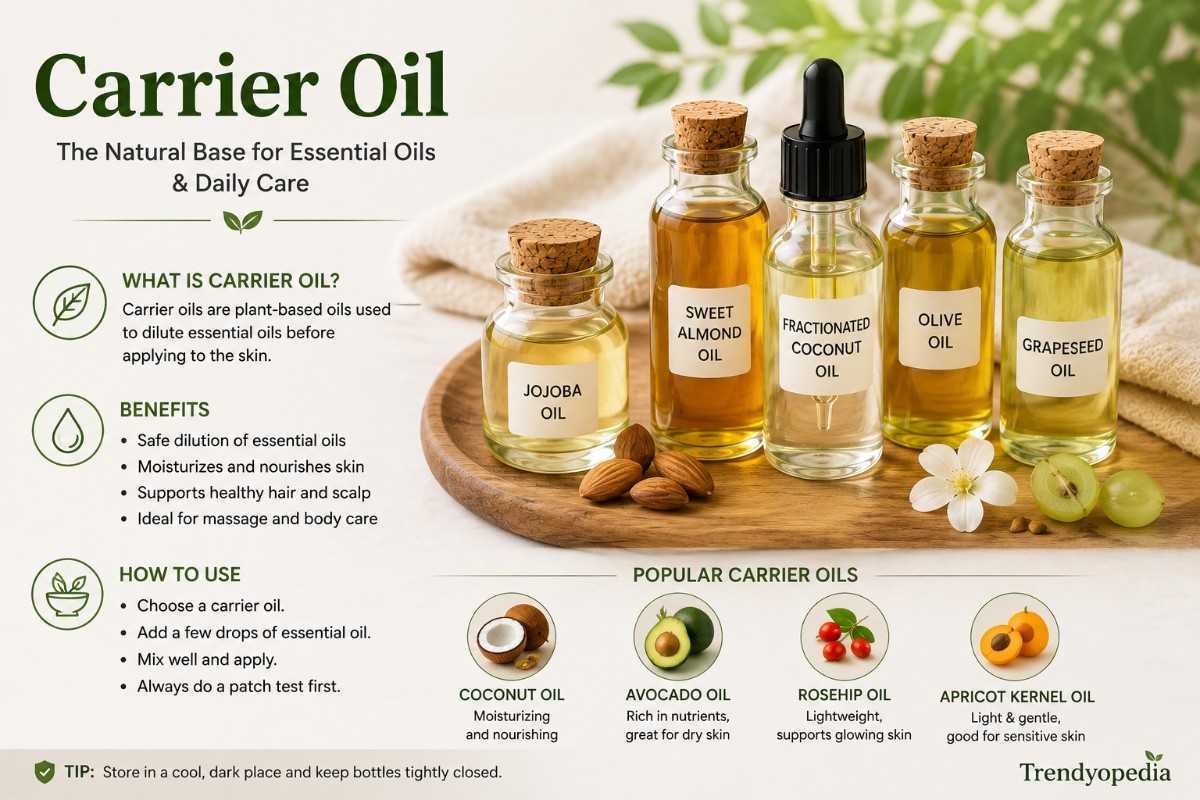
Carrier Oil is a plant-based oil commonly used to dilute essential oils before they are applied to the skin. Because many essential oils are highly concentrated, using an appropriate carrier oil can help spread them over a larger area and reduce the concentration applied to the skin.
Popular carrier oils include Coconut Oil, Jojoba Oil, Almond Oil, Olive Oil, Avocado Oil, Rosehip Oil, and Flaxseed Oil. Each has a different texture, fatty-acid profile, scent, and shelf life.
This guide explains what This oils are, how they work with essential oils, common types, potential benefits, how to use them, safety considerations, and how to choose the right carrier oil for your needs.
What Is a Carrier Oil?
A carrier oil is a vegetable-derived oil used to dilute essential oils and other highly concentrated botanical extracts for topical application.
Essential oils are generally much more concentrated than This oils. Applying certain essential oils directly to the skin can cause irritation or sensitization.
This oils help dilute the essential oil while also providing their own moisturizing properties.
Common Carrier Oils
Some widely used This oils include:
- Coconut Oil
- Fractionated Coconut Oil
- Jojoba Oil
- Sweet Almond Oil
- Olive Oil
- Avocado Oil
- Grapeseed Oil
- Argan Oil
- Rosehip Oil
- Apricot Kernel Oil
- Sunflower Oil
- Hemp Seed Oil
Carrier Oil vs Essential Oil
This oils and essential oils are different products.
| Carrier Oil | Essential Oil |
|---|---|
| Usually made from fatty plant parts such as seeds, nuts, or fruits | Usually concentrated aromatic extracts from plants |
| Generally non-volatile | Highly volatile |
| Used to dilute essential oils | Usually needs dilution for topical use |
| Often moisturizing | Primarily valued for aroma and concentrated plant compounds |
| Can generally be applied more directly to skin | May irritate skin when used undiluted |
For topical aromatherapy, essential oils are generally diluted in a suitable carrier oil.
Why Are Carrier Oils Used?
1. Dilute Essential Oils
One of the main purposes of a carrier oil is to lower the concentration of an essential oil before topical application.
This makes it easier to spread a small amount of essential oil over the skin.
2. Help Reduce Skin Irritation
Undiluted essential oils can cause irritation or allergic contact dermatitis in some people.
Diluting an essential oil appropriately can reduce the amount of essential oil contacting the skin.
However, dilution does not eliminate the possibility of an allergic reaction.
3. Improve Application
This oils provide a medium that makes essential oils easier to apply evenly.
They can be used for:
- Massage
- Body oils
- Skincare
- Aromatherapy blends
- Scalp and hair treatments
4. Provide Moisturizing Properties
Many This oils contain fatty acids and other compounds that can help soften and moisturize the skin.
Different oils have different textures, so the best option depends on your skin type and intended use.
Best Carrier Oils
1. Jojoba Oil
Jojoba Oil is a popular carrier oil because of its lightweight texture and long shelf life.
It is commonly used in:
- Facial oils
- Body oils
- Massage blends
- Hair-care products
2. Sweet Almond Oil
Sweet Almond Oil is a popular carrier oil with a smooth texture.
It is commonly used for:
- Massage
- Body care
- Hair care
- Essential-oil dilution
People with almond or tree-nut allergies should use appropriate caution.
3. Coconut Oil
Coconut Oil is another widely used carrier oil.
It can be used in body-care and hair-care routines and is available in different forms, including fractionated coconut oil.
4. Olive Oil
Olive Oil can be used as a carrier oil and is widely available.
It has a richer texture than some lighter This oils, making it popular for body massage and certain homemade blends.
5. Avocado Oil
Avocado Oil has a richer texture and contains various fatty acids.
It is commonly used in skincare and hair-care products.
6. Rosehip Oil
Rosehip Oil is commonly used in facial skincare products.
Because it can be more delicate than some other oils, proper storage is important.
7. Flaxseed Oil
Flaxseed Oil contains alpha-linolenic acid (ALA), a plant-based omega-3 fatty acid.
It can be used in certain topical formulations, although its relatively short shelf life makes storage particularly important.
Carrier Oil for Skin
This oils can be incorporated into skincare routines to help moisturize and soften the skin.
Simple Method
- Choose a suitable carrier oil.
- Perform a patch test.
- Apply a small amount to clean skin.
- Massage gently.
- Stop if irritation develops.
If you are adding essential oil, dilute it appropriately before applying the mixture.
Carrier Oil for Hair
This oils are frequently used in hair-oiling and scalp-care routines.
Common choices include:
- Coconut Oil
- Jojoba Oil
- Almond Oil
- Avocado Oil
- Olive Oil
A carrier oil can help condition the hair and make dry hair feel softer.
However, This oils should not automatically be described as treatments for hair loss or scalp disease.
Carrier Oil for Massage
This oils are commonly used during massage because they help provide slip, allowing hands to move smoothly over the skin.
Popular options include:
- Sweet Almond Oil
- Jojoba Oil
- Coconut Oil
- Grapeseed Oil
- Olive Oil
Choose an oil based on texture, fragrance preference, skin sensitivity, and how easily it washes from clothing.
How to Dilute Essential Oils With Carrier Oil
The correct dilution depends on the essential oil, the person using it, the body area, and the intended use.
For adults, a commonly used starting point for general topical applications is a low concentration, especially for facial or sensitive-skin applications.
For example, a 1% dilution means approximately 1 part essential oil in 99 parts carrier oil.
Always check reliable safety guidance for the specific essential oil rather than assuming every oil has the same safety profile.
Carrier Oil Safety
Natural does not automatically mean risk-free.
Before using a carrier oil:
- Check the ingredient label.
- Patch-test new products.
- Avoid applying oils to damaged skin.
- Keep oils away from the eyes.
- Stop if irritation develops.
- Store oils according to the label.
- Consider allergies before use.
- Use only products intended for topical use on the skin.
If you are pregnant, breastfeeding, taking medication, or have a medical condition, consult a healthcare professional before using essential-oil blends.
Carrier Oil for Different Skin Types
Choosing a carrier oil depends on your skin type, texture preference, and intended use. There is no single carrier oil that works best for everyone.
For Dry Skin
Richer oils may be more comfortable for dry skin. Popular options include:
- Sweet Almond Oil
- Avocado Oil
- Olive Oil
- Coconut Oil
These oils can help soften the skin and reduce the feeling of dryness.
For Oily Skin
People with oily or combination skin may prefer lightweight-feeling oils such as:
- Jojoba Oil
- Grapeseed Oil
- Sunflower Oil
Start with a small amount and see how your skin responds.
For Sensitive Skin
If you have sensitive skin, keep your routine simple. Choose products with minimal ingredients and patch-test before wider application.
Avoid assuming that an oil is safe simply because it is labeled “natural.”
Carrier Oil for Facial Skincare
This oils can be used in facial skincare, but not every oil is suitable for every person.
Simple Facial Oil Routine
- Cleanse your face.
- Apply your regular skincare products.
- Use a small amount of carrier oil.
- Gently press it onto the skin.
- Apply sunscreen during the daytime.
If you are using an essential oil in your facial blend, make sure it is appropriate for facial use and properly diluted.
Avoid applying essential oils close to the eyes.
Carrier Oil for Dry Skin
This oils can act as emollients, helping the skin feel softer and smoother.
For dry areas such as elbows, knees, hands, and feet, apply a small amount after bathing while the skin is slightly damp.
If your skin remains extremely dry, painful, cracked, itchy, or inflamed, consider speaking with a dermatologist rather than relying on oils alone.
Carrier Oil for Hair
This oils are commonly used for hair conditioning and oiling routines.
Popular Choices
Coconut Oil: Often used for hair conditioning.
Almond Oil: A lightweight-to-medium oil commonly used on dry hair.
Jojoba Oil: Popular in scalp and hair-care products.
Avocado Oil: A richer oil used in many conditioning formulations.
Olive Oil: Commonly used for hair and scalp oiling.
A carrier oil may improve the feel and appearance of dry hair, but this should not be confused with proven treatment for hair loss.
Carrier Oil for Scalp Massage
Some people use This oils during scalp massage.
If you choose to do this:
- Use a small amount of carrier oil.
- Massage gently with your fingertips.
- Avoid scratching the scalp.
- Leave the oil for a short period if desired.
- Wash your hair thoroughly.
Stop if you experience itching, redness, burning, or increased scalp irritation.
Persistent dandruff, scalp inflammation, or hair loss should be evaluated by a healthcare professional.
Carrier Oil for Essential Oils
This oils are particularly useful for diluting essential oils before topical application.
Examples include:
- Jojoba Oil + lavender essential oil
- Sweet Almond Oil + suitable essential oil
- Coconut Oil + suitable essential oil
- Grapeseed Oil + suitable essential oil
The essential oil should always be appropriately diluted rather than used directly on the skin unless a qualified professional specifically recommends otherwise.
Carrier Oil Dilution Guide
Dilution should be based on the essential oil, age of the user, body area, and intended application.
For a general adult topical application, lower concentrations are often preferred for routine use.
| Approximate Dilution | General Use |
|---|---|
| 0.5% | Very sensitive areas or cautious use |
| 1% | Facial or general gentle applications |
| 2% | General adult body applications |
| Higher concentrations | Should have a specific reason and appropriate safety guidance |
For children, older adults, pregnancy, sensitive skin, or certain medical conditions, additional caution is necessary.
Do not assume that increasing the concentration will make an essential oil more effective.
Carrier Oil vs Essential Oil
This oils and essential oils serve different purposes.
Carrier Oil
- Dilutes essential oils
- Helps spread products over the skin
- Can provide moisturizing properties
- Usually has little or no strong aroma
Essential Oil
- Highly concentrated plant extract
- Often strongly aromatic
- Used in very small amounts
- Can cause irritation or sensitization
- Usually requires dilution for topical use
They are complementary products, not interchangeable ones.
Carrier Oil vs Coconut Oil
Coconut Oil can actually be a carrier oil, so these terms are not opposites.
Carrier oil describes the function of an oil, while Coconut Oil describes a specific type of oil.
Other oils can also serve as This oils, including Almond Oil, Jojoba Oil, Olive Oil, and Avocado Oil.
How to Choose the Best Carrier Oil
Consider these factors:
1. Skin Type
Choose a texture that feels comfortable on your skin.
2. Intended Use
A facial oil may be different from an oil intended for body massage.
3. Allergies
Check ingredients carefully, especially if you have nut or seed allergies.
4. Shelf Life
Some oils oxidize faster than others.
5. Texture
Some oils feel light and dry, while others are richer and heavier.
6. Fragrance
Choose an oil with a scent you find comfortable, especially for massage.
7. Quality
Look for reputable manufacturers, clear ingredient labels, and proper packaging.
How to Store Carrier Oils
Proper storage can help maintain oil quality.
- Keep bottles tightly closed.
- Store away from direct sunlight.
- Avoid excessive heat.
- Follow the manufacturer’s storage instructions.
- Use clean hands or tools when handling the oil.
- Check the expiration or best-before date.
- Discard oil if it develops a noticeably rancid smell.
Some delicate oils may benefit from refrigeration after opening. Always follow the product label.
Common Carrier Oil Mistakes
Using Too Much
More oil isn’t necessarily better. Start with a small amount.
Applying Essential Oils Undiluted
This can increase the risk of irritation and sensitization.
Ignoring Allergies
Always check the ingredients before use.
Using Old or Rancid Oil
Oxidized oils may smell unpleasant and should not be used.
Applying Oils Around the Eyes
Avoid direct eye contact.
Treating Medical Conditions With Oils
This oils can be part of a cosmetic routine but shouldn’t replace appropriate medical treatment.
Can Carrier Oils Clog Pores?
Different oils behave differently on different people’s skin.
Some people may tolerate facial oils well, while others may experience clogged pores or breakouts.
If you have acne-prone skin:
- Choose products carefully.
- Start with a small amount.
- Patch-test first.
- Stop if breakouts worsen.
There is no universal rule that every carrier oil will or will not clog pores.
Can Carrier Oils Be Used Every Day?
Some This oils can be used regularly as part of a skincare or hair-care routine if your skin and hair tolerate them.
Daily use isn’t necessary for everyone.
Start with a small amount and adjust according to your needs.
FAQs
What is a carrier oil?
A carrier oil is usually a plant-based oil used to dilute essential oils before topical application. It can also provide moisturizing and conditioning properties.
What is the best carrier oil?
There is no single best carrier oil. Jojoba, Coconut, Almond, Olive, Avocado, and Grapeseed oils are among the commonly used options.
Can coconut oil be a carrier oil?
Yes. Coconut Oil can be used as a carrier oil for suitable essential-oil blends.
Can I apply carrier oil directly to my skin?
Many This oils can be applied directly to the skin, but individual sensitivity varies. Patch-testing is recommended.
Can carrier oils be used on hair?
Yes. Many This oils are used to condition hair and improve softness and manageability.
Do carrier oils make hair grow?
This oils can condition hair, but there isn’t enough evidence to claim that they directly stimulate hair growth.
Can I mix two carrier oils?
Yes. Different This oils can be blended according to your desired texture and intended use.
How long do carrier oils last?
Shelf life varies significantly between oils. Check the manufacturer’s expiration or best-before date and store the oil properly.
Can I use essential oils without a carrier oil?
Some essential oils may have specific uses where different application methods are recommended, but undiluted topical application can increase the risk of skin irritation and sensitization. Follow reliable safety guidance for the specific essential oil.
Are This oils safe during pregnancy?
Safety depends on the specific oil and whether essential oils are added. If you’re pregnant or breastfeeding, consult a qualified healthcare professional before using essential-oil blends.
Conclusion
Carrier Oils are versatile plant-based oils commonly used to dilute essential oils and support skincare, hair care, and massage routines. Popular choices include Jojoba Oil, Coconut Oil, Almond Oil, Olive Oil, Avocado Oil, and Rosehip Oil.
The best Carrier Oil depends on your skin type, hair needs, preferred texture, and intended use. Always patch-test new products, use essential oils at an appropriate dilution, and follow reliable safety guidance.
For more natural oil guides, explore our Ginger Oil, Neem Oil, Onion Oil articles on Trendyopedia.
Author
Author: Hitasha
Hitasha is a beauty, nutrition, and wellness writer at Trendyopedia. She creates reader-friendly, research-informed content covering natural oils, skincare, hair care, nutrition, and healthy lifestyle topics.
Disclaimer
This article is for informational purposes only and does not replace professional medical advice. Essential oils are highly concentrated substances and may cause skin irritation, allergic reactions, or other adverse effects. Always use products according to appropriate safety guidance. Pregnant people, children, people with allergies, and those with medical conditions should seek professional advice before using essential-oil products.