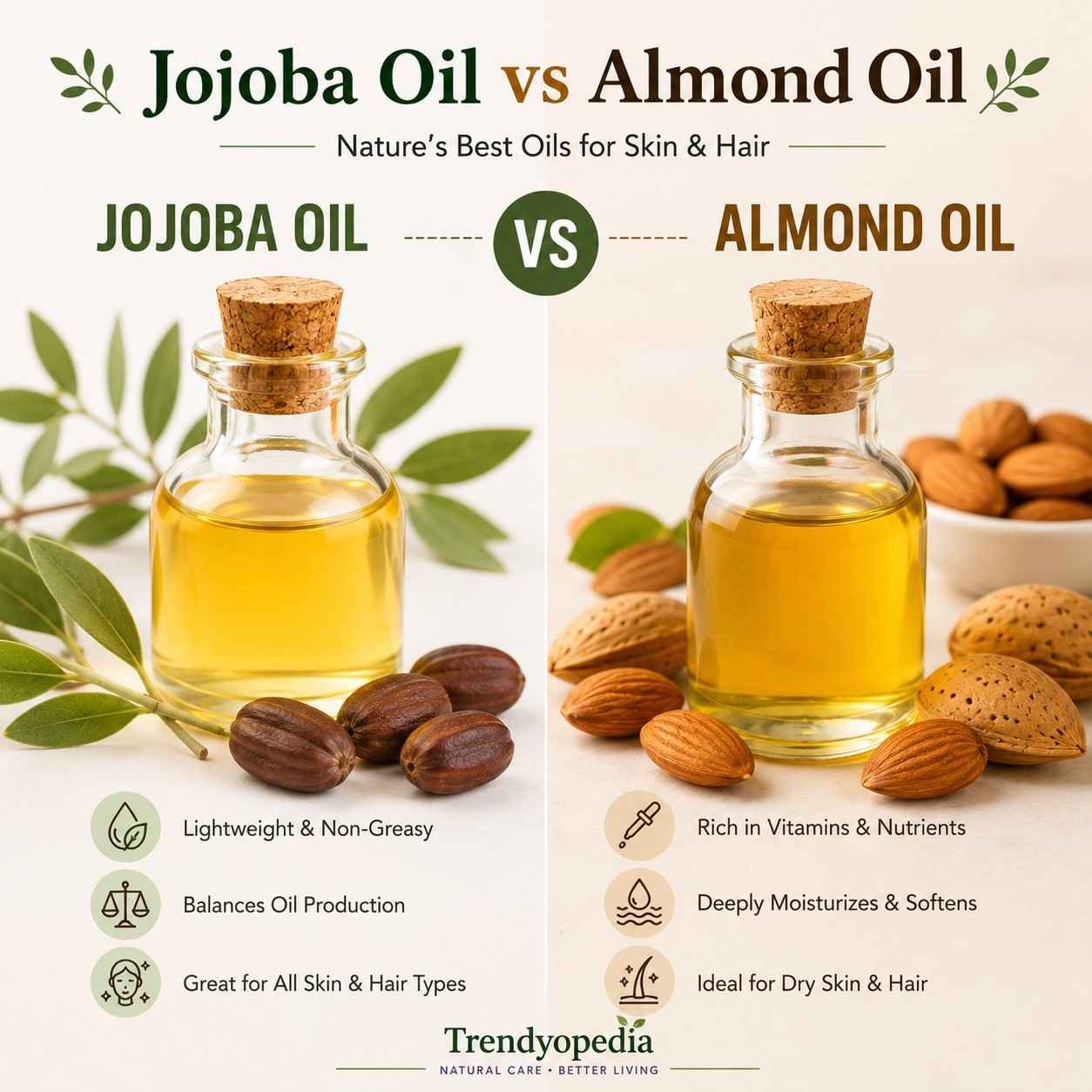
Jojoba Oil vs Almond Oil is a useful comparison for anyone choosing a natural oil for skincare, hair care, massage, or everyday beauty routines.
Both oils are popular cosmetic ingredients, but they have different textures and compositions. Jojoba is technically a liquid wax, while sweet almond oil is a plant-based fatty oil. Research reviews suggest that both can have useful cosmetic applications, particularly as emollient and moisturizing ingredients.
So, which one should you choose? The answer depends on your skin type, hair needs, preferred texture, and how you plan to use the oil.
If you’re comparing natural oils, you may also want to read our Carrier Oil guide and learn how carrier oils differ from essential oils.
Jojoba Oil vs Almond Oil: Quick Comparison
| Feature | Jojoba Oil | Almond Oil |
|---|---|---|
| Texture | Lightweight, smooth | Smooth, slightly richer |
| Source | Jojoba seeds | Almond kernels |
| Main cosmetic use | Skin, hair, scalp | Skin, hair, massage |
| Skin feel | Lightweight | Soft and conditioning |
| Best for | Many skin types | Dry or normal skin |
| Hair use | Scalp and hair conditioning | Hair and scalp conditioning |
| Strong fragrance | Usually mild | Mild |
| Nut allergy concern | Generally not a tree-nut oil | Important consideration |
Both oils can work well in cosmetic formulations, but individual results can vary.
What Is Jojoba Oil?
Jojoba Oil comes from the seeds of the jojoba plant (Simmondsia chinensis). Unlike most common vegetable oils, jojoba is primarily composed of liquid wax esters.
Its structure and skin feel make it a popular ingredient in moisturizers, facial oils, hair products, and other cosmetic formulations. Reviews have examined its emollient and dermatological applications.
What Is Almond Oil?
Almond Oil is made from almonds and is commonly used in skincare, massage products, hair products, and cosmetics.
Sweet Almond Oil is generally the type discussed in cosmetic skincare. It has an emollient texture and can help make skin feel softer and smoother.
Research reviews have examined sweet almond oil’s potential applications in skincare and its role in maintaining skin comfort and hydration.
Jojoba Oil for Skin
Jojoba Oil is popular for facial and body skincare because of its smooth, lightweight feel.
It can be used in:
- Facial oils
- Moisturizers
- Body oils
- Massage blends
- Lip-care products
- Hair and scalp products
A review of jojoba research describes its use as an emollient in cosmetic formulations and notes its potential role in supporting skin suppleness.
Is Jojoba Oil Good for Dry Skin?
It can be useful as an emollient that helps improve the feel of dry skin. However, severe or persistent dryness may require a proper moisturizer or medical evaluation rather than oil alone.
Almond Oil for Skin
Sweet Almond Oil is widely used in body-care and skincare products.
Its smooth texture makes it popular for:
- Dry-skin care
- Body massage
- Moisturizing products
- Facial formulations
- Hand and foot care
Research reviews have identified sweet almond oil as an ingredient with cosmetic and emollient applications, although evidence varies depending on the specific condition and formulation.
Jojoba Oil vs Almond Oil for Dry Skin
Jojoba Oil vs Almond Oil: If your main goal is to make dry skin feel softer, both oils can be reasonable options.
Jojoba Oil
Choose Jojoba if you prefer:
- A lightweight feel
- A less greasy finish
- A versatile facial and body oil
- An oil that also works well in hair products
Almond Oil
Choose Almond Oil if you prefer:
- A smooth, richer-feeling oil
- Body massage
- Dry-skin care
- Hair conditioning
Your personal preference matters because different oils feel different on the skin.
Jojoba Oil vs Almond Oil for Oily Skin
Jojoba Oil vs Almond Oil: For oily or combination skin, texture can be an important consideration.
Jojoba Oil is often preferred in lightweight skincare formulations because of its cosmetic feel and similarity to certain components of skin surface lipids.
However, no facial oil is guaranteed to work for every oily or acne-prone person.
If you are prone to breakouts, introduce one product at a time and stop if your skin becomes irritated or your breakouts worsen.
Jojoba Oil vs Almond Oil for Hair
Jojoba Oil vs Almond Oil: Both oils can be used as hair-conditioning ingredients.
Jojoba Oil for Hair
Jojoba Oil can be used on:
- Dry hair
- Hair ends
- Scalp-care routines
- Pre-shampoo treatments
- Hair masks
Its lighter feel may appeal to people who don’t like heavy oils.
Almond Oil for Hair
Almond Oil can be used for:
- Dry hair
- Hair ends
- Scalp massage
- Pre-shampoo oiling
- Conditioning treatments
It can leave hair feeling softer and smoother. For additional natural hair-care options, explore our guides to Amla Oil, Castor Oil, Moringa Oil, and Hibiscus Oil.
Jojoba Oil vs Almond Oil for Scalp
Jojoba Oil vs Almond Oil: Both oils are used in scalp-care routines, but they should not be considered proven treatments for hair loss or scalp disease.
For simple oiling:
- Apply a small amount.
- Massage gently.
- Avoid scratching the scalp.
- Leave it for an appropriate amount of time.
- Wash thoroughly.
If you have persistent itching, scaling, inflammation, or hair loss, speak with a dermatologist.
Jojoba Oil vs Almond Oil for Massage
Both oils can work well as massage oils.
Jojoba Oil may be preferred when you want a lighter, less greasy feel.
Almond Oil is popular for body massage because of its smooth texture and easy spreadability.
Your choice can simply come down to texture, fragrance, price, and personal preference.
Which Oil Is Better for Facial Skincare?
There is no universal winner.
Choose Jojoba Oil if:
- You prefer a lightweight oil.
- You want a versatile facial oil.
- You dislike a heavy or greasy feeling.
Choose Almond Oil if:
- You prefer a richer texture.
- Your skin feels dry.
- You want an oil that can also be used for body massage.
Both oils have been reviewed for cosmetic skincare applications, but more research is needed to make strong claims about treating specific skin conditions.
Which Oil Is Better for Hair?
Again, it depends on your preference.
Jojoba Oil may be better if you want a lightweight conditioning oil.
Almond Oil may be better if you prefer a richer oil for dry or coarse hair.
Neither should be marketed as a guaranteed hair-growth treatment.
Jojoba Oil vs Almond Oil for Sensitive Skin
Jojoba Oil vs Almond Oil: Sensitive skin requires extra care with any new cosmetic product.
Before applying either oil to your face:
- Check the ingredient list.
- Apply a small amount to a limited area.
- Wait and observe your skin.
- Stop if you experience redness, itching, burning, or swelling.
Remember that an oil being “natural” does not guarantee that everyone will tolerate it.
Almond Allergy and Almond Oil
This is an important difference between the two oils.
Almond Oil comes from almonds, which are tree nuts. People with known almond or tree-nut allergies should be cautious and check product labeling carefully.
If you have a known allergy, speak with your healthcare professional before using almond-derived cosmetic products.
Can You Mix Jojoba Oil and Almond Oil?
Yes. They can be combined in a cosmetic or personal-care blend if your skin tolerates both.
For example, you could combine a smaller amount of Almond Oil with Jojoba Oil to create a texture that feels comfortable for your skin.
Always introduce new blends gradually.
Jojoba Oil vs Almond Oil: Which Is More Versatile?
Jojoba Oil vs Almond Oil: Both are versatile, but Jojoba Oil has a particularly broad cosmetic use because of its unique liquid-wax composition and stable formulation characteristics.
Almond Oil is also widely used in skincare, hair care, massage, and cosmetic products.
Jojoba Oil vs Almond Oil: Pros and Cons
Jojoba Oil
Pros
- Lightweight feel
- Versatile
- Popular in facial products
- Useful for hair and scalp routines
- Suitable for many cosmetic formulations
Cons
- Can be more expensive than some common oils
- May not suit every individual skin type
- Not a treatment for medical skin conditions
Almond Oil
Pros
- Smooth texture
- Popular for massage
- Useful for dry-skin routines
- Can be used in hair care
- Widely available
Cons
- Tree-nut allergy concerns
- Can feel richer than Jojoba Oil
- May not suit every acne-prone or sensitive skin type
Jojoba Oil vs Almond Oil: Final Verdict
Jojoba Oil vs Almond Oil: If you prefer a lightweight and versatile facial and hair oil, Jojoba Oil may be the better choice.
If you prefer a smooth, richer oil for dry skin, body care, massage, or hair, Almond Oil may be a better fit.
Neither oil is universally better. The best choice depends on your skin type, hair needs, allergies, desired texture, and personal preference.
FAQs
Is Jojoba Oil better than Almond Oil?
Not necessarily. Both have useful cosmetic applications. Jojoba Oil is often chosen for its lightweight feel, while Almond Oil is popular for its smooth, richer texture.
Which is better for dry skin?
Both can help skin feel softer, but the best option depends on your skin and the rest of your skincare routine.
Which is better for oily skin?
Jojoba Oil may be preferred by some people because of its lightweight cosmetic feel, but oily or acne-prone skin can react differently to oils.
Which is better for hair?
Both can condition hair. Jojoba Oil may feel lighter, while Almond Oil may feel richer.
Can I use Jojoba Oil and Almond Oil together?
Yes, if your skin tolerates both. They can be blended for skincare, massage, or hair care.
Can Almond Oil cause allergies?
Yes. Almond-derived products can be a concern for people with almond or tree-nut allergies.
Does Jojoba Oil grow hair?
There is not enough evidence to claim that Jojoba Oil directly grows hair. It can be used as a conditioning ingredient.
Does Almond Oil grow hair?
Almond Oil can condition hair and improve its feel, but it should not be presented as a proven hair-growth treatment.
Can I use these oils on my face every day?
Some people can use them regularly, but frequency depends on your skin type and how your skin responds.
Conclusion
Jojoba Oil vs Almond Oil: Jojoba Oil and Almond Oil are both popular natural oils for skincare, hair care, and massage. Jojoba Oil offers a lightweight, versatile feel, while Almond Oil provides a smooth and richer-feeling option.
The better choice depends on your individual skin type, hair needs, allergies, and preferred texture. Rather than choosing based only on popularity, start with a small amount and see how your skin or hair responds.
For more natural oil guides, explore our Coconut Oil, Avocado Oil, Rosehip Oil, and Flaxseed Oil articles on Trendyopedia.
Author
Hitasha is a beauty, nutrition, and wellness writer at Trendyopedia, creating reader-friendly, research-informed content about natural oils, skincare, hair care, nutrition, and healthy lifestyle topics.
Disclaimer
This article is for informational purposes only and does not replace professional medical advice. Natural oils can cause irritation or allergic reactions in some people. Always patch-test new products and consult a qualified healthcare professional if you have allergies, persistent skin problems, or other concerns.