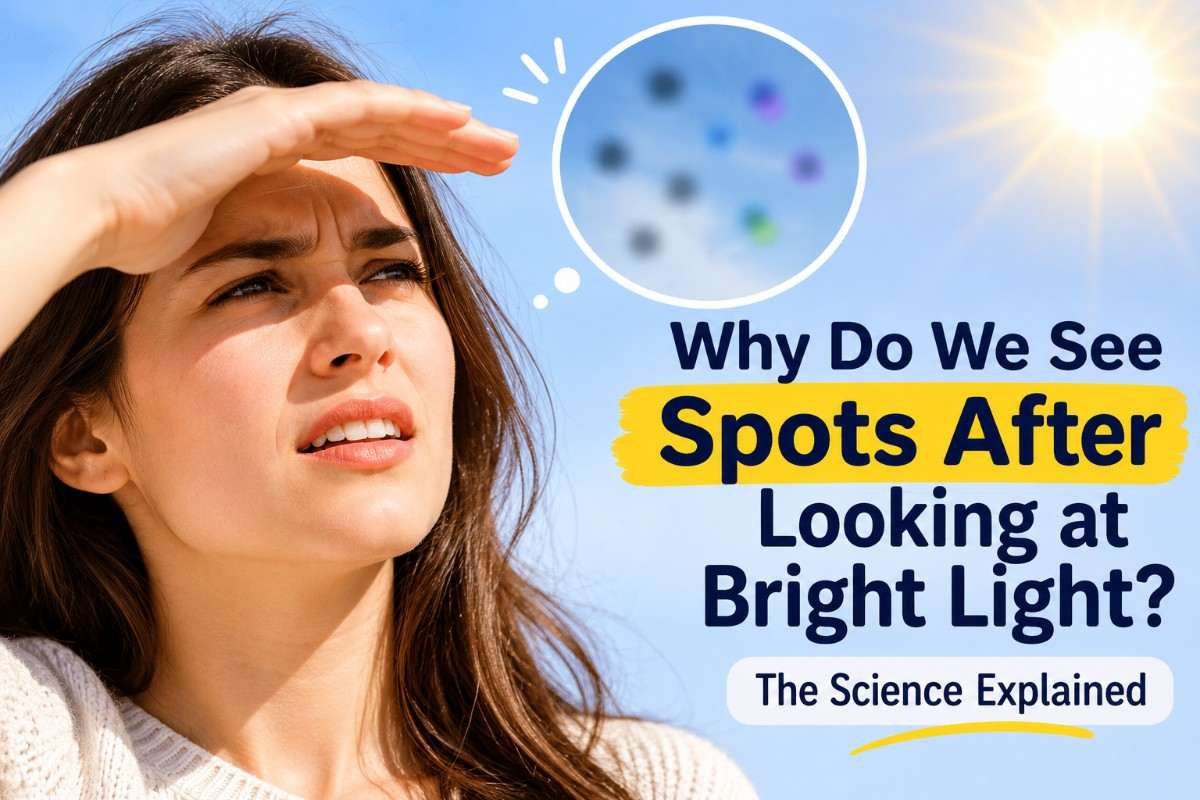
Why Do We See Spots After Looking at Bright Light: To understand why you see spots after looking at bright light, it helps to know how your eyes work.
Your eyes contain a light-sensitive layer called the retina, located at the back of the eye. The retina contains special cells known as photoreceptors.
There are two main types:
- Rods: Help you see in dim light and detect movement.
- Cones: Help you see colors and fine details, especially in brighter conditions.
When light enters your eyes, these cells detect it and send electrical signals through the optic nerve to your brain. Your brain then processes those signals to create the images you see.
When you look at a very bright light, the photoreceptors become strongly stimulated. Their light-sensitive pigments temporarily change, reducing their sensitivity until those pigments regenerate.
Bright light can also trigger other surprising reactions in the human body. For example, some people start sneezing when they suddenly step into sunlight. This unusual response is known as the photic sneeze reflex. Learn more about Why Do We Sneeze in Bright Sunlight? and discover how the eyes and nervous system work together.
During this recovery period, you may notice a spot, shadow, or unusual shape in your vision. This is one reason afterimages appear after bright-light exposure. <Cite refs={[“turn613171search13″,”turn613171search8”]}/>
What Is an Afterimage?
An afterimage is an image that remains in your vision for a short time after you stop looking at an object or light source.
For example, imagine looking at a bright camera flash. When you turn your eyes toward a wall, you might still notice a glowing patch or a dark shape.
That lingering image is called an afterimage.
There are two common types.
1. Positive Afterimage
A positive afterimage looks similar to the original image.
For example, after seeing a bright flash, you may briefly notice a bright patch that resembles the light source.
It usually disappears quickly.
2. Negative Afterimage
A negative afterimage appears with the opposite brightness or color pattern of the original image.
For example, after looking at a bright shape, you may notice a darker version of that shape when you look away.
You may also see unusual colors after staring at a strongly colored object.
This happens partly because the visual system adapts to the light and color information it receives. When you look somewhere else, the balance of visual signals temporarily changes.
This is why a bright object can sometimes leave behind a dark-looking or differently colored image.
Why Do Spots Appear in Different Colors?
Why Do We See Spots After Looking at Bright Light: Have you ever noticed that spots after looking at bright light are not always white?
Sometimes they look purple, green, yellow, blue, or even reddish.
This happens because your visual system processes colors through different groups of light-sensitive cells and opposing color signals.
When you look at a bright or strongly colored object for a period of time, some visual pathways become temporarily adapted to that stimulation.
When you look away, the balance of signals changes, creating the appearance of another color.
For example:
- A bright red object may leave a greenish afterimage.
- A blue object may produce a yellowish afterimage.
- A bright white light may leave a dark or pale patch.
The exact appearance depends on the light’s intensity, color, duration, and surrounding environment.
These visual effects are usually temporary.
Why Do We Sometimes See Spots After Looking at the Sun?
Why Do We See Spots After Looking at Bright Light: The Sun is an extremely powerful source of light. Looking directly at it can expose the retina to intense visible light and potentially cause permanent eye damage.
Even when you look away, you might notice a lingering bright spot or a temporary change in your vision.
However, you should never deliberately stare at the Sun to experience an afterimage.
Direct sunlight exposure can damage the retina, and the injury may not cause immediate pain.
If you accidentally look at the Sun and experience persistent blurred vision, a central blind spot, distorted vision, or changes in color perception, seek prompt evaluation from an eye specialist.
Never look directly at the Sun, even when wearing ordinary sunglasses.
Why Do We See Spots After a Camera Flash?
Why Do We See Spots After Looking at Bright Light: Camera flashes produce a sudden burst of bright light.
When the flash enters your eyes, the photoreceptors respond to the sudden brightness. After looking away, you may briefly notice a bright patch or dark shape.
This is a common example of a temporary afterimage.
The effect may be more noticeable when:
- You are in a dark room.
- The flash is very close.
- The light is especially bright.
- Your eyes are adapted to darkness.
Your vision generally returns to normal as the visual system readjusts.
Why Do We See Spots When Looking at a Bright Blue Sky?
Why Do We See Spots After Looking at Bright Light: Interestingly, not every spot you see against a bright background is an afterimage.
Some people notice tiny moving dots when looking at a clear blue sky.
This phenomenon is called the blue field entoptic phenomenon.
It happens because of the movement of white blood cells through tiny blood vessels in front of the retina.
White blood cells interact differently with blue light than red blood cells do. This can create the appearance of tiny bright dots moving through your field of vision.
These dots may look like small glowing particles or tiny moving worms.
According to the American Academy of Ophthalmology, this is a normal visual phenomenon for many people. <Cite refs={[“turn613171search1”]}/>
Are Afterimages and Eye Floaters the Same Thing?
Why Do We See Spots After Looking at Bright Light: No. Afterimages and floaters are different visual experiences.
Although both can look like spots, their causes are not the same.
Afterimages happen because of temporary changes in how your visual system responds to light.
Floaters are small shapes that appear to move through your vision. They are usually caused by tiny clumps or strands inside the vitreous, the gel-like substance that fills the eye.
Here is a simple comparison:
| Feature | Afterimages | Eye floaters |
|---|---|---|
| Appearance | Bright or dark patches | Dots, threads, or cobwebs |
| Main cause | Visual adaptation to light | Small clumps in the vitreous |
| Duration | Usually temporary | May remain or recur |
| Movement | Often follows the visual experience | Drifts as your eyes move |
| Background | Often noticed after bright light | More noticeable against a plain background |
Floaters are often harmless, but a sudden increase in floaters or new flashes of light needs urgent eye examination. <Cite refs={[“turn613171search7″,”turn613171search2”]}/>
How Long Do Spots After Bright Light Last?
Why Do We See Spots After Looking at Bright Light: The duration depends on the brightness of the light, how long you were exposed, and the condition of your eyes.
Many ordinary afterimages fade within seconds or a short period.
However, persistent visual changes should not automatically be assumed to be normal afterimages.
If a spot does not disappear, repeatedly returns without an obvious light source, or affects your ability to see clearly, arrange an eye examination.
After direct Sun exposure, persistent symptoms need prompt medical attention.
Can Looking at Bright Light Damage Your Eyes?
Why Do We See Spots After Looking at Bright Light: Not all bright light exposure causes permanent damage.
For example, briefly seeing a camera flash or a bright indoor light generally produces only temporary visual effects.
However, certain intense light sources can be harmful.
Examples include:
- Direct sunlight.
- Laser pointers.
- Intense industrial lights.
- Solar viewing without proper eye protection.
The risk depends on the intensity, wavelength, and duration of exposure.
Avoid looking directly at intense light sources. Use appropriate protective eyewear when required.
The human nervous system controls many automatic reactions that happen without conscious effort. One interesting example is goosebumps, which can appear when we feel cold, frightened, or emotionally excited. Read our article about Why Do We Get Goosebumps? to understand another fascinating response of the human body.
How Can You Protect Your Eyes From Bright Light?
Why Do We See Spots After Looking at Bright Light: Your eyes are sensitive organs, and protecting them is important for maintaining healthy vision.
Here are some simple habits that can help.
1. Wear Sunglasses Outdoors
Choose sunglasses that provide 100% UVA and UVB protection or are labeled UV400.
They help protect your eyes from harmful ultraviolet radiation.
2. Avoid Looking Directly at the Sun
Never stare directly at the Sun, even for a few seconds.
Ordinary sunglasses are not safe for direct solar viewing.
3. Use Proper Protection Around Lasers
Never look directly into a laser beam. Follow safety instructions and use appropriate protective equipment when necessary.
4. Take Breaks From Bright Screens
If your eyes feel uncomfortable after spending long periods looking at screens, take regular breaks and adjust the screen brightness to a comfortable level.
Screen brightness does not cause the same type of retinal exposure as staring at the Sun, but comfortable viewing habits can reduce eye strain.
5. Get Regular Eye Examinations
Routine eye examinations can help identify vision problems and other eye conditions.
If you notice unusual visual symptoms, do not wait for your next routine appointment.
When Should You Worry About Seeing Spots?
Why Do We See Spots After Looking at Bright Light: Although temporary afterimages are usually harmless, some visual symptoms can indicate an eye problem that needs immediate attention.
Contact an eye specialist urgently if you experience:
- A sudden appearance of many new floaters.
- Repeated flashes of light.
- A dark shadow or curtain across your vision.
- Sudden blurred vision.
- Sudden loss of vision.
- New visual changes after an eye injury.
These symptoms can be associated with a retinal tear or retinal detachment, which requires urgent medical assessment. <Cite refs={[“turn613171search0″,”turn613171search5″,”turn613171search6”]}/>
Do not assume that new flashes or spots are simply afterimages from bright light.
FAQs Why Do We See Spots After Looking at Bright Light
1. Why do I see a dark spot after looking at a bright light?
A dark spot may be a negative afterimage. After exposure to bright light, your visual system temporarily adapts to the brightness. When you look away, the remaining visual signal can make part of your vision appear darker.
2. Why do I see colorful spots after looking at a light?
Colorful spots can occur because your eyes and brain temporarily adapt to the color and intensity of the light. This can create an afterimage with a different color from the original light.
3. Is seeing spots after a camera flash normal?
Yes. A temporary afterimage after a camera flash is common. It generally fades as your visual system readjusts.
4. Why do I see spots when I close my eyes after looking at bright light?
Closing your eyes does not immediately stop visual activity. Your photoreceptors and brain may continue processing the effects of the previous light exposure, making an afterimage noticeable even with your eyes closed.
5. How long should a bright-light afterimage last?
Many ordinary afterimages disappear within seconds or a short period. Persistent or unusual visual changes should be evaluated by an eye specialist.
6. Can looking at the Sun cause permanent eye damage?
Yes. Directly looking at the Sun can damage the retina and cause solar retinopathy. Never stare directly at the Sun, even if it does not feel painful.
7. Are moving spots in my vision dangerous?
Some moving spots are ordinary floaters. However, a sudden increase in floaters, flashes of light, or a dark curtain over your vision can indicate a retinal problem. Seek urgent eye care.
8. Why do I see spots when looking at a blue sky?
Some people experience the blue field entoptic phenomenon. Tiny bright dots appear because of white blood cells moving through small blood vessels in front of the retina.
Conclusion: Why Do We See Spots After Looking at Bright Light
Seeing spots after looking at bright light is an interesting example of how your eyes and brain work together to process the world around you.
In many cases, these spots are temporary afterimages caused by changes in the sensitivity of your light-detecting cells and visual pathways.
The next time you notice a brief colored or dark patch after seeing a camera flash or bright indoor light, you will understand why it happens.
However, not every spot or flash is an afterimage. Sudden or persistent changes in vision should never be ignored.
Taking care of your eyes, avoiding direct exposure to intense light, and seeking medical attention when unusual symptoms appear are important steps toward protecting your vision.
Our bodies have many automatic responses that scientists find fascinating. Just as our eyes react to sudden brightness, our breathing muscles can also produce unexpected reactions such as hiccups. Explore Why Do We Get Hiccups? to discover what causes this common bodily reaction.
Author
Written by Hitasha
Hitasha is a content writer at Trendyopedia who enjoys exploring interesting facts, science, wellness, beauty, and lifestyle topics.
Disclaimer
This article is for informational and educational purposes only. It does not replace professional medical advice, diagnosis, or treatment. Consult an eye specialist if you experience unusual or persistent changes in vision.
Sources & References
Use these authoritative references at the end of your WordPress article: