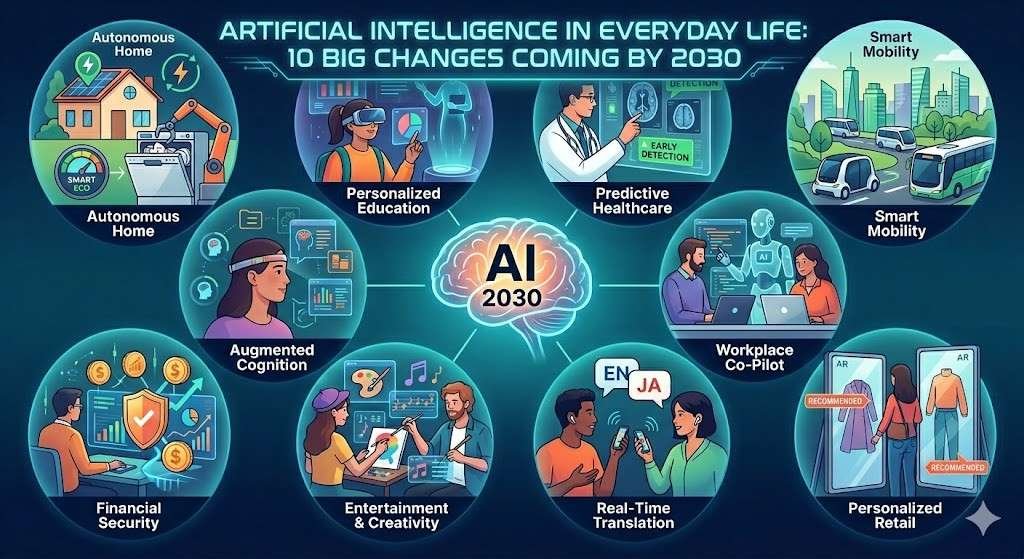
Artificial Intelligence in Everyday Life is no longer a future concept found only in science fiction. It is already present in phones, search engines, online shopping, navigation systems, digital payments, customer service, and healthcare tools. By 2030, artificial intelligence will become even more deeply woven into everyday life, influencing how people work, learn, travel, shop, communicate, and manage health.
The biggest change is not that robots will suddenly replace humans, but that AI systems will quietly assist in thousands of daily decisions behind the scenes. Many tasks that currently require manual effort will become faster, smarter, and more personalized.
By the end of this decade, artificial intelligence is expected to reshape daily routines in ways similar to how smartphones changed society during the last fifteen years. Understanding these changes helps individuals, families, and businesses prepare for a world where AI becomes a normal part of life.
What Artificial Intelligence Means in Daily Life
Artificial intelligence refers to computer systems that can analyze information, recognize patterns, make decisions, and improve performance through data.
In daily life, AI often appears through:
- Voice assistants
- Recommendation systems
- Smart cameras
- Translation tools
- Navigation apps
- Fraud detection systems
Many people already use AI without realizing it.
Examples include:
- Phone face recognition
- Smart email suggestions
- Shopping recommendations
- Video content selection
By 2030, these systems will become much more predictive and personalized.
AI in Homes: Smart Living Will Become Normal
The modern home is expected to become increasingly intelligent.

Smart homes by 2030 may include:
- Lighting that adjusts automatically
- Energy systems that reduce electricity waste
- Refrigerators that monitor food freshness
- Security systems that recognize unusual activity
- Voice assistants that understand complex requests
Instead of simple commands, future systems may predict needs.
For example:
- Air cooling may start before you arrive home
- Curtains may adjust according to sunlight
- Appliances may run during lower electricity cost hours
Why this matters
Homes become more efficient, comfortable, and energy-saving.
AI and Personal Health Will Change Preventive Care
Healthcare may become one of the most powerful AI-driven changes by 2030.

AI may help with:
- Early disease detection
- Continuous wearable monitoring
- Personalized health alerts
- Medication reminders
- Digital symptom analysis
Devices similar to Apple Watch already monitor heart rate and oxygen trends.
By 2030, wearables may detect:
- Dehydration
- Stress patterns
- Sleep quality risks
- Irregular heart signals
AI may reduce hospital pressure
Many minor health decisions may happen at home through AI-supported monitoring.
AI Will Transform Education at Every Level
Learning systems will become highly personalized.

AI education tools may:
- Adjust lessons based on student speed
- Detect weak learning areas
- Offer personalized exercises
- Translate content instantly
- Provide tutoring support anytime
A student struggling with mathematics may receive extra practice automatically.
Major benefit
Learning becomes adaptive rather than fixed.
Teachers may spend more time guiding creativity while AI handles repetitive support.
Workplaces Will Change Through AI Assistance
By 2030, many jobs will include AI support rather than full replacement.
AI may assist with:
- Scheduling
- Draft writing
- Data summaries
- Customer support
- Language translation
- Research organization
Jobs most affected
- Administration
- Basic customer service
- Repetitive reporting
- Data entry
Jobs that may grow
- AI supervision
- Creative roles
- Strategy roles
- Human-centered services
The future workplace may require stronger digital thinking skills.
Transportation Will Become Smarter
Travel systems are expected to improve significantly.
AI may help:
- Reduce traffic congestion
- Improve route planning
- Increase vehicle safety
- Predict maintenance issues
Cars such as Tesla already use advanced driving assistance.
By 2030:
- Traffic lights may respond dynamically
- Public transport may optimize routes in real time
- Delivery systems may become automated
Result
Travel becomes faster and safer.
AI Will Change Shopping Behavior
Shopping will become highly personalized.

AI may predict:
- What products you need
- Best buying times
- Price drops
- Personalized offers
Retail systems may recommend based on:
- Lifestyle
- Previous purchases
- Seasonal needs
Physical stores may also change
Smart shelves and cashier-free systems may expand.
Communication Will Become More Intelligent
Language barriers may shrink significantly.
AI tools may provide:
- Real-time translation
- Tone improvement
- Instant summarization
- Smart meeting notes
People may communicate globally with fewer language barriers.
Impact
International business and education become easier.
Entertainment Will Become Hyper-Personalized
AI is already changing digital entertainment.
Netflix uses recommendation engines today.
By 2030:
- Movies may adapt recommendations more precisely
- Music may match mood instantly
- Interactive storytelling may expand
Future possibility
Entertainment may become more responsive to emotional patterns.
AI and Finance Will Quietly Guide Daily Decisions
Financial systems increasingly rely on AI.
AI may help users:
- Detect unusual spending
- Suggest savings habits
- Predict bill cycles
- Improve fraud protection
Digital banking apps already use AI alerts.
By 2030, personal finance may become more predictive.
AI in Agriculture Will Affect Food Supply
Food systems may improve through AI long before food reaches homes.

AI may help farmers:
- Predict rainfall
- Detect crop disease
- Improve irrigation
- Reduce waste
Why consumers benefit
Food quality and supply may become more stable.
AI and Energy Use Will Improve Sustainability
AI can help manage power better.
Possible changes:
- Smarter energy grids
- Lower waste
- Better renewable balancing
This supports cleaner future living.
Challenges AI Will Bring by 2030
Despite benefits, challenges remain.
Privacy concerns
More data collection raises privacy questions.
Job shifts
Some repetitive roles may shrink.
Bias in systems
Poorly trained AI may create unfair results.
Human dependence
Too much automation may reduce human judgment.
Balanced regulation will be important.
Skills Humans Will Need in an AI Future
Important skills by 2030:
- Critical thinking
- Creativity
- Emotional intelligence
- Adaptability
- Digital understanding
Human strengths remain highly valuable.
Industries That May Change Fastest
Fastest AI transformation may happen in:
- Healthcare
- Finance
- Retail
- Education
- Logistics
- Media
Will AI Replace Humans?
The most realistic answer is partial replacement of tasks, not total replacement of people.
AI performs well in:
- Pattern recognition
- Speed
- Repetition
Humans remain stronger in:
- Empathy
- Ethics
- Creativity
- Complex judgment
The strongest future model is cooperation.
Everyday Life in 2030: What a Normal Day Could Look Like
A future day may include:
- AI alarm adjusting to sleep quality
- Breakfast suggestions based on health data
- Traffic route adjusted automatically
- Smart work summaries
- Personalized shopping reminders
- Health alerts during evening exercise
Most AI activity may happen quietly in the background.
Final Thoughts
Artificial Intelligence in Everyday Life by 2030 is likely to become an invisible assistant across daily life rather than a dramatic machine takeover.
The biggest changes will come through:
- Convenience
- Prediction
- Personalization
- Efficiency
People who understand AI early may benefit most because they can use technology intentionally rather than react passively.
The future will not simply belong to machines.
It will belong to people who learn how to work wisely with intelligent systems
FAQs – Artificial Intelligence in Everyday Life
1. What is artificial intelligence in everyday life?
Artificial intelligence in everyday life refers to smart computer systems that help people with daily tasks such as voice assistants, navigation, shopping recommendations, and smart home devices.
2. How is AI already used in daily life today?
AI is already used in mobile phones, online shopping, digital payments, email suggestions, social media feeds, maps, and video recommendations.
3. How will artificial intelligence change life by 2030?
By 2030, AI is expected to improve healthcare, education, transportation, home automation, workplace productivity, and personal finance through smarter and more personalized systems.
4. Will AI replace human jobs completely?
AI may automate repetitive tasks, but many jobs will still require human creativity, emotional intelligence, and decision-making.
5. How will AI improve healthcare in everyday life?
AI may help detect diseases early, monitor health through wearable devices, and provide personalized health alerts.
6. Can AI make homes smarter?
Yes, AI can control lighting, security, temperature, appliances, and energy use automatically in smart homes.
7. Is artificial intelligence safe for daily use?
AI can be safe when used responsibly, but privacy, data security, and ethical concerns remain important.
8. How does AI help students and education?
AI can personalize lessons, identify learning gaps, and provide digital tutoring support.
9. Will AI make shopping easier in the future?
AI may suggest products, predict needs, compare prices, and improve online shopping experiences.
10. Why is AI considered important for the future?
AI is important because it increases efficiency, supports innovation, and helps solve complex problems across many industries.
Also read :
What Is Gen Z? Understanding the Generation Shaping the Future