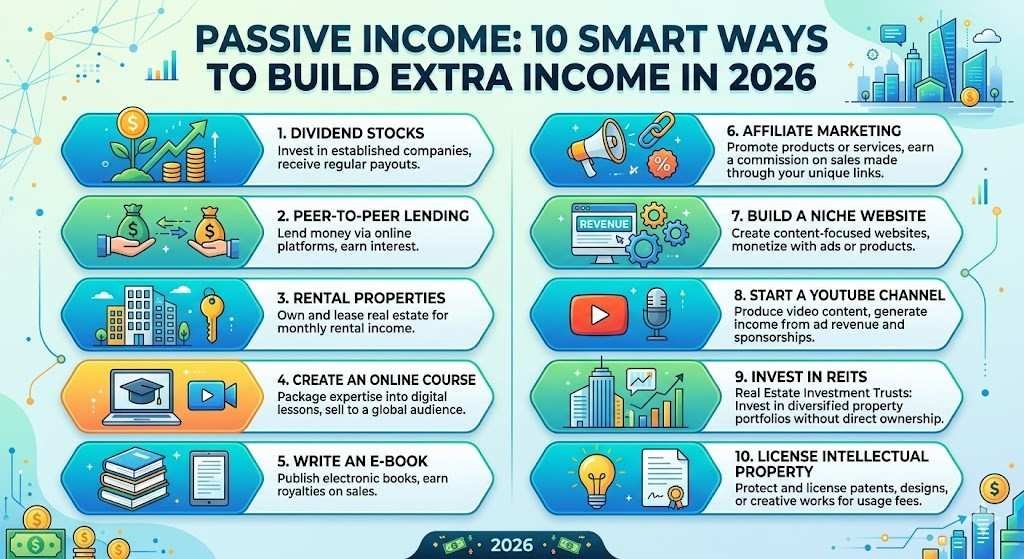
Passive income has become one of the most searched financial topics because people increasingly want income that continues even when they are not actively working. Rising living costs, digital opportunities, remote work culture, and changing financial goals have pushed more individuals to explore ways to create additional earnings beyond a regular salary.
Passive income does not always mean money arrives without effort. In most cases, it requires time, planning, skill, or initial investment before income becomes steady. The real advantage is that once a system is built, income may continue with less daily involvement than traditional work.
For beginners, passive income can start small. For experienced earners, it can become a long-term wealth strategy. By 2026, passive income opportunities are broader than ever because digital platforms, financial tools, and online markets allow people to monetize knowledge, assets, and creativity more easily.
This guide explains what passive income means, how it works, the most realistic methods, risks, and practical ideas for starting in today’s economy.
What Passive Income Means
Passive income refers to money earned regularly without continuous direct work for every payment received.
Examples include:
- Rental earnings
- Royalties
- Dividend returns
- Digital product sales
- Affiliate income
- Automated online businesses
The important difference is that passive income usually requires initial work, capital, or planning.
Passive income is not instant income
Many people misunderstand passive income as effortless money. In reality:
- Setup often takes time
- Income grows gradually
- Maintenance still matters
The goal is reduced active effort over time.
Why Passive Income Is Growing Fast in 2026
Several economic and lifestyle changes have made passive income highly popular.
Rising living costs
Many households want extra financial security.
Digital access
Online platforms allow small creators and beginners to earn globally.
Job uncertainty
People increasingly seek multiple income sources.
Financial independence goals
Passive income supports long-term freedom.
A second income stream can reduce dependence on one salary.
Types of Passive Income
Passive income generally falls into three major categories.
1. Investment-based passive income
Money generates returns through financial assets.
2. Asset-based passive income
Owned property or resources create income.
3. Digital passive income
Content, products, or systems earn online.
Each type has different risk levels.
Dividend Investing: Income from Stocks
S&P 500 dividend investing remains one of the most traditional passive income methods.
Some companies pay shareholders regular dividends.
How it works
You invest in dividend-paying shares and receive periodic payouts.
Benefits
- Long-term growth potential
- Compounding returns
- Relatively scalable
Risks
- Market volatility
- Dividend cuts
This method often suits long-term planners.
Rental Income from Property
Real estate remains a major passive income path.
Rental income can come from:
- Apartments
- Rooms
- Commercial spaces
- Vacation rentals
Advantages
- Stable monthly income potential
- Property value appreciation
Challenges
- Maintenance
- Vacancy risk
- Initial capital requirement
Property remains powerful but capital-intensive.
Digital Products: Low-Cost Passive Income Potential
Digital products have become one of the fastest-growing income methods.
Examples:
- E-books
- Templates
- Printable planners
- Courses
- Design assets
Why digital products are powerful
A product can be created once and sold repeatedly.
Popular platforms include:
- Etsy
- Gumroad
Strong niches
- Education
- Home planning
- Health guides
- Finance tools
Blogging as Passive Income
A blog can generate long-term income if built strategically.

Blog income may come from:
- Advertising
- Affiliate marketing
- Sponsored content
- Digital products
Why blogs still matter in 2026
Search traffic remains valuable for evergreen content.
Strong niches:
- Health
- Finance
- Home living
- Technology
Important truth
A blog usually takes months before strong income appears.
Affiliate Marketing
Affiliate income means earning commission by recommending products or services.

Popular affiliate systems:
- Amazon affiliate links
- Software referrals
- Course referrals
How it works
You recommend a product through content. When someone buys, you earn commission.
Best content types
- Product comparisons
- Reviews
- Guides
Trust matters greatly.
YouTube and Video Content Income
YouTube remains one of the strongest passive income channels.
Income sources:
- Ads
- Affiliate links
- Sponsorships
Why video works
Videos can continue earning long after upload.
Evergreen video ideas
- Tutorials
- Reviews
- Educational content
Selling Online Courses
Knowledge can become passive income.
People sell courses about:
- Language learning
- Fitness
- Design
- Business skills
Platforms include:
- Udemy
Why it works
One course may sell for years.
Print-on-Demand Business
Print-on-demand allows product sales without inventory.

Products:
- T-shirts
- Mugs
- Posters
Platforms print only after orders arrive.
Advantage
Low inventory risk.
High-Yield Savings and Fixed Returns
For conservative earners, simple savings still matter.
Examples:
- Fixed deposits
- Savings products
- Bonds
This offers lower risk but smaller returns.
Royalties from Creative Work
Creative assets may earn repeatedly.
Examples:
- Books
- Photography
- Music
- Licensing
A published digital asset can generate long-term returns.
Passive Income Myths
Myth 1: It requires no work
Reality: setup is often demanding.
Myth 2: It gives fast money
Reality: growth is usually gradual.
Myth 3: One method suits everyone
Reality: method depends on skill and resources.
Best Passive Income for Beginners
Strong beginner choices:
- Blogging
- Affiliate content
- Digital templates
- Small investing
- Printables
These often require less capital.
Best Passive Income for Low Budget
Low-cost options:
- E-books
- Simple niche blog
- Social content with affiliate links
- Printable products
Common Mistakes to Avoid
Avoid:
- Expecting instant returns
- Choosing too many methods at once
- Ignoring quality
- Quitting early
Consistency matters more than speed.
How Long Passive Income Takes
Typical timelines:
- Blogging: 6–18 months
- Digital products: 3–12 months
- Dividend investing: long-term
- Courses: depends on marketing
Patience is a major factor.
Passive Income and Financial Freedom
Passive income alone may not replace full income immediately.
But it can:
- Pay bills
- Build savings
- Reduce pressure
- Increase financial security
Over time, multiple streams matter most.
Future Passive Income Trends for 2030
Likely growth areas:
- AI-supported digital products
- Niche education
- Subscription communities
- Smart digital services
Digital systems will continue expanding.
Final Thoughts
Passive income is best understood as building systems that continue earning beyond immediate labor.
The strongest strategy is:
- Start small
- Choose one model
- Improve consistently
- Reinvest earnings
Long-term passive income often begins with active effort today
FAQs –
1. What is passive income?
Passive income is money earned regularly with limited ongoing effort after the initial setup, such as income from investments, rentals, digital products, or online businesses.
2. Is passive income really possible for beginners?
Yes, beginners can start passive income through blogging, affiliate marketing, digital products, printables, or small investments.
3. How much money is needed to start passive income?
Some passive income methods need investment, such as real estate or stocks, while others like blogging or digital products can start with a low budget.
4. Which passive income method is best in 2026?
Popular methods in 2026 include digital products, affiliate marketing, blogging, dividend investing, and online courses.
5. How long does passive income take to generate results?
It depends on the method. Blogging may take months, while dividend investing usually grows over years.
6. Can passive income replace a full-time salary?
Over time, multiple passive income streams can contribute significantly, but most people begin by using passive income as extra earnings.
7. Is blogging a passive income source?
Yes, a blog can generate passive income through ads, affiliate links, sponsored posts, and digital product sales.
8. What are low-cost passive income ideas?
Low-cost ideas include e-books, printable templates, affiliate content, blogging, and selling online courses.
9. Is passive income taxable?
In most countries, passive income is taxable depending on the source and local tax laws.
10. Why is passive income important today?
Passive income helps improve financial security, supports savings goals, and reduces dependence on one income source.
Also read :
Digital Finance: A Complete Guide to Modern Money Technology