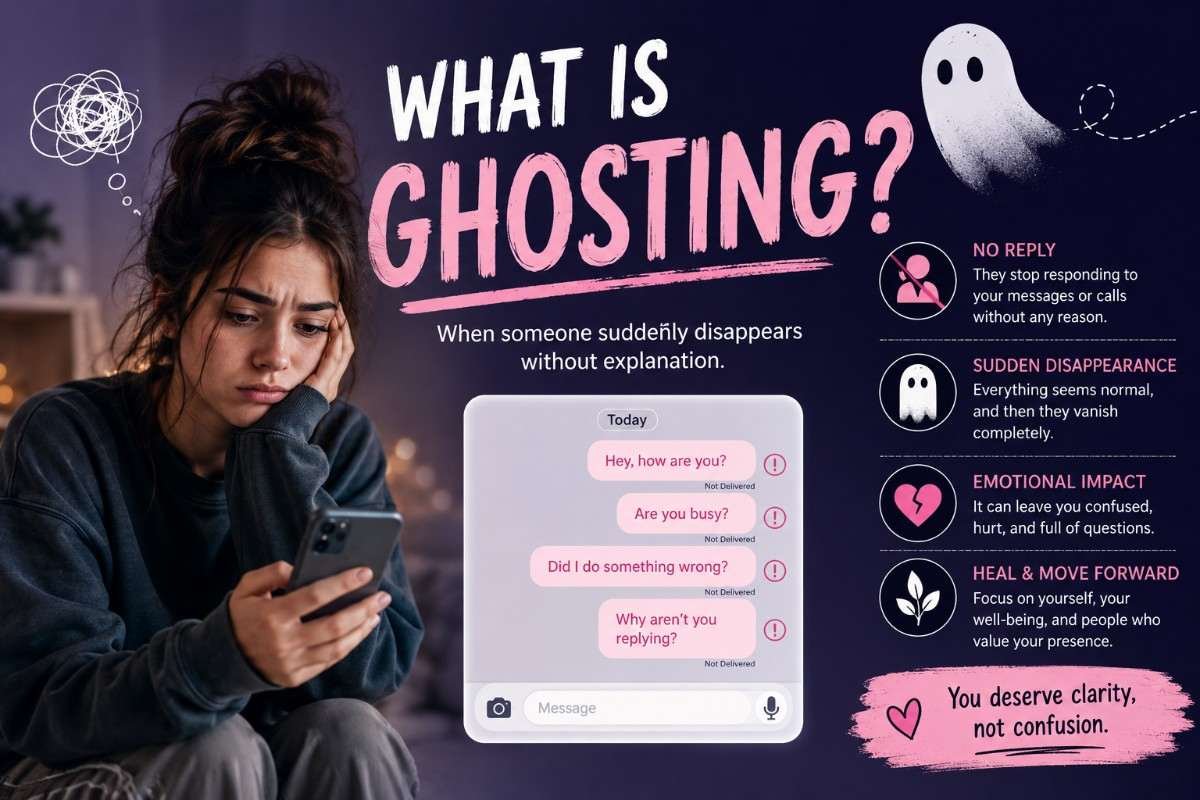
What Is Ghosting: Ghosting is when someone suddenly stops communicating with you without giving an explanation. They may stop replying to texts, ignore calls, or disappear from social media after previously communicating regularly.
Ghosting has become a common term in modern dating and online communication. But why do people ghost, what are the warning signs, and what should you do if someone suddenly disappears? This guide explains what ghosting means, why it happens, how it affects people, and how to move forward.
Ghosting has become a common term in modern dating and online communication. To understand other changes in modern dating culture, explore our guide to Gen Z Dating Trends.
What Is Ghosting?
What Is Ghosting: Ghosting means ending communication with someone by suddenly disappearing instead of directly explaining that you want to stop the connection.
For example, you may be texting someone regularly, going on dates, or building a friendship. Then, without warning, they stop responding.
You might send a message and receive no answer.
You may follow up later and still hear nothing.
Eventually, you realize the person has stopped communicating completely.
That’s commonly called ghosting.
Ghosting can happen in:
- Romantic relationships
- Dating
- Friendships
- Online connections
- Professional relationships
- Social-media interactions
Although the term is strongly associated with dating, ghosting isn’t limited to romantic relationships.
What Does Ghosting Mean in Dating?
What Is Ghosting: In dating, ghosting usually describes a situation where someone suddenly ends communication without explaining why.
For example:
Before ghosting:
You text every day, go on dates, and seem interested in each other.
After ghosting:
Messages are ignored, calls aren’t answered, and the person disappears.
The confusing part is that there may be no clear ending conversation.
Instead of hearing, “I don’t think we’re a good match,” the other person simply disappears.
10 Signs You’re Being Ghosted
What Is Ghosting: One unanswered message doesn’t necessarily mean someone is ghosting you. People can become busy, lose access to their phone, or need personal space.
However, these patterns may indicate ghosting.
1. They Suddenly Stop Replying
Someone who previously responded regularly suddenly stops answering your messages.
2. They Ignore Follow-Up Messages
You may send another message later, but there is still no response.
3. Their Communication Changes Dramatically
What Is Ghosting: Someone who used to message you throughout the day may suddenly become completely unavailable.
4. They Stop Answering Calls
Calls may go unanswered even though you previously communicated regularly.
5. They Disappear From the Connection
The person may stop responding across multiple platforms.
6. Plans Are Left Unfinished
What Is Ghosting: You may have discussed meeting or doing something together, but the person disappears instead of canceling.
7. They Stop Engaging With You Online
They may stop replying to your messages or interacting with your social-media content.
However, social-media activity alone isn’t enough to prove ghosting.
8. There Is No Explanation
What Is Ghosting: The biggest characteristic of ghosting is the lack of direct communication about why the connection ended.
9. The Silence Continues
A short delay isn’t necessarily ghosting. The pattern becomes more meaningful when communication stops for an extended period.
10. You Are Left Wondering What Happened
What Is Ghosting: You may find yourself repeatedly asking:
“Did I do something wrong?”
That uncertainty is one of the most difficult parts of ghosting.
Why Do People Ghost?
What Is Ghosting: There isn’t one reason why someone ghosts another person.
1. They Don’t Want a Difficult Conversation
Some people find rejection uncomfortable. Instead of saying they aren’t interested, they choose to disappear.
2. They Don’t Know How to End the Connection
A person may not have the communication skills needed to explain that they want to move on.
3. They Want to Avoid Conflict
Someone may believe that disappearing is easier than dealing with an uncomfortable conversation.
4. They Lost Interest
Sometimes interest simply fades.
Instead of communicating this directly, the person may stop responding.
5. They Feel Overwhelmed
Some people withdraw when communication becomes emotionally intense or demanding.
6. They Are Dealing With Personal Problems
Work, family responsibilities, stress, or other personal circumstances can affect communication.
This is why it’s important not to automatically assume that every delayed response is ghosting.
7. They Met Someone Else
In dating situations, someone may become interested in another person and stop communicating with previous matches.
8. They Feel Unsafe
Ghosting isn’t always careless behavior.
Someone may stop communicating because they feel uncomfortable, pressured, threatened, or unsafe.
In those situations, ending contact without an explanation may be an appropriate way to protect themselves.
Is Ghosting Always Bad?
Not necessarily.
What Is Ghosting: Ghosting can be hurtful and confusing, particularly when people have developed a meaningful connection.
However, there are situations where abruptly ending communication may be understandable.
For example, someone may choose to stop responding when:
- Their safety is at risk.
- Someone repeatedly ignores their boundaries.
- They are experiencing harassment.
- They feel pressured or threatened.
- They don’t feel comfortable continuing communication.
In ordinary dating situations where safety isn’t an issue, clear and respectful communication is generally a better way to end a connection.
Ghosting vs. Taking a Break
What Is Ghosting: These aren’t the same thing.
Ghosting
Someone disappears without explaining what is happening.
Taking a Break
Someone communicates that they need time or space.
For example:
Taking a break:
“I’ve got a lot going on right now and need some time to myself. I’ll reach out when I’m ready.”
Ghosting:
No explanation. No response. No clear ending.
The key difference is communication and clarity.
Ghosting vs. Slow Fading
What Is Ghosting: Ghosting and slow fading can look similar, but they aren’t exactly the same.
Ghosting: Communication suddenly stops.
Slow fading: Communication gradually becomes less frequent until it eventually disappears.
For example:
Week 1: Daily messages
Week 2: Messages every few days
Week 3: Short replies
Week 4: No communication
That pattern may be described as slow fading rather than sudden ghosting.
Ghosting vs. Breadcrumbing
What Is Ghosting: Breadcrumbing is different again.
Ghosting: Someone disappears.
Breadcrumbing: Someone continues giving small amounts of attention without making meaningful progress.
For example, a person might occasionally:
- Like your posts.
- Send a “Hey” message.
- Reply to your story.
- Flirt briefly.
- Disappear again.
This can keep the connection alive without providing genuine consistency.
Why Does Ghosting Hurt?
What Is Ghosting: Ghosting can be emotionally difficult because it creates uncertainty.
When someone clearly ends a relationship, you at least know what happened.
Ghosting can leave you asking:
- Did I say something wrong?
- Did they lose interest?
- Did something happen?
- Should I send another message?
- Was the connection real?
- Why didn’t they tell me?
This lack of closure can make it harder to move forward.
What Should You Do If Someone Ghosts You?
What Is Ghosting: If you believe someone is ghosting you, try not to immediately blame yourself.
Step 1: Give Them Some Time
People can become unavailable for legitimate reasons.
Don’t assume ghosting after a few hours or one missed message.
Step 2: Send One Clear Follow-Up
If appropriate, send a simple message.
For example:
“Hey, I haven’t heard from you. I hope everything is okay. If you don’t want to continue talking, I understand.”
You don’t need to repeatedly message someone.
Step 3: Don’t Chase Endless Explanations
If someone continues ignoring you, repeated messages usually won’t create the closure you’re looking for.
Step 4: Accept the Information
Silence can also communicate something.
If someone repeatedly chooses not to respond, their behavior may be telling you that they don’t want to continue the connection.
Step 5: Focus on Yourself
Spend time with friends, return to your hobbies, and maintain your normal routines.
Try not to make one person’s response—or lack of response—the center of your day.
What Not to Do After Being Ghosted
Don’t Send Dozens of Messages
Repeatedly asking why someone disappeared can increase your frustration.
Don’t Blame Yourself Automatically
You may never know the exact reason they stopped communicating.
Don’t Constantly Check Their Social Media
Checking their activity repeatedly can keep you emotionally connected to a situation that has already ended.
Don’t Try to Get Revenge
Posting indirect messages or trying to make someone jealous usually creates more stress.
Don’t Ignore Your Own Boundaries
If someone disappears and later returns, you are allowed to decide whether you want to continue communicating.
What If a Ghoster Comes Back?
What Is Ghosting: Sometimes people who disappeared return later.
They may send:
“Hey, stranger!”
or:
“Sorry, I’ve been busy.”
You don’t have to immediately continue the relationship.
Before responding, consider:
- Did they explain what happened?
- Do their actions match their words?
- Has their communication changed?
- Do you trust them?
- Do you actually want to reconnect?
You can accept an apology without automatically giving someone the same level of access to your life.
How to Respond When a Ghoster Comes Back
What Is Ghosting: If you want an explanation, you can ask directly:
“I’m open to talking, but I’d like to understand why you disappeared without explaining.”
If you don’t want to continue:
“I appreciate you reaching out, but I don’t think reconnecting is right for me.”
You don’t owe someone another chance simply because they returned.
How to Avoid Ghosting Someone Yourself
What Is Ghosting: If you’re no longer interested, you can communicate honestly.
You don’t need a long explanation.
Try:
“I’ve enjoyed getting to know you, but I don’t think we’re the right match. I wish you the best.”
Or:
“I don’t feel the connection I’m looking for, so I think it’s better to be honest and end things here.”
A short, respectful message is usually better than disappearing when it is safe to communicate.
Ghosting in the Age of Social Media
What Is Ghosting: Digital communication has made it easier to connect with people—but it has also made disappearing easier.
You can meet someone through:
- Dating apps
- TikTok
- Online communities
- Gaming platforms
- Messaging apps
Because communication is so accessible, people may expect quick replies.
At the same time, digital communication can make it easier for someone to stop responding without having an uncomfortable face-to-face conversation.
This is one reason ghosting has become such a recognizable term in modern dating culture.
Ghosting and Modern Dating
What Is Ghosting: Ghosting is one of several terms that have become common in modern dating culture.
Other terms include:
- Textationship — a connection mainly maintained through texting.
- Situationship — an undefined romantic relationship.
- Breadcrumbing — giving occasional attention without meaningful commitment.
- Love bombing — overwhelming someone with intense attention or affection.
- Soft launching — subtly revealing a relationship online.
- Slow fading — gradually reducing communication.
- Benching — keeping someone interested as a possible future option.
If you’re interested in digital dating, you can also read What Is Textationship? Meaning, Signs, Risks & How to Handle One.
How to Protect Your Emotional Well-Being
What Is Ghosting: Getting ghosted can be upsetting, but you don’t have to let the experience define your self-worth.
Try to:
- Maintain your normal routine.
- Spend time with supportive people.
- Avoid excessive social-media checking.
- Give yourself permission to feel disappointed.
- Focus on what you can control.
- Remember that another person’s communication style doesn’t determine your value.
If you’re experiencing significant or persistent emotional distress, consider talking with a qualified mental-health professional.
FAQs
What is ghosting in simple words?
Ghosting means suddenly ending communication with someone without explaining why.
How long before it is considered ghosting?
There is no universal time limit. A missed message or short period of silence isn’t automatically ghosting. The pattern, context, previous communication, and circumstances matter.
Why do people ghost instead of saying goodbye?
People may ghost because they want to avoid an uncomfortable conversation, have lost interest, feel overwhelmed, or don’t know how to communicate their feelings. In some situations, people may also stop communicating for safety reasons.
Is ghosting a form of rejection?
It can function as an indirect form of rejection because the person is choosing not to continue communication. However, the reason for the silence isn’t always known.
Should I text someone who ghosted me?
If you’re concerned that something happened, one respectful follow-up can be reasonable. If they continue not responding, repeatedly contacting them usually isn’t helpful.
What if my ghoster comes back?
You can decide whether you want to respond. Consider whether they take responsibility, explain what happened, and show consistent behavior before deciding whether to reconnect.
Is ghosting common in online dating?
Ghosting is a recognized behavior in modern online dating, where communication can begin and end through digital platforms. However, not every delayed or unanswered message means someone is ghosting.
Can ghosting happen in friendships?
Yes. Ghosting can happen in friendships, family connections, online communities, and other relationships—not just dating.
Conclusion
What Is Ghosting: Ghosting is the sudden disappearance of communication without a clear explanation. It can happen in dating, friendships, and online relationships, and it can leave people feeling confused or rejected.
If you’ve been ghosted, remember that you don’t need to spend endless amounts of energy trying to understand someone else’s decision. Give the situation reasonable space, avoid repeatedly chasing answers, and focus on your own well-being.
And if you’re the person considering disappearing, remember that when it is safe to do so, a short and respectful message can provide much more clarity than silence.
Modern dating can be complicated, but clear communication, healthy boundaries, and mutual respect remain valuable in any relationship.
You can also explore our Gen Z Health Guide 2026, Gen Z Sign Language for a broader look at health and wellness topics relevant to this generation.
About the Author
Hitasha is a lifestyle and wellness writer at Trendyopedia, creating easy-to-understand content about modern trends, relationships, beauty, health, and everyday lifestyle topics. Her goal is to make trending subjects simple, practical, and informative for readers.
Disclaimer
This article is for general informational and educational purposes only. Relationship experiences vary from person to person. This content is not a substitute for professional relationship or mental-health advice.