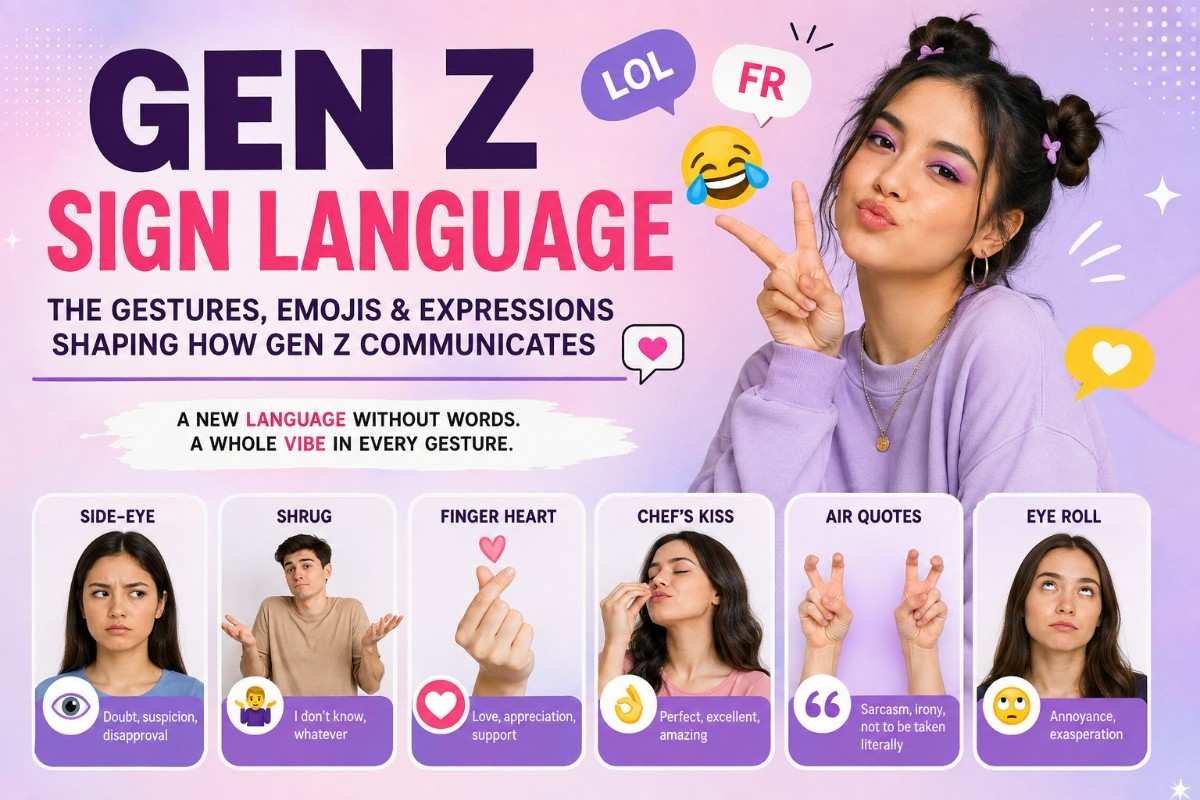
Gen Z has developed a unique way of communicating that goes far beyond spoken words. From hand gestures and facial expressions to emojis, memes, TikTok trends, and viral phrases, Gen Z sign language is constantly evolving.
While it is not an official sign language like American Sign Language (ASL), the term “Gen Z sign language” is often used online to describe the visual gestures and nonverbal expressions associated with Gen Z culture.
A simple hand movement, facial expression, or emoji can communicate an entire feeling. Someone might use a specific gesture to mean “I’m not impressed,” a dramatic facial expression to show disbelief, or an emoji to add humor to a text.
In this guide, we’ll explore what Gen Z sign language means, popular Gen Z gestures, their meanings, how social media influences them, and the important difference between internet gestures and real sign languages.
Gen Z communication is changing rapidly, from online slang and emojis to lifestyle and cultural trends. To better understand this generation, start with our guide on What Is Gen Z, which explains who Gen Z is and what makes this generation different.
What Is Gen Z Sign Language?
Gen Z sign language is an informal term for the gestures, expressions, emojis, and visual communication styles commonly associated with Generation Z.
Gen Z generally refers to people born from the late 1990s through the early 2010s, although the exact birth years vary depending on the source.
Unlike formal sign languages, Gen Z’s visual communication does not have standardized grammar or an official dictionary. Instead, meanings often come from:
- Social media trends
- TikTok videos
- Memes
- Emojis
- Popular culture
- Facial expressions
- Hand gestures
- Internet slang
- Viral challenges
Because online culture changes quickly, a gesture that is popular today may have a completely different meaning—or disappear entirely—later.
Gen Z Sign Language vs. American Sign Language
One of the most important things to understand is that Gen Z sign language is not the same thing as American Sign Language (ASL).
ASL is a complete natural language with its own grammar, vocabulary, syntax, and cultural history. It is used by many Deaf and hard-of-hearing people.
Gen Z gestures, on the other hand, are informal forms of communication. They generally do not have a standardized grammar or linguistic system.
Calling viral gestures “sign language” can therefore be misleading.
A better description is Gen Z gestures, internet gestures, or Gen Z visual communication when discussing casual online trends.
Gen Z’s communication style is influenced by social media, lifestyle trends, and changing attitudes. You can also explore our Gen Z Health Guide 2026 for a broader look at health and wellness topics relevant to this generation.
Popular Gen Z Gestures and Their Meanings
Gen Z communication includes many gestures that can be understood through context.
1. The Side-Eye Look
The side-eye is one of the most recognizable forms of nonverbal communication.
It can communicate:
- Doubt
- Disapproval
- Suspicion
- Disbelief
- “Really?”
- Awkwardness
For example, someone might give a side-eye when a friend makes an obviously questionable statement.
2. The Shoulder Shrug
The shrug is not exclusive to Gen Z, but it remains common in digital and everyday communication.
It can mean:
“I don’t know.”
“It doesn’t matter.”
“What can I do?”
The shrug is often paired with an emoji such as 🤷.
3. Finger Heart
The finger-heart gesture became especially popular through Korean pop culture and social media.
It is usually made by crossing the thumb and index finger to create a tiny heart.
It commonly represents:
- Love
- Appreciation
- Affection
- Support
- Friendship
The gesture became particularly recognizable among younger internet users because of K-pop and celebrity culture.
4. The “Chef’s Kiss”
The chef’s-kiss gesture is traditionally made by bringing the fingertips together and moving them away from the lips.
It generally means something is:
- Excellent
- Perfect
- Delicious
- Beautiful
- Well done
Online, the phrase “chef’s kiss” is also frequently used without the physical gesture.
5. Air Quotes
Gen Z Sign Language: Air quotes involve making quotation marks with your fingers.
They can indicate that a person is:
- Being sarcastic
- Questioning a phrase
- Using a term loosely
- Referring to something ironically
For example, someone might say “He’s an ‘expert’” while using air quotes.
Gen Z Uses Emojis Like a Visual Language
Emojis are an important part of modern Gen Z communication.
However, emoji meanings can be very different from their literal appearance.
😂
The laughing emoji traditionally means that something is funny.
However, different generations may use alternative emojis such as 😭 to communicate intense laughter.
😭
Gen Z frequently uses the crying emoji to express:
- Extreme laughter
- Emotional overwhelm
- Shock
- Sadness
- Amusement
The meaning depends heavily on context.
💀
The skull emoji is commonly used to mean something like:
“That was so funny I’m dead.”
It can also communicate disbelief, embarrassment, or being overwhelmed.
🫠
The melting-face emoji can express:
- Awkwardness
- Embarrassment
- Exhaustion
- Stress
- “I’m barely holding it together.”
👀
The eyes emoji often means:
- “I’m watching.”
- “Tell me more.”
- “I’m interested.”
- “What’s going on?”
Digital communication is only one part of Gen Z culture. Food is another major area where Gen Z trends are changing quickly. See our guide to Gen Z Food Trends to explore popular foods and eating trends.
Gen Z Facial Expressions
Gen Z Sign Language: Gen Z communication is not limited to hand movements.
Facial expressions can communicate entire reactions without words.
Common examples include:
The Blank Stare
A blank stare may communicate:
“I don’t even know what to say.”
The Dramatic Eye Roll
An eye roll can communicate annoyance, disbelief, or sarcasm.
The Raised Eyebrow
A raised eyebrow can indicate suspicion, surprise, or a silent question.
The Laughing Reaction
Sometimes a person’s facial expression communicates that something is funny even before they say anything.
These reactions often become viral memes and GIFs, further spreading their meanings online.
Gen Z Hand Gestures on Social Media
Gen Z Sign Language: Social media has accelerated the spread of gestures.
A movement that begins in a TikTok video can become recognizable around the world within days or weeks.
Platforms such as TikTok, Instagram, YouTube, and Snapchat allow users to imitate gestures and create new variations.
This creates a kind of visual internet vocabulary.
A gesture can become popular because of:
- A viral dance
- A celebrity
- A meme
- A movie
- A television show
- A music video
- A social challenge
- A popular creator
Why Does Gen Z Communicate With So Many Gestures?
Gen Z Sign Language: There are several reasons.
1. Social Media Encourages Visual Communication
Gen Z grew up in an environment dominated by visual platforms.
Photos, short videos, GIFs, memes, and emojis make visual communication natural.
2. Gestures Are Fast
A gesture can communicate an emotion instantly.
Instead of saying “I don’t believe what you just said,” a person may simply give a side-eye.
3. Humor Is Important
Many Gen Z gestures are connected to irony and humor.
A simple expression can become funny because of the context in which it is used.
4. Online Trends Spread Quickly
Social media allows communication styles to spread across countries and cultures at remarkable speed.
Gen Z Slang and Visual Communication
Gen Z Sign Language: Gen Z slang and gestures often work together.
For example, someone might say:
“It’s giving…”
while using a facial expression or hand gesture to emphasize the vibe they are describing.
Other expressions such as:
- “No cap”
- “Bet”
- “Low-key”
- “High-key”
- “Slay”
- “Period”
- “It’s giving”
- “Sus”
can be reinforced by gestures and facial expressions.
This combination makes Gen Z communication highly expressive.
Is Gen Z Sign Language a Real Language?
No. Gen Z sign language is not a formal language.
The phrase is generally used informally to describe the visual communication styles associated with Gen Z culture.
Formal sign languages such as ASL are completely different. They have established linguistic structures and are used as primary languages by Deaf communities.
This distinction is important because casually labeling internet gestures as “sign language” can unintentionally minimize the linguistic and cultural importance of actual signed languages.
How Gen Z Sign Language Changes
Gen Z Sign Language: One of the most interesting things about Gen Z communication is how quickly it changes.
A gesture can become popular through a viral video and then disappear months later.
Meanings can also shift.
For example, an emoji that originally communicated one emotion may eventually develop a completely different meaning among younger users.
This is why context is extremely important when interpreting Gen Z communication.
Gen Z Communication Isn’t Universal
Gen Z Sign Language: Not every Gen Z person uses the same gestures.
Communication can differ depending on:
- Country
- Language
- Age
- Online community
- Cultural background
- Friend group
- Social media platform
A gesture that is common in one online community may be completely unfamiliar somewhere else.
Therefore, there is no single universal “Gen Z dictionary.”
Gen Z Gestures and Cultural Influence
Modern internet communication is heavily influenced by different cultures.
K-pop, anime, gaming, Black internet culture, LGBTQ+ communities, memes, television, and global social media trends have all contributed to the way young people communicate online.
It is important to recognize the origins of gestures rather than assuming every popular gesture was created by Gen Z.
Many expressions associated with Gen Z existed long before the generation itself; social media simply helped spread or remix them.
How to Understand Gen Z Gestures
Gen Z Sign Language: If you are unfamiliar with a gesture, context is usually the best clue.
Ask yourself:
- What was happening when the gesture was used?
- Was the person being serious or sarcastic?
- Which social media platform was involved?
- What words accompanied the gesture?
- Is the gesture connected to a specific trend or community?
Avoid assuming that one gesture always has one fixed meaning.
Gen Z Sign Language in Text Messages
Gen Z’s visual communication also appears in texting.
Instead of writing long explanations, people may use combinations of:
😭💀
to communicate intense laughter.
Or:
👀
to indicate interest or curiosity.
Or:
🤨
to communicate suspicion or disbelief.
This creates a compact visual form of communication that can be understood almost instantly.
Common Gen Z Visual Expressions
| Gesture or Expression | Common Meaning |
|---|---|
| Side-eye | Doubt, suspicion, disbelief |
| Shrug | Uncertainty or indifference |
| Finger heart | Love or appreciation |
| Chef’s kiss | Excellent or perfect |
| Eye roll | Annoyance or sarcasm |
| 👀 | Interest or curiosity |
| 💀 | Extreme laughter or disbelief |
| 😭 | Laughter, emotion, or overwhelm |
| 🫠 | Awkwardness or exhaustion |
| 🤨 | Suspicion or questioning |
Remember that these meanings are informal and context-dependent.
FAQs
Is Gen Z sign language real sign language?
No. The phrase usually describes informal gestures, emojis, facial expressions, and internet communication styles. It is not a formal sign language.
What is the most common Gen Z gesture?
There isn’t one universal Gen Z gesture. Side-eye, finger hearts, shrugs, facial reactions, and various social-media gestures are commonly associated with younger internet culture.
Does Gen Z use emojis as a language?
Emojis aren’t a complete language, but they can function as powerful visual communication tools. Their meanings often depend on context.
Why does Gen Z use the skull emoji?
The 💀 emoji is often used to communicate extreme laughter, embarrassment, disbelief, or a reaction so strong that the person jokingly describes themselves as “dead.”
What does 👀 mean in Gen Z texting?
The 👀 emoji commonly communicates interest, curiosity, anticipation, or “I’m paying attention.”
Is ASL the same as Gen Z sign language?
No. ASL is a formal natural language with its own grammar and structure. Gen Z gestures are informal cultural and internet expressions.
Concusion
Gen Z sign language is best understood as a collection of informal gestures, facial expressions, emojis, memes, and visual reactions rather than an actual sign language.
Its popularity shows how communication continues to evolve in the digital age. Gen Z often combines words, images, gestures, emojis, and humor to communicate emotions quickly.
The most important thing to remember is that meanings aren’t universal. Internet culture changes rapidly, and the same gesture or emoji can mean different things depending on the person, platform, community, and situation.
If you’re trying to understand Gen Z communication, don’t focus on memorizing every gesture. Understanding the context is often more important than the gesture itself.
Gen Z is influencing everything from communication and internet culture to food, health, beauty, and work. For a broader understanding of this generation, read our r Gen Z Skincare Routine, How Gen Z Is Redefining Success Without 9–5 Jobs .
Author
Hitasha is a content writer at Trendyopedia who covers internet culture, lifestyle, beauty, health, and emerging trends. Her goal is to make changing online trends easier to understand through clear, accessible articles.
Disclaimer
This article discusses informal internet and cultural communication trends. It is not a guide to American Sign Language or any other formal signed language. Meanings may vary by culture, community, platform, and context.
Sources & References