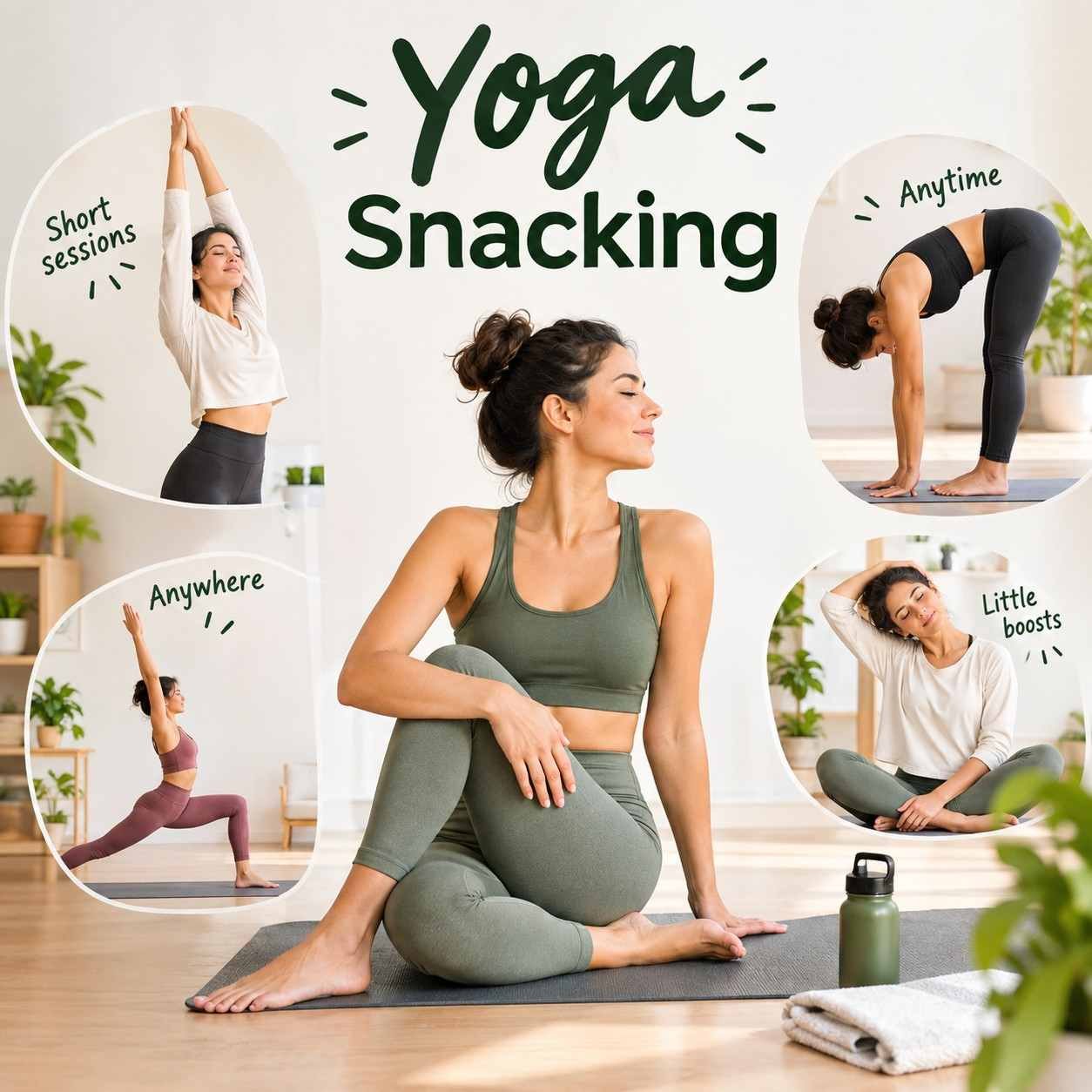
Yoga snacking is a simple approach to movement that breaks yoga into short sessions throughout the day instead of requiring one long workout. Rather than setting aside 60 minutes for a complete yoga class, you might do five minutes of stretching in the morning, a few mobility poses during a work break, and another short routine in the evening.
As busy schedules make it harder to maintain traditional workout routines, these small “movement snacks” are becoming an appealing way to add more activity to everyday life.
Yoga snacking can also fit well with other low-impact activities, such as Walking Yoga, making it easier to stay active throughout a busy day.
What Is Yoga Snacking?
Yoga snacking means practicing short bursts of yoga throughout the day.
A yoga snack could be as short as two to five minutes or last around 10 minutes. The idea is not to replace every longer yoga session but to make movement easier to fit into your schedule.
For example, your day might look like this:
- Morning: 5 minutes of gentle yoga
- Work break: 3 minutes of shoulder and neck movement
- Afternoon: 5 minutes of standing stretches
- Evening: 10 minutes of relaxing yoga
Instead of thinking about yoga as one scheduled workout, yoga snacking turns it into several small movement opportunities.
Why Is Yoga Snacking Trending?
The popularity of short-form wellness routines reflects a broader change in how people approach exercise.
Many people have busy work schedules, long periods of sitting, family responsibilities, and limited time for structured workouts. A 60-minute yoga class may not always fit into the day.
A five-minute routine, however, can feel much more manageable.
Yoga snacking also fits into the growing interest in low-impact exercise, mobility, mindful movement, and practical wellness habits.
The concept is similar to other short movement habits. Instead of waiting for the perfect time to exercise, you use small pockets of free time.
Yoga Snacking vs. a Traditional Yoga Session
The biggest difference is the amount of time and structure.
A traditional yoga session may involve a warm-up, a sequence of poses, breathing exercises, and relaxation.
Yoga snacking is much more flexible.
| Yoga Snacking | Traditional Yoga |
|---|---|
| Usually a few minutes | Often 30–60+ minutes |
| Can happen several times a day | Usually one scheduled session |
| Flexible and informal | Often follows a structured class |
| Easy to fit around work | Requires dedicated time |
| Can focus on one body area | May include a complete sequence |
Neither approach has to replace the other. Short sessions can complement longer yoga practices.
Benefits of Yoga Snacking
1. Makes Movement More Convenient
One of the biggest advantages is convenience.
You don’t necessarily need to change clothes, travel to a studio, or dedicate an entire hour to a yoga session.
A few minutes beside your desk or in your living room may be enough for a short movement break.
2. Helps Break Up Long Periods of Sitting
Many people spend significant portions of the day sitting at a desk, driving, studying, or using electronic devices.
Short movement breaks can provide an opportunity to stand up, move your joints, and change your posture.
Simple movements such as shoulder rolls, standing side stretches, gentle twists, and hip movements can be incorporated into these breaks.
3. Encourages Consistency
A common problem with exercise routines is that people create schedules that are difficult to maintain.
Yoga snacking takes a different approach.
Instead of saying, “I need an hour for yoga,” you might think, “I have five minutes.”
That smaller commitment can make regular movement feel more achievable.
4. Can Support Mobility
Regularly moving through comfortable ranges of motion can be useful for maintaining mobility.
Short yoga snacks can focus on areas that commonly feel stiff after sitting, such as the shoulders, hips, upper back, and legs.
The goal should be comfortable movement rather than forcing deep stretches.
5. Creates Mindful Breaks
Yoga isn’t only about physical movement.
Even a short session can give you an opportunity to pause, breathe, and step away from whatever you were doing.
For someone working on a computer for several hours, a two- or five-minute mindful movement break can create a useful transition between tasks.
Because yoga snacking encourages people to slow down and pay attention to how their body feels, it can also complement mindful movement practices such as Somatic Yoga, which emphasizes gentle movement and body awareness.
The Best Times to Try Yoga Snacking
There is no single perfect time for a yoga snack. The best time is usually one that fits naturally into your routine.
Morning Yoga Snack
Start your day with five minutes of gentle movement.
Try:
- Cat-cow
- Gentle spinal movements
- Child’s pose
- Standing side stretches
- Easy forward folds
Keep the movements comfortable and gradual.
Midday Yoga Snack
A midday session can be particularly convenient for people who work at a desk.
Try:
- Shoulder rolls
- Neck movements
- Seated twists
- Wrist stretches
- Standing side bends
- Gentle chest-opening movements
This can be done during a short break.
Afternoon Yoga Snack
If you tend to become stiff or inactive during the afternoon, use a few minutes to move.
A standing routine can include:
- Arm circles
- Side bends
- Gentle squats
- Calf raises
- Standing forward fold
Evening Yoga Snack
An evening routine can focus on slower movements.
Try:
- Legs-up-the-wall pose
- Gentle seated forward fold
- Reclined spinal twist
- Easy breathing exercises
- Comfortable relaxation
Avoid forcing stretches, particularly when you’re tired.
A 5-Minute Yoga Snack for Beginners
You don’t need a complicated sequence to get started.
Minute 1: Cat-Cow
Start on your hands and knees if comfortable.
Slowly alternate between gently rounding and extending your spine.
Move with your breathing.
Minute 2: Child’s Pose
Move back toward a comfortable resting position.
Keep your knees and hips in a position that feels natural.
Minute 3: Downward-Facing Dog
If this pose feels comfortable for you, move into a gentle downward-facing dog.
You don’t need to straighten your legs completely.
Alternatively, stay standing and perform a gentle forward fold.
Minute 4: Standing Side Stretch
Stand comfortably and reach one arm overhead.
Lean gently to the opposite side.
Switch sides.
Minute 5: Breathing and Relaxation
Finish by standing or sitting comfortably.
Take several slow breaths and notice how your body feels.
This simple routine can be repeated at different points throughout the day.
Yoga Snacking at Work
Your workplace can become one of the easiest places to experiment with short yoga breaks.
You don’t need a large space.
A few simple movements beside your desk can include:
Shoulder rolls: Slowly roll your shoulders backward and forward.
Seated spinal rotation: Sit upright and gently rotate your torso.
Wrist movement: Move your wrists through comfortable ranges of motion.
Standing stretch: Stand up and reach your arms overhead.
Calf raises: Slowly rise onto your toes and lower your heels.
If your workplace isn’t suitable for floor-based poses, stick with standing or seated movements.
If you spend much of your day sitting, combining short yoga breaks with regular walking can be a simple way to add more movement. You can also explore the Walking Pad Trend for another convenient at-home movement option.
Can Yoga Snacking Replace a Full Workout?
Not necessarily.
Yoga snacking can be a useful way to add movement to your day, but short yoga sessions don’t automatically provide everything your body needs from physical activity.
A balanced exercise routine can include different types of movement, such as aerobic activity, strength training, mobility work, and flexibility exercises.
Think of yoga snacks as small additions to your overall movement routine, rather than a requirement to eliminate longer workouts.
Yoga Snacking and the Rise of Micro-Workouts
Yoga snacking is part of a larger interest in micro-workouts.
Micro-workouts are short periods of exercise performed throughout the day.
Instead of completing one long workout, someone might accumulate several short periods of activity.
For example:
- 5 minutes of yoga
- 10 minutes of walking
- 5 minutes of bodyweight exercises
- 5 minutes of stretching
This approach can make physical activity feel less intimidating for people who struggle to find a large block of free time.
Yoga Snacking and Walking
Yoga doesn’t have to be your only short movement habit.
Walking can also be divided into smaller periods throughout the day. This idea fits well with the growing popularity of convenient walking-based wellness routines.
For people who enjoy gentle movement, combining short yoga sessions with walking can create a varied daily routine.
You can also explore Walking Yoga, another approach that combines walking and mindful movement.
How to Create Your Own Yoga-Snacking Routine
Start by identifying three moments when you naturally have a few free minutes.
For example:
After waking up: 5 minutes of gentle yoga.
After lunch: 3–5 minutes of standing mobility.
Before bed: 5–10 minutes of relaxing movement.
Keep your routines simple.
You don’t need to perform a different sequence every day. Repeating a few comfortable movements can make the habit easier to remember.
Keep Your Yoga Snacks Short
Don’t feel pressured to make every session 20 or 30 minutes.
The whole idea is to remove the pressure of needing a large amount of time.
Use Existing Habits as Reminders
Attach yoga snacks to activities you already do.
For example:
- After brushing your teeth
- After making coffee
- Before lunch
- After finishing a work meeting
- Before getting ready for bed
This can make the practice easier to remember.
Listen to Your Body
Short doesn’t mean intense.
Avoid forcing your body into a position because you think you should be able to do it.
Move within a comfortable range and stop if you experience pain, dizziness, or unusual symptoms.
Who Can Try Yoga Snacking?
Yoga snacking may appeal to:
- Office workers
- Students
- Beginners
- People with busy schedules
- People who enjoy gentle exercise
- People who want more movement during the day
- Anyone who prefers shorter routines
However, individual needs differ. If you have an injury, significant mobility limitations, or a medical condition, consider asking a qualified healthcare professional about appropriate exercises.
Is Yoga Snacking the Future of Everyday Wellness?
It may be better understood as one practical option within the broader movement toward small, sustainable wellness habits.
Modern wellness doesn’t always have to involve an elaborate routine.
A few minutes of movement between everyday activities can be easier to maintain than waiting for the perfect hour-long workout.
That’s the main appeal of yoga snacking: it makes yoga feel less like another appointment and more like a flexible part of everyday life.
Conclusion
Yoga snacking offers a simple way to fit mindful movement into a busy schedule. Instead of waiting until you have an uninterrupted hour, you can use small pockets of time throughout the day.
A few minutes in the morning, a short desk break, and a relaxing evening routine can all become opportunities to move.
Yoga snacking shouldn’t necessarily replace a complete exercise program, but it can complement your existing routine and make regular movement more convenient.
The next time you think you don’t have enough time for yoga, you may not need an hour. You might only need five minutes.
For people building a relaxing evening routine, small movement breaks can be combined with other calming habits, such as choosing Best Tea for Deep Sleep as part of a nighttime wellness routine.
FAQs
What is yoga snacking?
Yoga snacking is the practice of doing short yoga or mindful movement sessions throughout the day instead of completing one long session.
How long is a yoga snack?
A yoga snack can be as short as a few minutes. Many people may find 3–10 minutes practical, depending on their schedule.
Can beginners try yoga snacking?
Yes. Beginners can start with simple movements and gradually become more comfortable with yoga.
Can I do yoga snacks at work?
Yes. Seated and standing movements can be performed in many workplaces without needing a yoga mat.
Can yoga snacking help with flexibility?
Regular gentle movement may support flexibility and mobility, although results depend on the individual and the type and consistency of practice.
Can yoga snacking replace exercise?
Short yoga sessions can contribute to daily movement, but they don’t necessarily replace all forms of physical activity, such as aerobic and strength exercise.
Is five minutes of yoga worth doing?
A short session can still provide an opportunity to move and practice body awareness. Short sessions can also make it easier to maintain a consistent movement habit.
When should I do a yoga snack?
You can practice in the morning, during work breaks, in the afternoon, or in the evening. Choose times that fit naturally into your routine.
About the Author
Hitasha is a lifestyle and wellness writer at Trendyopedia, creating easy-to-understand content about wellness trends, healthy habits, fitness, beauty, and everyday lifestyle topics. Her goal is to make trending wellness information simple, practical, and useful for readers.
Disclaimer
This article is for informational and educational purposes only. It is not medical advice and should not replace guidance from a qualified healthcare professional. If you have a health condition, injury, or concerns about starting yoga or exercise, consult a healthcare professional before making changes to your routine.
Sources & References