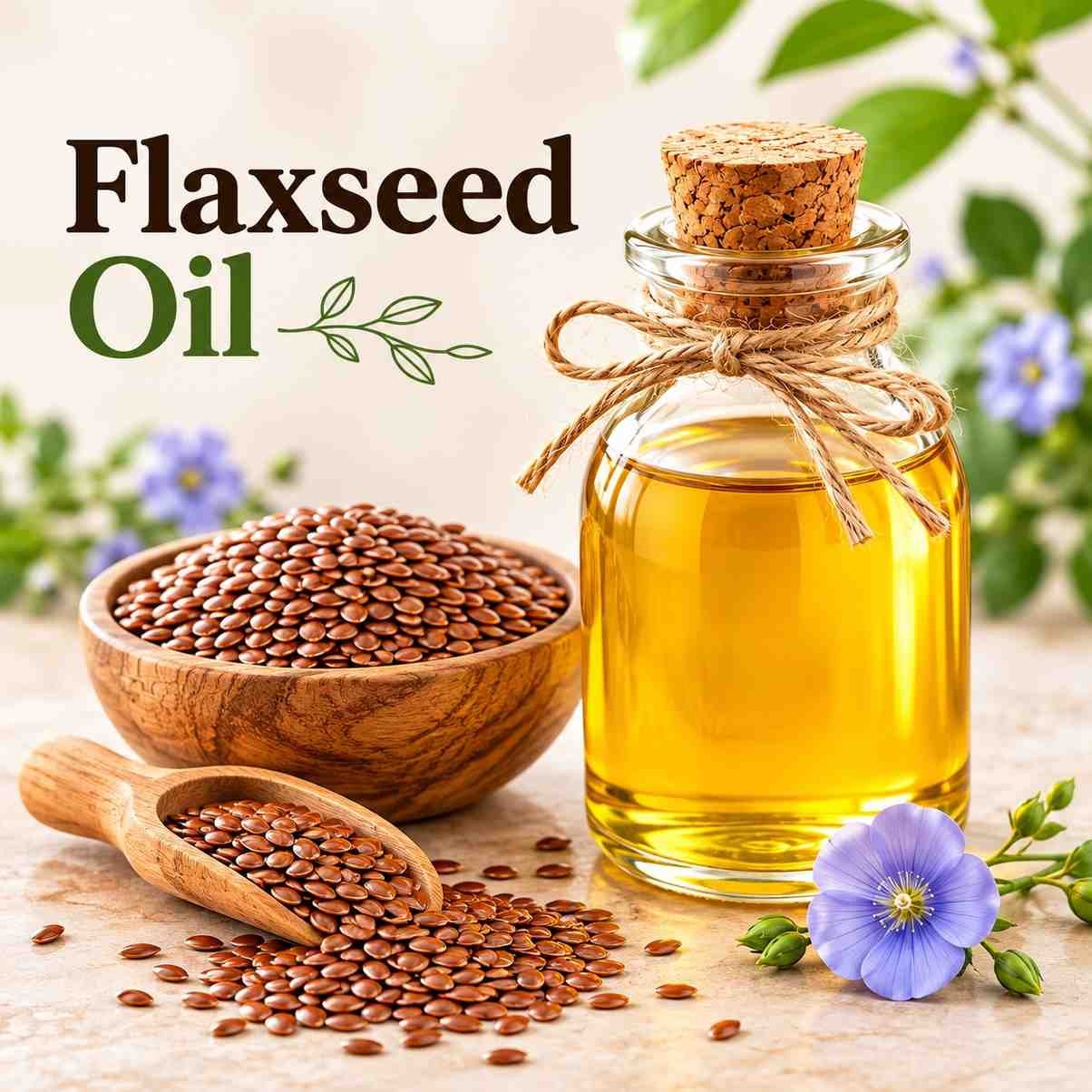
Flaxseed Oil, also known as flax oil or linseed oil, is a plant-based oil made by pressing the seeds of the flax plant (Linum usitatissimum). It is particularly known for its high concentration of alpha-linolenic acid (ALA), a plant-based omega-3 fatty acid.
Flaxseed Oil is commonly used as a food ingredient and is also found in some skincare and hair-care products. Because of its fatty-acid profile, it has attracted interest from people looking for natural ways to support their diet, skin, and hair-care routines.
However, Flaxseed Oil should not be considered a cure for medical conditions, and topical benefits can vary depending on the formulation and individual skin or hair type.
For readers interested in natural beauty oils, our Ashwagandha Oil guide explores another versatile plant-based oil commonly used for hair, skin, and body care. You can also explore Amla Oil and Rosehip Oil for additional skincare options.
What Is Flaxseed Oil?
Flaxseed Oil is extracted from mature flaxseeds. The oil contains mainly unsaturated fatty acids, with ALA omega-3 being one of its most notable components.
It can be produced using different extraction methods, including cold pressing.
Flaxseed Oil is available as:
- Food-grade flaxseed oil
- Cold-pressed This oil
- Organic flaxseed oil
- Flaxseed oil capsules
- Cosmetic or hair-care formulations
Important: Food-grade flaxseed oil and industrial linseed oil are not interchangeable. Industrial linseed oil may contain additives or processing agents and should never be consumed.
This Oil comes from the same seeds used to make Flaxseed Water and other flaxseed preparations. However, these products are different: This Oil is a concentrated fat source, while Flaxseed Water is a water-based preparation.
Flaxseed Oil Nutrition
One of the main nutritional features of This Oil is its omega-3 fatty acid content.
Key Components
- Alpha-linolenic acid (ALA)
- Linoleic acid
- Oleic acid
- Other unsaturated fatty acids
Unlike whole flaxseeds, flaxseed oil contains very little or no fiber and lignans, because these components are largely associated with the seed itself rather than the extracted oil.
What Makes Flaxseed Oil Different?
Flaxseed Oil stands out because it is one of the richer plant sources of ALA, an essential omega-3 fatty acid.
The body can convert ALA into the longer-chain omega-3 fatty acids EPA and DHA, but the conversion is limited. Therefore, This oil should not automatically be considered nutritionally equivalent to fish or algae sources of EPA and DHA.
Potential Benefits of Flaxseed Oil
1. Provides Plant-Based Omega-3 ALA
This Oil is a concentrated plant source of alpha-linolenic acid.
ALA is an essential fatty acid, meaning the body needs it from the diet.
2. Supports a Balanced Diet
Replacing some sources of saturated fat with unsaturated fats can be part of a heart-conscious eating pattern.
This Oil can be incorporated into meals as one source of unsaturated fat.
3. Supports Skin Moisture
When used in suitable topical formulations, the fatty acids in This Oil can help moisturize dry skin.
4. Helps Condition Dry Skin
A small amount of cosmetic-grade This Oil may help leave dry skin feeling softer and smoother.
5. Supports the Skin Barrier
Dietary fats and topical emollients can play different roles in maintaining comfortable, moisturized skin.
Flaxseed Oil is sometimes included in cosmetic formulations designed for dry skin.
6. May Help Improve Skin Softness
Its emollient properties can help reduce the rough feeling associated with dry skin.
7. Can Be Used in Hair Care
Flaxseed Oil can be incorporated into hair oils and conditioning treatments.
8. Helps Condition Dry Hair
Applying an appropriate hair-care formulation containing This Oil may help make dry hair feel softer.
9. May Help Reduce the Appearance of Frizz
Oils can coat the hair shaft and improve smoothness, potentially making hair appear less frizzy.
10. Adds Shine to Hair
A small amount of oil can give dry hair a smoother, shinier appearance.
11. Supports Scalp Moisture
When suitable for your scalp, This Oil can be used as part of a moisturizing scalp-care routine.
12. Provides an Alternative to Some Animal-Based Omega-3 Sources
For people following plant-based diets, This oil provides dietary ALA.
However, ALA is different from EPA and DHA, so these sources are not nutritionally identical.
13. Easy to Add to Cold Foods
Food-grade This Oil can be added to foods such as:
- Smoothies
- Salad dressings
- Yogurt
- Oatmeal
- Dips
Avoid using it for high-heat cooking unless the specific product is designed for that purpose.
14. Can Be Used in Homemade Beauty Blends
Cosmetic-grade or appropriately prepared Flaxseed Oil can be combined with other carrier oils for hair and body-care applications.
15. Works Well With Other Carrier Oils
It can be blended with oils such as:
- Jojoba Oil
- Coconut Oil
- Olive Oil
- Avocado Oil
- Rosehip Oil
Flaxseed Oil for Skin
This Oil is sometimes used in natural skincare because of its fatty-acid profile.
Potential Uses
- Dry skin
- Rough patches
- Body moisturizing
- Massage
- Homemade body oils
For facial use, start with a small amount and perform a patch test first.
Simple Skin Routine
- Cleanse your skin.
- Apply your usual moisturizer.
- If appropriate for your skin, apply a very small amount of This Oil.
- Use sunscreen during the daytime.
If you’re interested in natural skincare oils, explore our Pomegranate Seed Oil, Avocado Oil, Jojoba Oil guide
Flaxseed Oil for Hair
This Oil can be used as a conditioning oil for dry or coarse hair.
Potential Uses
- Hair conditioning
- Dry hair care
- Frizz management
- Hair-end care
- Scalp moisturizing
However, there is not enough evidence to claim that Flaxseed Oil directly causes new hair growth.
How to Use It
- Take a small amount of This Oil.
- Warm it between your palms.
- Apply to the hair lengths and ends.
- Leave for approximately 20–30 minutes.
- Shampoo thoroughly.
Flaxseed Oil for Scalp Care
If you have a dry scalp, a small amount of oil may provide temporary moisturization.
Simple Scalp Oil Routine
- Apply a small amount.
- Massage gently without scratching.
- Leave for 20–30 minutes.
- Wash with a gentle shampoo.
If you experience persistent itching, redness, scaling, or hair loss, consider speaking with a dermatologist instead of relying on oil treatments.
How to Use Flaxseed Oil in Food
If you’re using food-grade Flaxseed Oil, it can be added to cold or lightly prepared foods.
Ideas
Salad Dressing:
Mix This Oil with lemon juice, herbs, and a small amount of mustard.
Smoothie:
Add a small amount to a smoothie.
Yogurt:
Mix with plain yogurt and fruit.
Oatmeal:
Drizzle over prepared oatmeal after cooking.
Always follow the serving instructions on the product label.
Flaxseed Oil vs Flax Seeds
| Feature | Flaxseed Oil | Whole Flax Seeds |
|---|---|---|
| ALA Omega-3 | High | High |
| Fiber | Very little/none | High |
| Lignans | Much lower | Higher |
| Calories | Concentrated | Less concentrated |
| Best Use | Omega-3-rich oil | Whole-food nutrition |
Whole flaxseeds offer fiber and other seed components that are largely removed during oil extraction.
Flaxseed Oil vs Fish Oil
Flaxseed Oil provides ALA, while fish oil provides the long-chain omega-3 fatty acids EPA and DHA.
The body can convert ALA to EPA and DHA, but the conversion is limited.
Therefore, these oils should not be treated as identical sources of omega-3 fats.
How to Store Flaxseed Oil
Flaxseed Oil is relatively susceptible to oxidation.
For food-grade oil:
- Keep it tightly sealed.
- Protect it from heat and light.
- Follow the manufacturer’s storage instructions.
- Refrigerate after opening if the label recommends it.
- Check the expiration date.
- Discard oil if it develops an unpleasant rancid smell or taste.
Proper storage is particularly important because This oil contains a high proportion of polyunsaturated fatty acids.
Who Should Be Careful With Flaxseed Oil?
Although food-grade This Oil can be part of many diets, some people should discuss its use with a healthcare professional.
This includes people who:
- Take medications that affect blood clotting
- Are preparing for surgery
- Are pregnant or breastfeeding
- Have a chronic medical condition
- Have allergies to flax
For topical use, people with sensitive skin should patch-test first.
Flaxseed Oil and Heart Health
This Oil is rich in alpha-linolenic acid (ALA), an essential plant-based omega-3 fatty acid. ALA is important for normal nutrition, and research has examined its relationship with cardiovascular health.
However, This Oil should be viewed as one part of an overall healthy eating pattern rather than a treatment for heart disease.
For better overall nutrition, combine healthy fats with vegetables, fruits, whole grains, legumes, nuts, and seeds.
Flaxseed Oil and Weight Management
This Oil is calorie-dense because it is almost entirely fat. While healthy fats can be part of a balanced diet, simply adding extra oil to your meals does not necessarily promote weight loss.
For weight management, portion size and total calorie intake matter.
A balanced diet, regular physical activity, adequate sleep, and sustainable eating habits are more important than relying on one specific oil.
Flaxseed Oil for Skin
This Oil can be used as an emollient in skincare and may help dry skin feel softer.
Possible Uses
- Moisturizing dry skin
- Body oiling
- Massage
- Dry elbows and knees
- Hair and scalp care
If you have acne-prone or sensitive skin, introduce it gradually because individual responses to facial oils vary.
Flaxseed Oil for Hair
This Oil can provide conditioning and help improve the feel and appearance of dry hair.
Potential Uses
- Dry hair
- Rough hair ends
- Frizz management
- Pre-shampoo oiling
- Scalp moisturizing
There is currently insufficient evidence to claim that topical This Oil directly stimulates hair growth.
Best Time to Use Flaxseed Oil
For Food
Food-grade This Oil can be incorporated into meals according to the product’s serving instructions.
It is commonly used with cold foods such as:
- Salads
- Smoothies
- Yogurt
- Oatmeal
- Dips
For Skin
It can be applied after cleansing and moisturizing if it suits your skin.
For Hair
A pre-shampoo treatment can be used once or twice a week.
Flaxseed Oil vs Coconut Oil
| Feature | Flaxseed Oil | Coconut Oil |
|---|---|---|
| Main Fatty Acids | High in ALA | Rich in saturated fats |
| Common Use | Food and beauty | Food, hair, and skin |
| Texture | Lightweight | Richer |
| Omega-3 ALA | High | Very low |
| Hair Care | Conditioning | Conditioning and moisturizing |
Flaxseed Oil vs Olive Oil
| Feature | Flaxseed Oil | Olive Oil |
| Main Fat | ALA-rich polyunsaturated fat | Primarily monounsaturated fat |
| Flavor | Nutty, delicate | Fruity or peppery |
| Common Food Use | Cold foods | Cooking and dressings |
| Omega-3 ALA | High | Low |
| Oxidation Stability | Relatively low | Generally higher |
Both can be part of a balanced diet, but they have different fatty-acid profiles and cooking properties.
Flaxseed Oil vs Flax Seeds
Whole flaxseeds provide nutrients that are not present in the same amounts in the extracted oil.
Flax Seeds Provide
- Fiber
- ALA
- Plant protein
- Lignans
- Minerals
Flaxseed Oil Provides
- Concentrated ALA
- Other unsaturated fats
- No meaningful amount of fiber
If you’re looking for the broader nutritional benefits of flax, whole or ground flaxseeds may offer more nutritional diversity.
Possible Side Effects
Food-grade This Oil is generally tolerated by many people when consumed appropriately, but some people may experience:
- Digestive discomfort
- Loose stools
- Bloating
- Allergic reactions
Topical use may occasionally cause:
- Redness
- Itching
- Irritation
- Contact dermatitis
Stop using the product if you develop an adverse reaction.
Flaxseed Oil and Medication
If you take medication, especially medicines that affect blood clotting, speak with your healthcare professional before taking concentrated flaxseed oil supplements.
Do not use This Oil as a substitute for prescribed treatment.
Safety Tips
- Use food-grade oil for consumption.
- Never consume industrial linseed oil.
- Follow the product’s serving instructions.
- Store food-grade This Oil properly.
- Keep it away from heat and direct sunlight.
- Perform a patch test before topical use.
- Avoid applying oil to damaged or irritated skin.
- Keep cosmetic oils away from the eyes.
- Stop use if irritation develops.
FAQs
Is Flaxseed Oil the same as flaxseed oil capsules?
They can contain the same basic oil, but capsules provide a measured serving and may contain additional ingredients. Always check the product label.
Is Flaxseed Oil good for hair growth?
This Oil can condition hair and improve its appearance, but there isn’t enough evidence to say that applying it directly to the scalp causes hair growth.
Can I use Flaxseed Oil on my face?
Yes, some people use it as a facial oil or as an ingredient in skincare products. Patch testing is recommended, particularly for sensitive or acne-prone skin.
Can I cook with Flaxseed Oil?
This Oil is generally better suited to cold preparations because it is rich in polyunsaturated fats and can oxidize more readily with heat. Follow the manufacturer’s instructions.
Can I take Flaxseed Oil every day?
Some people consume food-grade This Oil regularly, but the appropriate amount depends on the product and individual dietary needs. Follow the label or ask a healthcare professional.
Is Flaxseed Oil better than whole flaxseeds?
Not necessarily. This Oil provides concentrated ALA but lacks most of the fiber and many of the other nutrients found in whole flaxseeds.
Does Flaxseed Oil help dry skin?
It can act as an emollient and may help make dry skin feel softer when used appropriately.
Can Flaxseed Oil be used on the scalp?
Yes, it can be used as a conditioning oil. However, persistent scalp problems should be evaluated by a dermatologist.
Conclusion
Flaxseed Oil is a versatile plant-based oil best known for its high concentration of alpha-linolenic acid (ALA), a plant-based omega-3 fatty acid. It can be used in cold foods and is also found in various skincare and hair-care products.
For nutrition, remember that Flaxseed Oil and whole flaxseeds are not identical. The oil provides concentrated ALA, while whole flaxseeds provide fiber, lignans, protein, and other nutrients.
For beauty, This Oil can be used as a moisturizing and conditioning ingredient for skin and hair. However, claims about direct hair growth or treatment of specific skin conditions should not be overstated.
If you’re exploring more natural oils and wellness topics, visit our Avocado Oil, Kumkumadi Oil, Ginger Oil, guides on Trendyopedia.
Author
Author: Hitasha
Hitasha is a beauty, nutrition, and wellness writer at Trendyopedia. She focuses on creating reader-friendly, research-informed content covering natural oils, nutrition, skincare, hair care, and healthy lifestyle trends.
Disclaimer
This article is for informational purposes only and does not replace professional medical or dietary advice. Flaxseed Oil should not be used as a treatment for a medical condition. If you take medications, have a medical condition, or are pregnant or breastfeeding, consult a qualified healthcare professional before using This oil supplements.