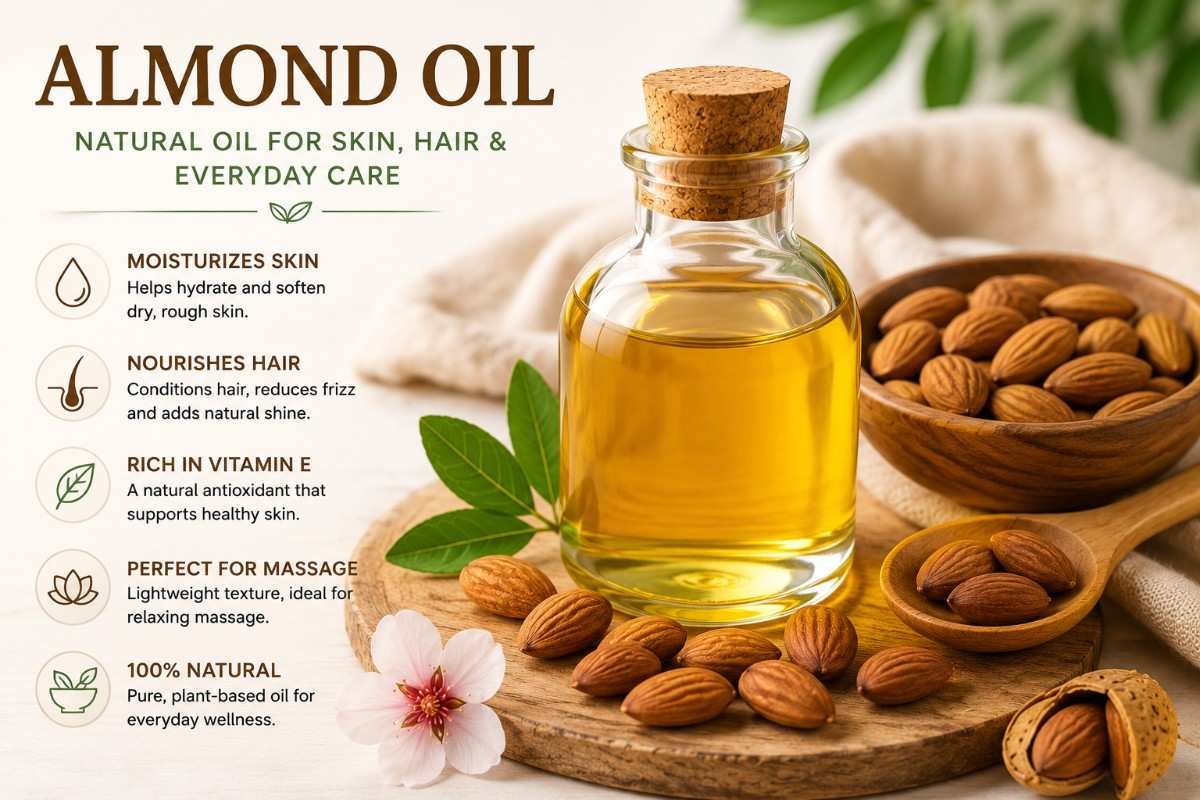
Almond Oil is a popular plant-based oil made from almonds and is widely used in skincare, hair care, massage, and beauty routines. Sweet almond oil is especially common in cosmetic products because of its smooth texture and moisturizing properties.
Almond Oil contains fatty acids and vitamin E, making it a popular ingredient in moisturizers, hair oils, body lotions, and massage blends.
If you’re interested in other natural oils, you can also explore our Avocado Oil, and Flaxseed Oil guides.
In this guide, we’ll explore what Almond Oil is, its potential benefits, uses for skin and hair, how to use it, safety considerations, and how it compares with other popular natural oils.
What Is Almond Oil?
This Oil is extracted from almonds. For cosmetic and skincare purposes, sweet almond oil is generally the type used.
It has a lightweight-to-medium texture and is commonly used as a carrier oil.
This Oil can be found in:
- Face oils
- Body lotions
- Hair oils
- Massage oils
- Soaps
- Creams
- Lip-care products
- Homemade beauty treatments
Sweet Almond Oil vs Bitter Almond Oil
These oils should not be confused.
Sweet almond oil is commonly used in food and cosmetics, while bitter almond oil is associated with different compounds and processing requirements.
For skincare, always check the product label and choose an oil intended for cosmetic use.
Almond Oil Nutrition
When used as a food ingredient, This oil primarily provides fat rather than protein or fiber. Almond Oil and whole almonds are not nutritionally identical. Whole Almonds provide protein, fiber, vitamins, minerals, and other nutrients, while the extracted oil is primarily a source of fat.
Its fatty-acid profile includes:
- Monounsaturated fats
- Polyunsaturated fats
- Smaller amounts of saturated fats
- Vitamin E
The exact nutritional composition can vary depending on the product and processing method.
Potential Benefits of Almond Oil
1. Helps Moisturize Dry Skin
This Oil can act as an emollient, helping soften and smooth dry skin.
It can be especially useful for areas such as:
- Hands
- Elbows
- Knees
- Legs
- Feet
2. Supports Skin Softness
The fatty acids in This Oil can help leave the skin feeling smoother and more comfortable.
It can be applied after bathing when the skin is slightly damp.
3. May Help Reduce Dryness
Regular moisturizing is important for maintaining the skin barrier. This Oil can be incorporated into a moisturizing routine for people who tolerate facial or body oils well.
4. Contains Vitamin E
This Oil naturally contains vitamin E, an antioxidant nutrient.
Vitamin E helps protect cells from oxidative damage and is commonly included in skincare products.
5. Useful as a Massage Oil
Because of its smooth texture, Sweet This Oil is commonly used as a carrier oil for massage.
It spreads easily across the skin and can be combined with other cosmetic oils.
6. Helps Condition Dry Hair
This Oil can coat the hair shaft and help dry hair feel softer and smoother.
It may be particularly useful for dry hair lengths and ends.
7. May Help Reduce the Appearance of Frizz
Applying a small amount of oil to the hair can improve surface smoothness and make frizz less noticeable.
Avoid using too much, as excessive oil can make hair look greasy.
8. Adds Shine to Hair
A small amount of Almond Oil can make dry or dull-looking hair appear shinier.
For fine hair, start with just a few drops.
9. Supports Scalp Moisture
This Oil can be used as part of a moisturizing scalp routine when dryness is the main concern.
However, persistent itching, scaling, redness, or hair loss should not be treated with oil alone.
10. Helps Condition Dry Hair Ends
Applying a tiny amount to the ends of the hair can help improve the feel of dry or rough ends.
Almond Oil for Skin
This Oil is particularly popular in body-care routines because of its moisturizing texture.
How to Use Almond Oil on Skin
- Cleanse your skin.
- Pat it dry.
- Apply a small amount of This Oil.
- Massage gently until absorbed.
- Apply sunscreen during the daytime when appropriate.
For facial use, patch-test first, especially if you have sensitive or acne-prone skin.
Almond Oil for Dry Skin
Dry skin often benefits from regular moisturizing.
Almond Oil can be used on:
- Dry hands
- Elbows
- Knees
- Feet
- Legs
- Cuticles
For best results, apply it after bathing while the skin still contains some moisture.
Almond Oil for Hair
This Oil is commonly used as a pre-shampoo treatment or finishing oil.
Simple Hair-Oiling Method
- Take a small amount of This Oil.
- Apply it mainly to the hair lengths and ends.
- If your scalp tolerates oils, gently massage a small amount into the scalp.
- Leave it for about 20–30 minutes.
- Wash with a gentle shampoo.
You don’t need a large amount. Using too much oil can make the hair difficult to cleanse.
For additional natural hair-care ideas, read our Amla Oil, Onion Oil, and Moringa Oil guides.
Does Almond Oil Help Hair Growth?
This Oil can help condition the hair and improve its appearance, but this does not mean it is proven to stimulate new hair growth.
If you’re experiencing significant or sudden hair loss, it’s better to identify the underlying cause with a qualified healthcare professional.
Almond Oil for Scalp Care
For a dry scalp, a small amount of This Oil may provide temporary moisturization.
However, oily scalp conditions, dandruff, fungal infections, or persistent scalp irritation may require specific treatment rather than simply applying oil.
Almond Oil for Nails and Cuticles
A few drops of This Oil can be massaged into dry cuticles and the surrounding skin.
Its emollient properties may help keep the area feeling soft and moisturized.
Almond Oil for Body Care
This Oil works well as a simple body oil.
Easy Body-Oiling Routine
Apply a small amount to slightly damp skin after bathing. Massage gently until the oil is distributed evenly.
For additional natural body-care ideas, explore our Body Oiling Routine guide.
Sweet This Oil is commonly used in facial skincare because of its smooth, emollient texture. It may help reduce the feeling of dryness and leave skin feeling softer.
If you want to use This Oil on your face:
- Cleanse your face.
- Apply your usual moisturizer.
- Use 1–2 drops of This Oil if your skin tolerates it.
- Gently press it onto the skin.
- Use sunscreen during the daytime.
If you have oily or acne-prone skin, start with a small amount and patch-test first.
Almond Oil for Glowing Skin
This Oil does not literally change your skin color, but moisturizing dry skin can make it appear smoother and healthier.
For a simple routine:
- Cleanse
- Moisturize
- Apply a small amount of This Oil
- Use sunscreen during the day
Healthy-looking skin depends on more than one ingredient. Sleep, nutrition, hydration, sun protection, and a consistent skincare routine also matter.
Almond Oil for Under-Eye Care
The skin around the eyes is delicate and can become dry.
A very small amount of cosmetic-grade Sweet This Oil may be used around the orbital area if your skin tolerates it.
However, avoid getting oil directly into your eyes.
This Oil should not be promoted as a proven treatment for dark circles, eye bags, or wrinkles because these concerns can have many different causes.
Almond Oil for Lips
This Oil can be used as an emollient in some lip-care products.
A tiny amount may help soften dry lips, but avoid using it if you have an almond allergy.
For severely cracked or irritated lips, a dermatologist-recommended lip balm may be more appropriate.
Almond Oil for Hair
This Oil can be useful as a conditioning treatment for dry or rough hair.
Pre-Shampoo Treatment
- Apply a small amount of This Oil to your hair.
- Concentrate on the lengths and ends.
- Leave it for 20–30 minutes.
- Wash thoroughly with shampoo.
- Condition as usual.
You don’t need to soak your hair in oil. A small amount is usually enough.
Almond Oil for Curly Hair
Curly and textured hair can sometimes feel dry because natural scalp oils may not spread evenly along the hair shaft.
A small amount of This Oil can be used as a finishing oil to help improve softness and reduce the appearance of frizz.
Always adjust the amount according to your hair type.
Almond Oil for Dry Hair Ends
Dry ends may benefit from a small amount of oil applied after washing.
Rub 1–2 drops between your palms and gently smooth them over the ends.
Avoid applying excessive oil because it can make the hair look heavy or greasy.
Does Almond Oil Make Hair Grow Faster?
There is not enough high-quality evidence to conclude that Almond Oil directly increases hair growth.
It may improve the feel and appearance of hair by conditioning it, but conditioning should not be confused with stimulating new hair growth.
For persistent hair thinning or excessive shedding, consult a dermatologist.
Almond Oil vs Coconut Oil
| Feature | Almond Oil | Coconut Oil |
|---|---|---|
| Texture | Lightweight to medium | Richer |
| Common Use | Skin, hair, massage | Skin, hair, cooking |
| Vitamin E | Naturally present | Present in smaller amounts |
| Hair Care | Conditioning | Conditioning |
| Skin Care | Moisturizing | Moisturizing |
Both oils can be useful, but the best choice depends on your skin type, hair type, and personal preference.
Almond Oil vs Jojoba Oil
| Feature | Almond Oil | Jojoba Oil |
| Origin | Almonds | Jojoba seeds |
| Texture | Smooth and lightweight | Lightweight |
| Main Use | Skin and hair | Skin and hair |
| Commonly Used As | Carrier oil | Carrier oil |
| Suitable For | Dryness and conditioning | Many skincare routines |
Jojoba Oil is often popular in facial skincare because of its lightweight feel.
Almond Oil vs Olive Oil
| Feature | Almond Oil | Olive Oil |
| Texture | Light to medium | Richer |
| Common Use | Beauty and massage | Food and beauty |
| Vitamin E | Present | Present |
| Hair Care | Conditioning | Conditioning |
| Skin Care | Moisturizing | Moisturizing |
How to Choose Almond Oil
When buying This Oil for skincare or hair care, look for:
- 100% Sweet Almond Oil
- Cosmetic-grade labeling
- Clear ingredient information
- A reputable manufacturer
- Proper packaging
- An expiration or best-before date
For food use, choose a product specifically labeled food-grade.
Never assume that an industrial or cosmetic oil is suitable for consumption.
Sweet Almond Oil vs Bitter Almond Oil
Sweet Almond Oil and bitter almond products are not interchangeable.
For everyday skincare, Sweet Almond Oil is the commonly used cosmetic oil.
If a product contains bitter almond or bitter almond essential oil, follow the manufacturer’s safety instructions carefully.
Possible Side Effects
This Oil is tolerated by many people, but reactions can occur.
Possible topical reactions include:
- Redness
- Itching
- Burning
- Irritation
- Rash
Stop using the product if you experience a reaction.
Almond Allergy Precautions
People with an almond or tree-nut allergy should be particularly cautious.
Do not apply This Oil to your skin or consume it unless you have confirmed with a qualified healthcare professional that the specific product is safe for you.
Always check the ingredient label.
Can Almond Oil Cause Acne?
This Oil may work well for dry skin, but facial oils can affect individuals differently.
If you’re acne-prone:
- Start with a small amount.
- Patch-test first.
- Avoid applying excessive amounts.
- Stop if breakouts or irritation increase.
If you have persistent acne, use products recommended for acne-prone skin rather than relying on oils alone.
How to Store Almond Oil
To maintain quality:
- Keep the bottle tightly closed.
- Store it away from direct sunlight.
- Keep it away from excessive heat.
- Follow the manufacturer’s storage instructions.
- Check the expiration date.
- Discontinue use if the oil develops an unusual rancid smell.
FAQs
Is Almond Oil good for the skin?
Sweet This Oil can help moisturize and soften dry skin. Individual results vary depending on skin type.
Is Almond Oil good for hair?
It can help condition dry hair, improve softness, and reduce the appearance of frizz.
Can Almond Oil make hair grow?
There isn’t sufficient evidence to conclude that This Oil directly stimulates hair growth.
Can I use Almond Oil on my face every day?
Some people can use it regularly, but it’s best to start with a small amount and patch-test first.
Is Almond Oil good for dry skin?
Yes, it can act as an emollient and help make dry skin feel softer.
Can I use Almond Oil on my scalp?
It can be used as a moisturizing treatment if your scalp tolerates it. Persistent scalp problems should be evaluated by a healthcare professional.
Is Sweet Almond Oil the same as Almond Oil?
Sweet This Oil is the type of This Oil most commonly used in cosmetics and skincare. Always check the product label.
Can people with nut allergies use Almond Oil?
People with almond or tree-nut allergies should consult a healthcare professional before using This Oil.
Conclusion
Almond Oil, particularly Sweet Almond Oil, is a versatile plant-based oil commonly used for skin moisturizing, hair conditioning, massage, and body care.
It can help dry skin feel softer and may improve the appearance and feel of dry or frizzy hair. However, claims that This Oil directly promotes hair growth or treats specific skin conditions should be avoided because the evidence is limited.
For the best results, use a suitable product, start with a small amount, patch-test before facial application, and choose products according to your skin and hair needs.
If you’re interested in more natural oils, explore our Pomegranate Seed Oil, Ginger Oil, Tea Tree Oil, and Kumkumadi Oil guides on Trendyopedia.
Author
Author: Hitasha
Hitasha is a beauty, nutrition, and wellness writer at Trendyopedia. She creates reader-friendly, research-informed content covering natural oils, skincare, hair care, nutrition, and healthy lifestyle topics.
Disclaimer
This article is for informational purposes only and is not a substitute for professional medical advice. People with almond or tree-nut allergies should take appropriate precautions before using Almond Oil. Speak with a qualified healthcare professional if you have concerns about allergies, skin conditions, or hair loss.