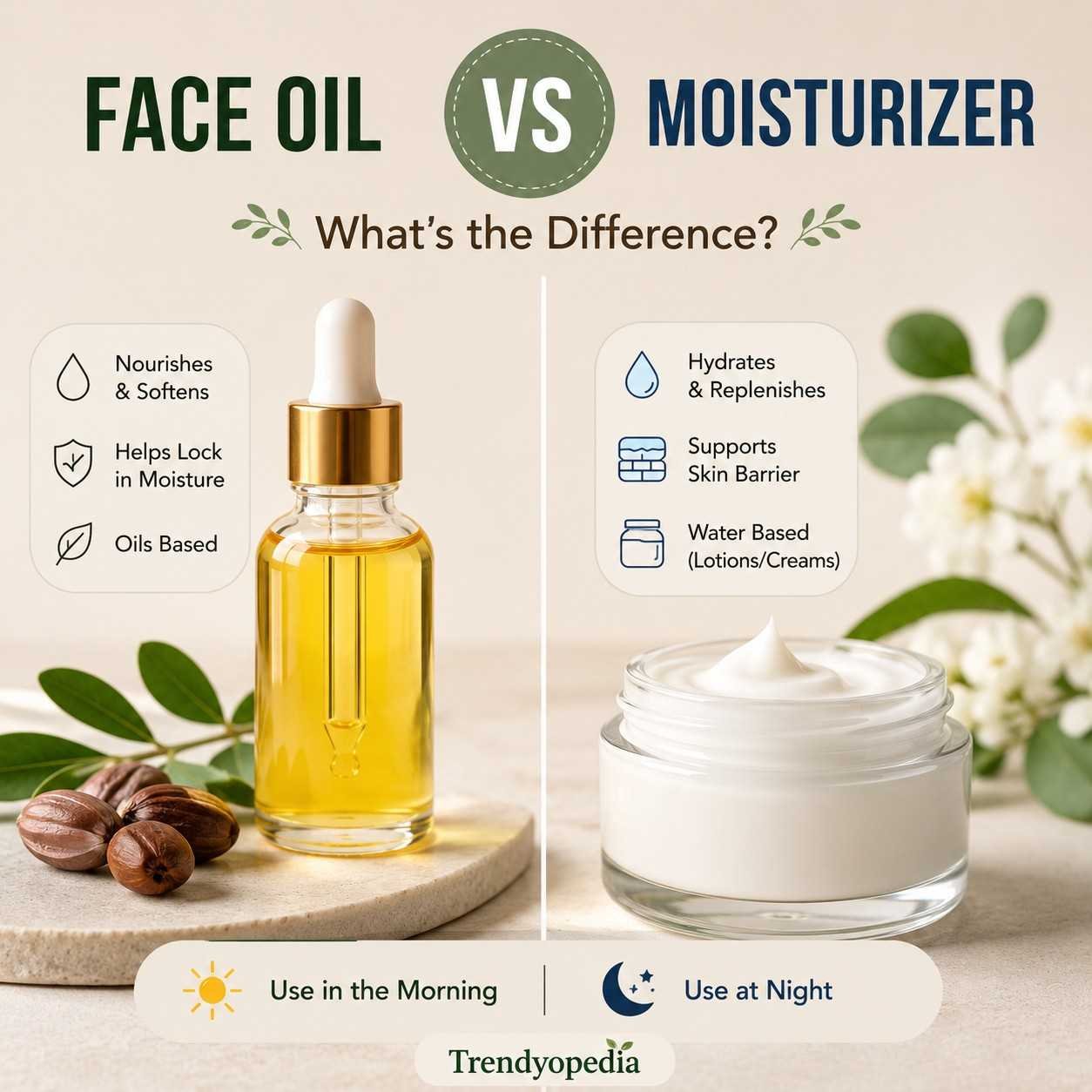
Face Oil vs Moisturizer is a common skincare question. Both products can help support softer, smoother-looking skin, but they work differently.
A moisturizer is formulated to hydrate the skin and support the skin barrier. A face oil mainly helps soften the skin and reduce moisture loss by forming an occlusive layer.
So, should you use face oil or moisturizer? For many people, they can actually be used together.
If you’re exploring natural skincare oils, learn more about Jojoba Oil and Almond Oil, two popular oils used in beauty routines.
What Is a Face Oil?
Face Oil vs Moisturizer: Face oils are oil-based skincare products made from ingredients such as:
- Jojoba Oil
- Rosehip Oil
- Squalane
- Argan Oil
- Avocado Oil
- Almond Oil
They can help soften dry-feeling skin and reduce transepidermal water loss.
Face oils don’t necessarily provide the same type of hydration as a water-based moisturizer.
What Is a Moisturizer?
A moisturizer is a skincare product designed to improve skin hydration and help maintain the skin barrier.
Moisturizers can contain different types of ingredients, including:
Humectants
These help attract and hold water in the outer layers of skin.
Examples include:
- Glycerin
- Hyaluronic acid
- Urea
Emollients
These help smooth and soften the skin.
Examples include:
- Plant oils
- Fatty acids
- Ceramides
Occlusives
These help reduce water loss from the skin.
Examples include:
- Petrolatum
- Mineral oil
- Certain plant oils
Many moisturizers combine several of these ingredient types. For readers interested in oil-based skincare, our Carrier Oil guide explains how carrier oils are commonly used in topical products.
Face Oil vs Moisturizer: Quick Comparison
| Feature | Face Oil | Moisturizer |
|---|---|---|
| Main role | Softens skin and helps reduce moisture loss | Hydrates and supports the skin barrier |
| Water content | Usually little or none | Often contains water |
| Humectants | Usually absent | Often included |
| Texture | Oily | Cream, lotion, gel, or balm |
| Best for | Softening and sealing | Daily hydration |
| Can be layered? | Yes | Yes |
| Suitable for all skin? | Depends on the oil | Depends on formulation |
Face Oil vs Moisturizer for Dry Skin
If your skin is dry, a moisturizer is usually the more important product.
Look for moisturizers containing ingredients such as:
- Ceramides
- Glycerin
- Hyaluronic acid
- Petrolatum
- Shea butter
A face oil can then be used as an additional step to help reduce moisture loss.
Simple routine
Cleanser → Moisturizer → Face Oil
This can be particularly useful when your skin feels dry or tight.
Face Oil vs Moisturizer for Oily Skin
Oily skin can still become dehydrated.
Using a lightweight moisturizer may help provide hydration without adding a heavy, greasy feeling.
If you want to use a face oil, choose a lightweight formulation and use a small amount.
However, if an oil appears to worsen breakouts or irritation, stop using it.
Face Oil vs Moisturizer for Combination Skin
Combination skin often has both oily and dry areas.
A lightweight moisturizer can be used across the face, while a small amount of face oil can be applied to drier areas.
You don’t necessarily need to apply the same amount of product everywhere.
Face Oil vs Moisturizer for Sensitive Skin
Sensitive skin can react to fragrances, essential oils, preservatives, or other ingredients.
If your skin is sensitive:
- Choose simple formulations.
- Avoid unnecessary fragrance.
- Introduce one new product at a time.
- Patch-test when appropriate.
- Stop using products that cause irritation.
A basic fragrance-free moisturizer may be a better starting point than a complex facial oil blend.
Can You Use Face Oil and Moisturizer Together?
Yes.
Using both can make sense because they perform different functions.
A simple routine could be:
Morning
- Gentle cleanser
- Moisturizer
- Sunscreen
Evening
- Gentle cleanser
- Moisturizer
- Face oil, if desired
Some people prefer applying face oil after moisturizer because the oil can help reduce moisture loss.
Should You Apply Face Oil Before or After Moisturizer?
Face Oil vs Moisturizer: There isn’t one universal rule, but a common approach is:
Moisturizer first → Face oil second
This allows the moisturizer to provide hydration while the oil can help seal in moisture.
However, product texture matters. Follow the manufacturer’s instructions when available.
Is Face Oil a Replacement for Moisturizer?
Usually, no.
A face oil and moisturizer are not interchangeable.
A moisturizer can contain humectants, emollients, and occlusives designed to support skin hydration.
A face oil primarily provides lipids and helps soften the skin.
If your skin needs hydration, replacing moisturizer with oil alone may not provide the same benefits.
Is Face Oil Good for Acne-Prone Skin?
Face Oil vs Moisturizer: It depends on the individual product and your skin.
Some facial oils may feel comfortable on acne-prone skin, while others may feel too heavy or contribute to clogged pores for some people.
If you’re acne-prone, choose products labeled non-comedogenic when possible and introduce them gradually.
Don’t use face oils as a replacement for proven acne treatments.
Face Oil vs Moisturizer for Aging Skin
Face Oil vs Moisturizer: As skin ages, it can become drier and more sensitive.
A moisturizer can help maintain hydration and support the skin barrier.
A face oil can be an optional addition for softness and comfort.
For an anti-aging routine, daily broad-spectrum sunscreen is particularly important.
Can Face Oil Cause Breakouts?
Face Oil vs Moisturizer: It can happen, although not every facial oil causes acne.
Factors include:
- The specific oil
- Product formulation
- Amount used
- Your skin type
- Other skincare products
If you notice persistent breakouts after introducing an oil, discontinue it and reassess your routine.
Best Face Oils for Different Skin Types
Dry Skin
Face Oil vs Moisturizer: Consider richer oils such as:
- Avocado Oil
- Almond Oil
- Rosehip Oil
Normal Skin
You may prefer:
- Jojoba Oil
- Squalane
- Rosehip Oil
Oily Skin
A lightweight option such as Jojoba Oil or Squalane may feel more comfortable.
Combination Skin
Use a lightweight oil only where needed.
Common Mistakes
Using Too Much Face Oil
A few drops may be enough. More isn’t necessarily better.
Skipping Moisturizer
If your skin needs hydration, face oil alone may not replace a properly formulated moisturizer.
Applying Too Many Products
A complicated routine isn’t automatically better.
Ignoring Sunscreen
Face oils do not replace sunscreen.
Using Essential Oils Directly on the Face
Essential oils are highly concentrated and can irritate the skin. They should not simply be added to your skincare routine without appropriate dilution and safety considerations.
Face Oil vs Moisturizer: Which Should You Choose?
Choose a Moisturizer If:
- Your skin feels dry or tight.
- You want daily hydration.
- You want barrier-supporting ingredients.
- You prefer a simple skincare routine.
Choose a Face Oil If:
- You want additional softness.
- Your skin feels dry after moisturizing.
- You enjoy facial oils.
- You want an optional final skincare step.
Choose Both If:
You want hydration from a moisturizer and the additional softness and moisture-loss protection provided by a face oil.
Simple Skincare Routine
Face Oil vs Moisturizer: For most people, a simple routine can be enough.
Morning:
Cleanser → Moisturizer → Sunscreen
Night:
Cleanser → Moisturizer → Face Oil
You don’t need to use a face oil every day. Adjust your routine according to how your skin responds.
For a complete step-by-step routine, check our Morning vs Night Skincare Routine article.
FAQs
Is face oil better than moisturizer?
No. They serve different purposes. Moisturizers are designed to hydrate and support the skin barrier, while face oils mainly soften skin and help reduce moisture loss.
Can I use face oil instead of moisturizer?
You can, but a face oil may not provide the same type of hydration as a moisturizer.
Should I use moisturizer before face oil?
A common approach is to apply moisturizer first and face oil afterward.
Can I use face oil every day?
Many people can, but frequency depends on the specific product and your skin type.
Is face oil good for dry skin?
It can help soften dry-feeling skin and reduce moisture loss, especially when used with a moisturizer.
Is moisturizer good for oily skin?
Yes. Oily skin still needs hydration. A lightweight, non-comedogenic moisturizer may be a good option.
Can face oil clog pores?
Some oils or formulations may contribute to clogged pores in certain people. Individual response varies.
Can I use face oil under makeup?
Yes, but allow it to absorb before applying makeup. Using too much can make makeup slide or appear greasy.
Does face oil replace sunscreen?
No. Face oil does not replace a properly formulated broad-spectrum sunscreen.
Conclusion
The choice between face oil vs moisturizer doesn’t have to be either-or.
A moisturizer is generally the foundation for daily hydration and skin-barrier support, while a face oil can be an optional addition that helps soften the skin and reduce moisture loss.
For many skincare routines, using a moisturizer first and a small amount of face oil afterward can work well. Choose products based on your skin type, ingredient preferences, and how your skin responds.
Simple is often better: cleanser, moisturizer, and sunscreen can form the foundation of a basic routine, with face oil added when useful.
Want to explore more natural oils? Read our guides to Flaxseed Oil, Pomegranate Seed Oil, Ashwagandha Oil, and Hibiscus Oil .
Author
Hitasha is a beauty, nutrition, and wellness writer at Trendyopedia, creating reader-friendly, research-informed content about skincare, natural oils, hair care, nutrition, and healthy lifestyle topics.
Disclaimer
This article is for informational purposes only and does not replace professional medical advice. Skincare products can cause irritation or allergic reactions. If you have a persistent skin condition or severe reaction, consult a qualified dermatologist or healthcare professional.