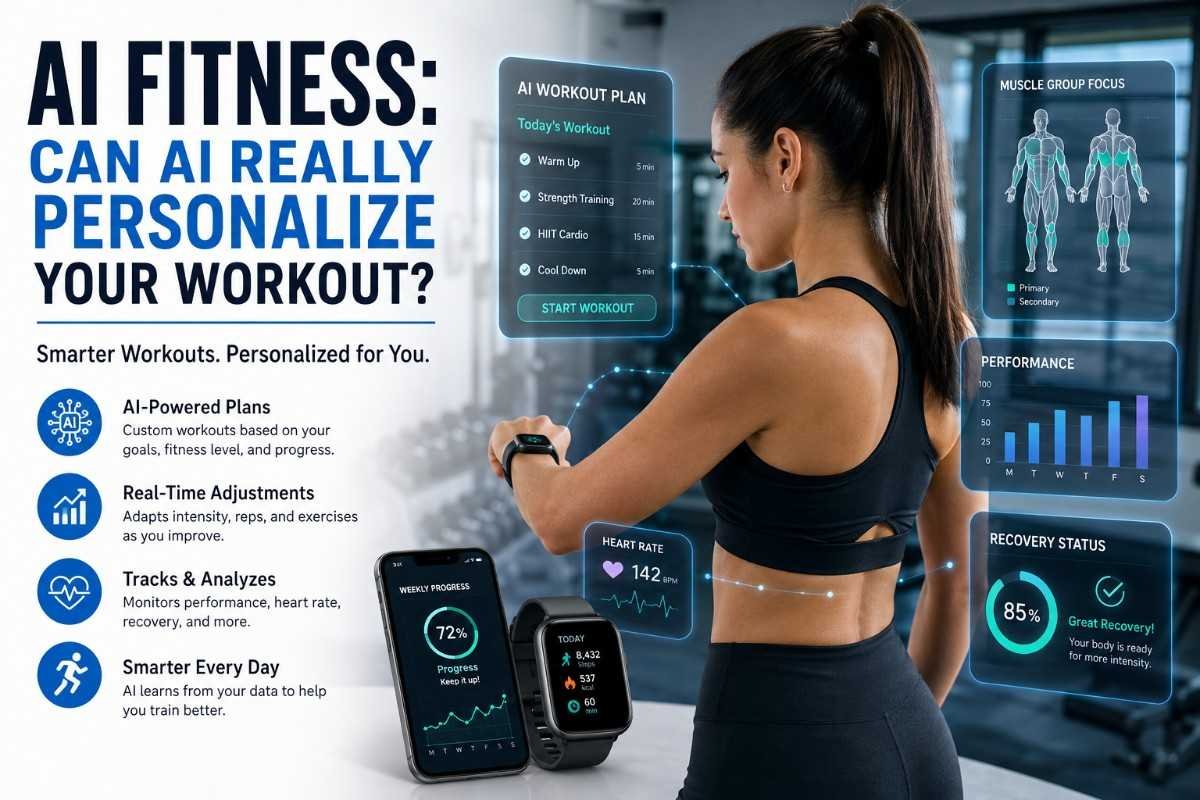
Your next workout might not come from a personal trainer. It might come from artificial intelligence.
AI fitness is becoming a major wellness trend, with apps, smartwatches, fitness platforms, and connected workout equipment increasingly using artificial intelligence to recommend exercises and adapt training plans.
Instead of following the same workout every day, an AI-powered system may consider information such as your fitness level, goals, activity history, available equipment, workout duration, and previous performance.
That sounds a lot like having a personal trainer in your pocket.
But can AI really personalize your workout?
Yes—but with important limitations.
AI can analyze data and adjust recommendations much faster than a traditional static workout plan. However, it doesn’t completely replace the experience, judgment, motivation, and safety awareness of a qualified fitness professional.
Let’s explore how AI fitness works, what it can do well, where it falls short, and how to use it more intelligently.
AI fitness is part of a larger shift toward technology-driven wellness. If you’re also interested in reducing technology dependence, read our guide to Digital Detox Trends: Simple Ways to Spend Less Time on Your Phone.
What Is AI Fitness?
AI fitness refers to the use of artificial intelligence and machine-learning technology to support exercise, training, and wellness.
Depending on the platform, AI may help with:
- Workout planning
- Exercise recommendations
- Progress tracking
- Training adjustments
- Activity analysis
- Exercise form feedback
- Recovery suggestions
- Personalized fitness goals
- Workout scheduling
Some systems use information from wearable devices, while others rely on information you provide yourself.
The goal is to move from a one-size-fits-all workout toward a more individualized experience.
Why Is AI Fitness Trending?
Traditional fitness programs often assume that everyone has similar needs.
But two people can have completely different:
- Fitness levels
- Goals
- Schedules
- Preferences
- Equipment
- Recovery abilities
- Training experience
AI makes it possible to process large amounts of information and generate recommendations quickly.
For busy people, this can be especially appealing.
Instead of spending an hour searching for workouts online, someone can receive a structured routine based on their stated goals and available time.
How Does AI Personalize a Workout?
AI personalization generally starts with information.
A fitness platform might ask about:
- Age
- Fitness experience
- Goals
- Workout frequency
- Available equipment
- Preferred activities
- Workout duration
A wearable device may also provide information about:
- Steps
- Heart rate
- Exercise duration
- Workout history
- Sleep patterns
- Training load
The system can then use that information to generate or modify recommendations.
For example, someone who wants to improve general fitness and has only 20 minutes available may receive a very different recommendation from someone training for a long-distance event.
Walking can be an easy way for beginners to become more active. You can also explore the Silent Walking Trend for a simple screen-free approach to movement.
7 Ways AI Can Personalize Your Workout
1. Goal-Based Training
The first step in personalization is understanding what you want to achieve.
Your goal might be:
- Building strength
- Improving endurance
- Increasing mobility
- Improving cardiovascular fitness
- Supporting weight management
- Becoming more active
- Preparing for a specific event
AI can organize workouts around these objectives.
However, a goal should still be realistic and appropriate for your individual circumstances.
2. Adjusting Workout Difficulty
One advantage of AI-based systems is that workouts can potentially change based on previous performance.
If a workout becomes too easy, the system may recommend:
- More repetitions
- Additional sets
- Increased resistance
- Longer duration
- More challenging variations
If a workout appears too difficult, it may suggest a simpler version.
This creates a more dynamic experience than following a fixed routine for several months.
3. Working With Your Schedule
Time is one of the biggest barriers to exercise.
AI can help create workouts around the time you actually have available.
For example:
10 minutes: Quick bodyweight session
20 minutes: Full-body workout
30 minutes: Strength and cardio combination
45 minutes: More comprehensive training session
This can make exercise feel more achievable.
4. Equipment-Based Recommendations
Not everyone has access to a gym.
An AI system can potentially create different workouts depending on what you have available.
No equipment
- Squats
- Lunges
- Push-ups
- Glute bridges
- Planks
Dumbbells
- Rows
- Presses
- Romanian deadlifts
- Goblet squats
Gym access
The routine can incorporate machines, cables, barbells, and other equipment.
This flexibility is one reason AI fitness can be attractive to people who exercise at home.
5. Tracking Progress
AI systems can analyze workout history to identify patterns.
For example, you may notice:
- Increasing strength
- Longer workout duration
- More repetitions
- Greater consistency
- Changes in activity levels
Seeing progress can make it easier to stay motivated.
However, progress shouldn’t be measured only by numbers.
Better energy, improved movement quality, consistency, and enjoyment can also matter.
6. Exercise Variety
Repeating the same workout every day can become boring.
AI can introduce different exercises and training formats.
For example:
Monday: Strength
Tuesday: Walking or cardio
Wednesday: Mobility
Thursday: Strength
Friday: Cardio
Saturday: Recreational activity
Sunday: Rest or gentle movement
A varied program can be more enjoyable and may help develop different aspects of fitness.
7. Form and Movement Feedback
Some AI-powered fitness systems use cameras or sensors to analyze movement.
They may attempt to identify things such as:
- Joint position
- Movement patterns
- Repetition counting
- Exercise tempo
This could be useful for basic exercise feedback.
However, this is one area where caution is particularly important.
AI movement analysis is not the same as having a qualified professional assess your technique.
If you’re learning a complex exercise or experiencing pain, professional guidance can be much more appropriate.
Can AI Replace a Personal Trainer?
Not completely.
AI can provide convenience, data analysis, and automated recommendations.
A qualified personal trainer can provide things AI cannot reliably reproduce, including:
- Real-time human judgment
- Motivation
- Context
- Hands-on coaching where appropriate
- Adaptation to unexpected situations
- Nuanced observation
- Individual communication
For someone new to exercise, recovering from an injury, or managing a medical condition, professional guidance may be especially valuable.
AI is better viewed as a fitness tool, not a complete replacement for human expertise.
Benefits of AI Fitness
Convenience
You can access workout recommendations whenever you need them.
Personalization
Programs can be adapted based on goals, experience, time, equipment, and available data.
Accountability
Tracking workouts can encourage consistency.
Variety
AI can generate different workout ideas and prevent routines from becoming repetitive.
Accessibility
People without access to a personal trainer may find AI-based fitness tools easier to access.
Data-Driven Feedback
Wearables and apps can provide information about activity and performance.
Limitations of AI Fitness
AI fitness is impressive, but it isn’t perfect.
1. AI Depends on the Information It Receives
If you give an AI system inaccurate or incomplete information, its recommendations may not be appropriate.
For example, if you say you’re an experienced lifter when you’re actually a beginner, the resulting workout could be too advanced.
Better input generally produces better recommendations.
2. AI Doesn’t Know Everything About Your Body
A wearable may detect movement and physiological measurements, but it doesn’t fully understand how you feel.
You may experience:
- Unusual fatigue
- Pain
- Stress
- Poor recovery
- Discomfort
These aren’t always captured accurately by algorithms.
3. More Training Isn’t Always Better
AI can generate an impressive amount of exercise.
But your body also needs recovery.
A good training plan should balance:
Training + Recovery + Nutrition + Sleep
Doing more workouts isn’t automatically better.
4. Recommendations Can Be Wrong
AI systems can make mistakes.
They may misunderstand:
- Your ability
- Your goals
- Your limitations
- Your exercise technique
- Your recovery needs
That’s why AI-generated fitness advice should be treated as guidance rather than unquestionable instructions.
AI Fitness and Weight Loss
AI can help organize workouts for people who want to become more active or manage their weight.
It may help you:
- Create an exercise schedule
- Track activity
- Set realistic goals
- Monitor consistency
- Find workouts that fit your lifestyle
But AI cannot guarantee weight loss.
Weight management involves many factors, including:
- Food intake
- Physical activity
- Sleep
- Stress
- Genetics
- Environment
- Individual health factors
A workout app alone isn’t a magic solution. Nutrition and exercise often work together when building healthier habits. Read Clean Eating to learn more about choosing nutritious, minimally processed foods.
AI Fitness for Beginners
AI can be particularly useful for beginners who don’t know where to start.
A simple beginner routine might include:
Day 1
Full-body strength
Day 2
Walking
Day 3
Rest
Day 4
Full-body strength
Day 5
Light cardio
Day 6
Optional recreational activity
Day 7
Rest
The exact routine should be adjusted according to fitness level, goals, and individual circumstances.
Beginners should prioritize learning proper technique and building consistency rather than trying to progress as quickly as possible.
AI Fitness and Wearables
Smartwatches and fitness trackers have made personal data a major part of modern exercise.
Depending on the device, users may track:
- Steps
- Heart rate
- Workout duration
- Distance
- Calories
- Sleep
- Activity levels
AI can potentially analyze these data points and turn them into recommendations.
For example, a system may notice that your activity level has decreased and suggest a lighter movement session.
But wearable data isn’t perfect.
Treat metrics as useful estimates, not absolute measurements.
AI Fitness and Recovery
Recovery is becoming an increasingly important part of modern fitness.
Some AI-based systems attempt to estimate readiness using information such as:
- Sleep
- Heart rate
- Recent exercise
- Activity levels
These insights can help people think about recovery instead of focusing exclusively on training.
However, if you feel exhausted or unwell, don’t let an app tell you that you must exercise simply because its algorithm says you’re “ready.”
Your actual experience matters.
How to Use AI Fitness Safely
AI can be useful when used thoughtfully.
1. Be Honest About Your Fitness Level
Don’t exaggerate your experience.
2. Tell the System About Your Equipment
A workout requiring equipment you don’t have isn’t useful.
3. Start Gradually
Avoid suddenly increasing exercise volume or intensity.
4. Pay Attention to Pain
Normal exercise effort and pain aren’t the same thing.
Stop an exercise if something feels wrong and seek appropriate professional advice when necessary.
5. Don’t Ignore Recovery
Schedule rest and easier days.
6. Verify Important Health Advice
AI-generated information shouldn’t replace guidance from qualified healthcare or fitness professionals.
AI Fitness vs. Personal Trainer
| Feature | AI Fitness | Personal Trainer |
|---|---|---|
| Workout generation | ✅ | ✅ |
| Data analysis | ✅ | Limited/depends on trainer |
| Available 24/7 | ✅ | ❌ |
| Human motivation | Limited | ✅ |
| Real-time human judgment | Limited | ✅ |
| Exercise demonstrations | ✅ | ✅ |
| Personalized feedback | Depends on system | ✅ |
| Complex individual situations | Limited | Better suited |
| Cost | Often lower | Usually higher |
| Convenience | Very high | Depends on schedule |
The choice doesn’t have to be either/or.
A personal trainer can provide expert guidance while AI tools can help with tracking and everyday organization.
How to Get Better Results From an AI Workout
If you’re using AI to create a workout, give it useful information.
Instead of asking:
“Give me a workout.”
Try providing:
- Your general fitness experience
- Your goal
- Available equipment
- Time available
- Days per week
- Preferred activities
- Exercises you enjoy
- Exercises you dislike
For example:
“Create a beginner-friendly 30-minute full-body workout using dumbbells three days per week. Include warm-up and cool-down and gradually increase difficulty.”
The more useful context you provide, the more practical the output can become. If you’re using AI to plan your fitness routine, you may also be interested in Boy Kibble: The Viral High-Protein Meal Trend Explained, which explores the growing interest in convenient high-protein meals.
Is AI Fitness the Future?
Very likely, but it will probably complement rather than completely replace traditional fitness.
AI can make workouts:
- More accessible
- More convenient
- More data-driven
- More flexible
- More personalized
At the same time, human expertise remains valuable.
The future of fitness may therefore look less like:
AI vs. Personal Trainer
and more like:
AI + Human Expertise + Wearable Data + Your Own Feedback
That combination can potentially provide a more complete fitness experience.
FAQs
Can AI create a personalized workout?
Yes. AI can create workout recommendations based on information such as your goals, fitness level, available equipment, schedule, and previous activity. However, the quality of personalization depends on the information available and the system being used.
Can AI replace a personal trainer?
Not completely. AI can help with planning and tracking, but qualified trainers can provide human judgment, motivation, and individualized coaching.
Is AI-generated exercise safe?
It can be useful for general fitness, but AI recommendations aren’t guaranteed to be appropriate for everyone. People with injuries, medical conditions, or special training needs should seek appropriate professional guidance.
Can AI help me lose weight?
AI can help organize exercise and track habits, but it cannot guarantee weight loss. Weight management involves diet, activity, sleep, genetics, and other factors.
Can AI check exercise form?
Some systems use cameras or sensors to provide movement feedback. However, this technology has limitations and shouldn’t be considered equivalent to professional assessment.
Is AI fitness good for beginners?
It can be a convenient starting point for general exercise, especially when used with simple movements and gradual progression. Beginners should prioritize technique and consistency.
Conclusion
AI fitness can personalize your workout—but it isn’t a replacement for human expertise.
The biggest advantage of AI is its ability to quickly organize information and adapt recommendations around your goals, schedule, equipment, and activity history.
It can help answer questions like:
- What should I do today?
- How long should my workout be?
- How can I make this exercise easier?
- What can I do with the equipment I have?
- How can I track my progress?
But AI doesn’t know everything.
Your energy, comfort, pain levels, motivation, recovery, and personal circumstances still matter.
The smartest approach is to use AI as a fitness assistant rather than a fitness authority.
Let technology handle organization and tracking while you listen to your body and seek professional guidance when necessary.
The future of fitness isn’t necessarily about choosing between humans and AI.
It’s about using technology to make healthy movement easier, smarter, and more sustainable.
You can also explore Olive Oil & Lemon Water: Wellness Trend or Overhyped? to learn more about another popular wellness trend.
Author
Hitasha is a health and lifestyle writer at Trendyopedia, covering fitness, wellness trends, nutrition, beauty, and modern lifestyle topics.
Disclaimer
This article is for general informational and educational purposes only and is not medical or professional fitness advice. AI-generated workout recommendations may not be appropriate for everyone. If you have an injury, medical condition, or specific health concern, consult a qualified healthcare professional or certified fitness professional before starting a new exercise program.
Sources & References