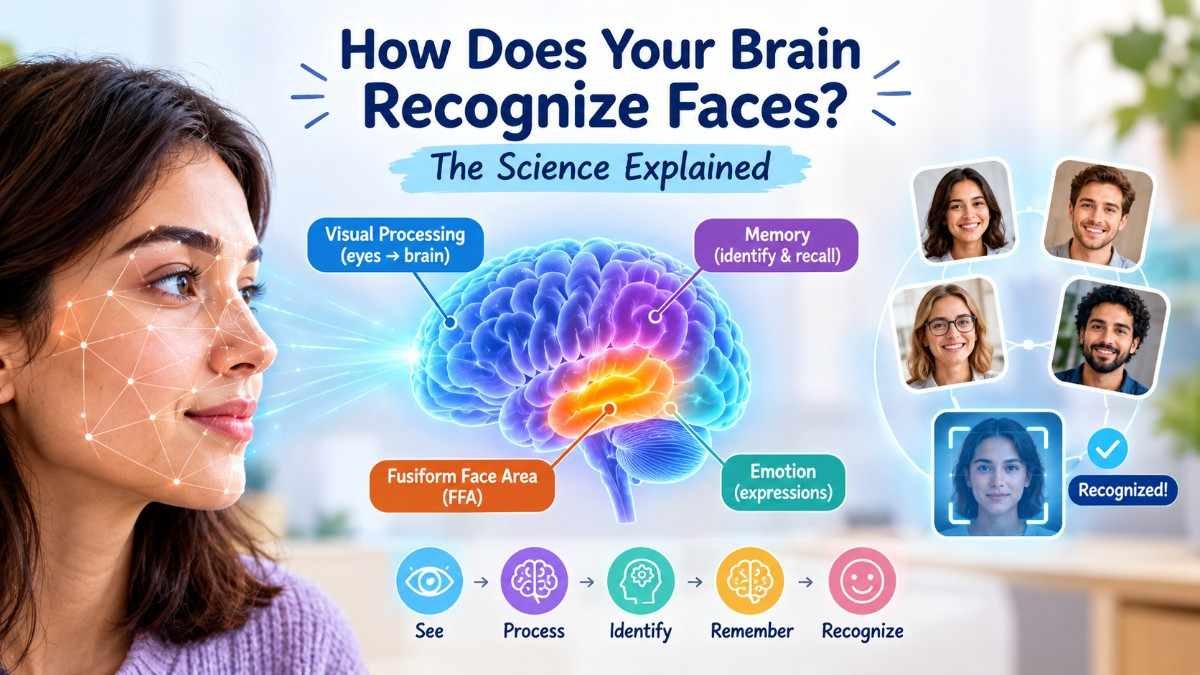
Have you ever recognized a friend from across a crowded room before they even said a word? Or spotted a familiar face in a photograph and instantly remembered the person’s name?
Your brain can recognize thousands of familiar faces, often in just a fraction of a second. It can notice small differences in eyes, facial shape, expressions, and other features to help you identify people you know.
But how does your brain accomplish this so quickly? Does it remember every face like a photograph, or does it use a more complicated process?
The answer involves several brain regions working together to process visual information, identify facial patterns, connect faces with memories, and recognize emotions.
The human brain does many fascinating things beyond recognizing faces. For example, have you ever wondered why we get goosebumps? Like face recognition, goosebumps show how the brain and nervous system respond to different situations.
In this article, we will explore how your brain recognizes faces, why some faces are easier to remember than others, and what happens when someone has difficulty recognizing familiar people.
How Does Your Brain Recognize Faces?
How Does Your Brain Recognize Faces: Your brain recognizes faces through a process called face perception. It analyzes visual information from your eyes and uses specialized brain networks to help identify facial features, expressions, and familiar people.
When you look at someone’s face, your brain processes several types of information, including:
- The shape and arrangement of facial features.
- The distance between the eyes and the shape of the nose and mouth.
- Skin tone, hair, and other visual details.
- Facial expressions and movements.
- Memories and information associated with the person.
Your brain combines these details to help determine whether you are looking at someone familiar.
Face recognition is not handled by just one part of the brain. It involves a network of regions that communicate with one another to interpret what you see.
1. Your Eyes Capture the Face
How Does Your Brain Recognize Faces: Face recognition begins when light reflected from a person’s face enters your eyes.
The light passes through the eye’s optical structures and reaches the retina, a light-sensitive layer at the back of the eye.
Specialized cells in the retina convert light into electrical signals. These signals travel through the optic nerve toward the brain, where visual information is processed.
At first, your brain analyzes basic visual properties such as edges, contrast, shapes, and patterns.
As the information moves through visual processing pathways, your brain builds a more detailed representation of what you are seeing.
This includes the arrangement of facial features and the overall structure of the face.
Your brain can perform much of this processing very quickly, allowing you to recognize familiar people without consciously examining every feature.
2. Your Brain Has Specialized Face-Processing Regions
How Does Your Brain Recognize Faces: One of the most fascinating discoveries in neuroscience is that certain brain regions respond strongly to faces.
An important example is the fusiform face area (FFA), located in the fusiform gyrus on the underside of the brain.
Research suggests that this region plays an important role in processing faces, particularly information useful for distinguishing one face from another.
However, it is not the only region involved in face perception. Other areas of the visual system help process facial details, expressions, movement, and gaze direction.
Different parts of this network contribute to different aspects of recognizing a face.
For example, your brain may process the relatively stable structure of someone’s face while also detecting a temporary expression, such as a smile or frown.
These processes work together to help you understand who you are looking at and what their face may be communicating.
3. Your Brain Recognizes Patterns, Not Just Individual Features
How Does Your Brain Recognize Faces: You might think that recognizing someone means identifying their eyes, nose, and mouth separately.
In reality, face recognition relies heavily on the relationships among facial features.
Your brain processes the overall arrangement of the face, including how the eyes, nose, mouth, and other features fit together.
This type of processing is often called configural processing.
For example, two people might have similar eye colors, hairstyles, and nose shapes. Yet the overall arrangement of their facial features can help you distinguish between them.
Your brain also processes individual features, but the combination of those features provides important information about identity.
This is one reason a photograph can look unfamiliar when a face is distorted or when the usual relationships among its features are changed.
Your brain is not simply checking a list of facial characteristics. It is building and comparing complex visual patterns.
4. Your Brain Connects Faces With Memories
How Does Your Brain Recognize Faces: Recognizing a face and remembering who the person is are related but different processes.
You might recognize someone’s face as familiar without immediately remembering their name. This happens because identifying a face and retrieving personal information about that person involve interacting brain systems.
When you see a familiar person, your brain may activate memories associated with them, such as their name, voice, occupation, or experiences you have shared.
Memory-related regions and other brain networks help connect visual recognition with stored knowledge.
For example, you might recognize a former classmate in a grocery store but struggle to remember where you know them from. A moment later, you may recall that you attended school together.
Your brain has detected familiarity, but retrieving the context took a little longer.
This everyday experience shows that face recognition is closely connected to memory, attention, and the information you have learned about other people.
Memory plays an important role in recognizing familiar people. Our brains constantly process and store information from everyday experiences. Another fascinating example of how the brain works is explained in our article on why we dream and interesting facts about dreams.
5. Why Can You Recognize a Friend in a Crowd?
How Does Your Brain Recognize Faces: Recognizing someone in a crowd can be surprisingly easy, even when the person’s face is partly hidden or viewed from a different angle.
Your brain does not depend on a single perfect image of a face. Instead, it can use learned information about a person’s appearance across different situations.
You may recognize someone from their usual facial structure, hairstyle, or familiar visual patterns.
Your brain also uses context. If you see a coworker at your workplace, for example, that setting may make the person’s identity easier to recognize.
Attention matters, too. If you are actively looking for a friend at a busy event, you may be more likely to notice them than if you are distracted.
Lighting, distance, face coverings, and changes in appearance can still make recognition harder.
Your ability to recognize familiar people is therefore a combination of visual processing, memory, attention, and context.
6. Why Are Some Faces Easier to Remember Than Others?
How Does Your Brain Recognize Faces: You have probably met someone once and remembered their face for years, while forgetting another person’s appearance almost immediately.
Several factors can influence how well you remember faces.
Attention: You are more likely to remember a face when you pay attention to it during the first encounter.
Repeated exposure: Seeing someone regularly can help you build a stronger representation of their appearance.
Distinctive features: Unusual or memorable features may make a face easier to distinguish from others.
Emotional significance: Faces associated with important experiences may be easier to remember.
Context: Remembering where you met someone or what you discussed can help you retrieve the person’s identity later.
Viewing conditions: Poor lighting, a brief encounter, or seeing someone from an unfamiliar angle can make learning a face more difficult.
Face memory also varies naturally from person to person. Some people are exceptionally good at recognizing faces, while others find the task more challenging.
7. How Does Your Brain Recognize Emotions on Faces?
Your brain does more than identify who someone is. It also interprets facial expressions that may communicate emotions.
When you look at a person’s face, your brain processes changes in the eyes, eyebrows, mouth, and other facial areas.
Networks involving visual, emotional, and social-processing regions help interpret these changes.
For example, a smile may suggest happiness, while a furrowed brow may indicate concern or concentration.
However, facial expressions are not perfect indicators of what someone is feeling. The same expression can mean different things depending on the situation, culture, and individual.
Your brain combines facial information with tone of voice, body language, context, and past experience to form an impression of another person’s emotional state.
This helps explain why a brief facial expression can influence a social interaction, even before anyone speaks.
8. Why Do Faces Sometimes Look Familiar When You Do Not Know the Person?
How Does Your Brain Recognize Faces: Have you ever looked at a stranger and felt certain that you had seen them before?
This experience can occur because the brain sometimes detects similarities between a new face and previously encountered faces.
A person’s facial structure, hairstyle, expression, or overall appearance may remind you of someone you know.
Familiarity and certainty are not always the same thing. Your brain may generate a feeling of recognition without being able to identify a specific memory.
Context and attention can influence this experience, too.
You might recognize a face from a television show, an online video, or a place you visited months ago without immediately remembering the source.
Sometimes the feeling of familiarity is simply an impression rather than a reliable memory of an actual encounter.
The brain also helps us understand sensations and reactions that happen automatically. One interesting example is why yawning is contagious, which shows how a simple everyday behavior can involve complex brain processes.
9. What Is Prosopagnosia, or Face Blindness?
How Does Your Brain Recognize Faces: Some people have significant difficulty recognizing faces, even when their vision is otherwise normal.
This condition is called prosopagnosia, commonly known as face blindness.
People with prosopagnosia may struggle to recognize familiar people, including friends or family members, by their faces alone.
Depending on the individual, they may rely more heavily on other clues, such as a person’s voice, hairstyle, clothing, or walking pattern.
Prosopagnosia can be developmental, meaning it occurs without an obvious brain injury, or acquired following certain types of brain damage.
It is different from simply forgetting someone’s name or occasionally failing to recognize a person in an unexpected setting.
Researchers continue to study how face recognition works and why its effectiveness varies among individuals.
If difficulty recognizing people is new, sudden, or follows a head injury or other neurological symptoms, seek prompt medical evaluation.
10. Can You Improve Your Ability to Remember Faces?
How Does Your Brain Recognize Faces: People naturally differ in their face-recognition abilities, but paying attention to faces and their context may help you remember people more effectively.
Here are some practical strategies:
Pay attention during introductions. When meeting someone, focus on their face and listen carefully to their name.
Notice distinctive features. Observe a person’s general facial structure rather than relying only on a temporary detail such as clothing.
Connect the face with context. Remember where you met the person, what you discussed, or who introduced you.
Use the person’s name in conversation. This can help reinforce the association between their identity and your memory of the encounter.
Avoid relying entirely on photographs. Real faces change with expressions, lighting, and viewing angles, so recognizing someone in different situations is useful.
These strategies may help with remembering people, although they do not guarantee that everyone will become equally skilled at face recognition.
FAQs How Does Your Brain Recognize Faces
1. Which part of the brain recognizes faces?
Face recognition involves a network of brain regions. The fusiform face area is one important region associated with processing faces, while other visual and memory-related areas contribute to recognizing people and retrieving information about them.
2. How quickly can the brain recognize a face?
The brain can begin processing faces very rapidly, often within fractions of a second. The time required to identify a particular person depends on familiarity, attention, viewing conditions, and the complexity of the situation.
3. Why can I recognize a face but forget the person’s name?
Recognizing a face and remembering a name involve related but distinct processes. Your brain may identify someone as familiar before successfully retrieving the person’s name or the context in which you met them.
4. Why are some people better at recognizing faces?
Face-recognition ability varies naturally. Differences in attention, experience, visual processing, and memory can influence how effectively someone learns and recognizes faces.
5. What is face blindness?
Face blindness, or prosopagnosia, is a condition in which recognizing people by their faces is unusually difficult. It can occur developmentally or after certain types of brain injury.
6. Does the brain recognize familiar faces differently from unfamiliar ones?
Yes. Familiar faces can activate stored information about a person’s identity and experiences, making recognition different from processing a face you have never seen before.
7. Can the brain recognize a person without seeing their whole face?
Sometimes. People can recognize familiar individuals from partial facial information, depending on visibility, familiarity, and context. However, covering important facial features can make recognition more difficult.
8. Why do I sometimes think a stranger looks familiar?
A stranger may share features or an overall appearance with someone you have encountered before. This can create a feeling of familiarity even when you cannot identify a specific memory.
Conclusion
How Does Your Brain Recognize Faces: Your brain recognizes faces through an impressive network of visual-processing and memory systems.
Your eyes capture visual information, specialized brain regions help analyze facial patterns, and memory networks connect familiar faces with names and personal experiences. Other brain systems help interpret expressions and social signals.
This process happens so efficiently that recognizing a friend can feel almost automatic.
Yet face recognition is more complex than simply matching a photograph. It depends on attention, experience, context, and the way your brain processes relationships among facial features.
The next time you recognize someone in a crowded room, remember that your brain is carrying out a remarkable task: turning a pattern of light into a meaningful identity.
The human body and brain are full of surprising facts that we experience every day. If you enjoy learning about these mysteries, explore our articles on why we get brain freeze and why we get hiccups. These everyday experiences reveal just how interesting the human body can be.
About the Author
Hitasha is a content writer at Trendyopedia who enjoys exploring science, psychology, human behavior, and fascinating everyday facts. Her goal is to explain complex topics in simple, engaging language that readers can easily understand.
Disclaimer: This article is for informational and educational purposes only. It is not a substitute for professional medical advice, diagnosis, or treatment.
Sources and References
2 thoughts on “How Does Your Brain Recognize Faces? The Science Explained”