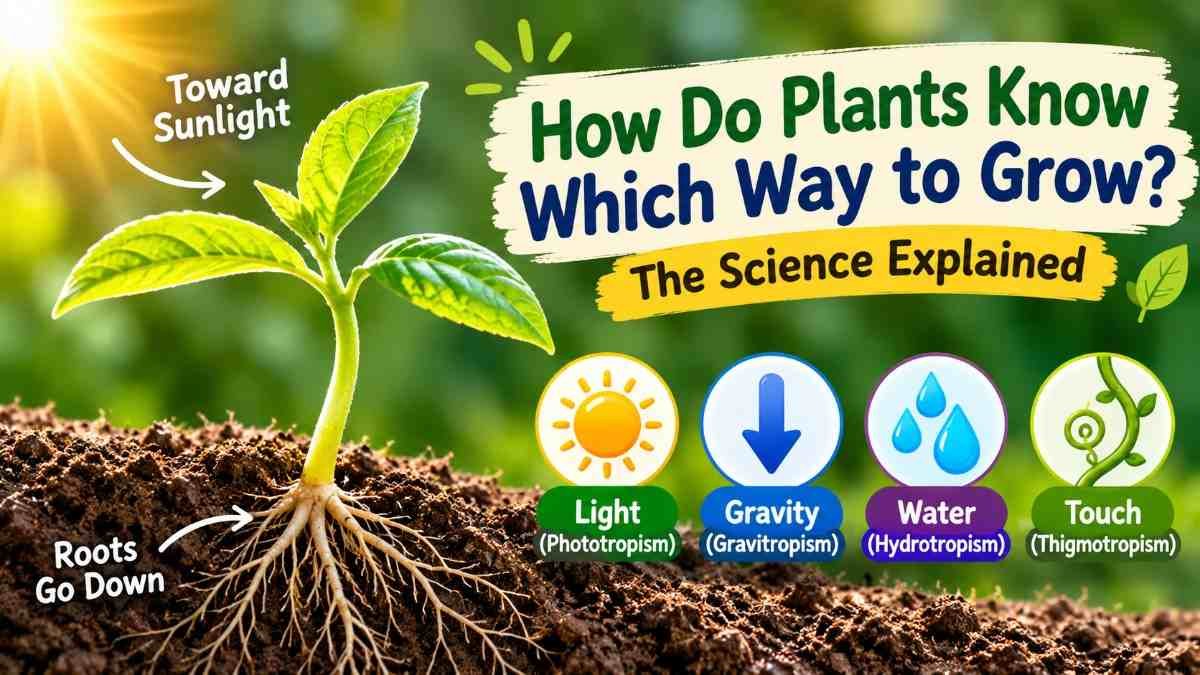
Have you ever noticed how a plant near a window slowly bends toward sunlight? Or wondered why roots grow downward into the soil while stems usually grow upward?
It almost looks as if plants know exactly which direction they should go. But plants do not have eyes, brains, or a nervous system like humans and animals. So how do they know which way to grow?
The answer is surprisingly fascinating. Plants can sense environmental signals such as light, gravity, water, and touch. They use these signals to adjust their growth and move toward conditions that help them survive.
Scientists call these responses tropisms. They allow plants to grow in useful directions without needing to move from one place to another.
Plants are fascinating because they can respond to their surroundings without having a brain or eyes. Understanding how plants grow can also make gardening more interesting. If you enjoy growing plants at home, check out our guide on How to Start a Small Herb Garden to learn how to grow your own herbs.
In this article, we will explore how plants respond to sunlight, gravity, water, and touch, why roots grow downward, and how a tiny seedling can find its way toward the light.
How Do Plants Know Which Way to Grow?
Plants use specialized cells and chemical signals to detect changes in their surroundings. These signals help them adjust how quickly different parts of their stems and roots grow.
For example, when light comes from one side, a plant stem may bend toward it. When a seed begins growing underground, its roots generally grow downward while its shoot grows upward.
Plants respond to several environmental factors, including:
- Light: Helps shoots grow toward a useful light source.
- Gravity: Helps roots grow downward and shoots grow upward.
- Water: Guides root growth toward areas with available moisture.
- Touch: Influences how climbing plants attach to nearby objects.
- Temperature and other environmental conditions: Affect the timing and pattern of growth.
These responses help plants find resources, support their structure, and adapt to their environment.
1. Plants Grow Toward Sunlight Through Phototropism
How Do Plants Know Which Way to Grow: One of the most noticeable plant behaviors is the way stems bend toward sunlight.
This response is called phototropism.
Phototropism occurs when a plant changes its growth direction in response to light. Many plant shoots show positive phototropism, meaning they grow toward a light source.
But how does a plant detect light without eyes?
Plants contain light-sensitive proteins called phototropins. These proteins help detect blue light and trigger responses that influence plant growth.
When light comes from one side, a growth-regulating hormone called auxin becomes distributed unevenly in the shoot.
In many young stems, more auxin accumulates on the shaded side. Auxin encourages cells on that side to elongate more than cells on the brightly illuminated side.
As the shaded side grows faster, the stem bends toward the light.
This is why a houseplant placed near a sunny window may gradually lean in that direction.
Interesting fact: Plants do not need to move their entire bodies to reach sunlight. They can change the direction of growth in specific parts of their stems.
Sunlight plays an important role in nature, not only by helping plants grow but also by creating beautiful natural phenomena. One fascinating example is a rainbow, which forms when sunlight interacts with water droplets. Discover the science behind Why Do Rainbows Have Seven Colors? in our interesting facts guide.
2. Gravity Tells Roots to Grow Downward
How Do Plants Know Which Way to Grow: Have you ever wondered how roots know which direction is down, even when a seed is planted sideways?
The answer is a process called gravitropism, also known as geotropism.
Gravitropism is a plant’s growth response to gravity.
Roots usually show positive gravitropism because they grow in the direction of gravity. Shoots generally show negative gravitropism because they grow against gravity.
Specialized cells in plants contain tiny, dense structures called statoliths. These structures are associated with sensing gravity and help the plant determine its orientation.
In root cells, statoliths can settle toward the direction of gravity. This helps trigger chemical signaling that changes auxin distribution.
In many roots, a higher concentration of auxin slows cell elongation. This causes cells on one side to grow more slowly than those on the opposite side, helping the root bend downward.
Shoots respond differently. Auxin generally promotes elongation in young shoot tissues, allowing the shoot to bend upward.
This coordinated response helps roots explore the soil while shoots move toward the surface.
Interesting fact: Even if you place a germinating seed on its side, its root and shoot can gradually adjust their growth directions in response to gravity.
3. Plants Can Sense Water in the Soil
How Do Plants Know Which Way to Grow: Water is essential for plant survival. It supports photosynthesis, transports nutrients, and helps maintain the structure of plant cells.
But how do roots find water underground when they cannot see it?
Plants can respond to moisture gradients through a process called hydrotropism.
Hydrotropism is the growth response of a plant toward or away from water or moisture.
Roots can respond to differences in water availability in the surrounding soil. When moisture is unevenly distributed, root growth may adjust toward areas with more available water.
This response can help plants improve their access to moisture.
However, root growth is influenced by several factors at once, including gravity, soil conditions, nutrients, and physical obstacles.
For example, a root may encounter dry soil in one direction and a wetter area nearby. Its growth response can help it explore the more favorable region.
Hydrotropism is particularly interesting because it shows that plants can respond to conditions hidden beneath the soil surface.
4. Climbing Plants Use Touch to Find Support
How Do Plants Know Which Way to Grow: Have you ever watched a cucumber vine, pea plant, or climbing plant wrap itself around a stick or fence?
This behavior is related to a response called thigmotropism.
Thigmotropism is a plant’s growth response to physical contact.
Some climbing plants have special structures called tendrils. These thin, flexible structures help them attach to nearby objects.
When a tendril touches a support, the contact can trigger changes in growth on different sides of the structure. Uneven growth causes the tendril to bend and curl around the object.
This allows climbing plants to use nearby structures for support rather than developing thick, self-supporting stems.
Thigmotropism can also be observed in other plant structures that respond to physical contact.
Interesting fact: A pea plant does not need to see a fence or stick. Its tendrils can respond to physical contact and grow around the support.
5. Auxin Helps Control the Direction of Plant Growth
How Do Plants Know Which Way to Grow: One of the most important chemicals involved in plant growth is auxin.
Auxin is a plant hormone that helps regulate cell elongation, development, and responses to environmental signals.
It plays a major role in phototropism and gravitropism.
For example, when a young stem receives light from one side, auxin can become unevenly distributed. This difference in auxin levels causes cells to grow at different rates, bending the stem toward the light.
Auxin also helps roots and shoots respond differently to gravity.
However, auxin is not the only hormone responsible for plant growth. Other plant hormones, including gibberellins, cytokinins, abscisic acid, and ethylene, also influence development and responses to environmental conditions.
Together, these chemical signals help plants adjust their growth to changing surroundings.
6. Plants Can Grow Around Obstacles
How Do Plants Know Which Way to Grow: Plants do not always grow in perfectly straight lines.
Sometimes a root encounters a rock, a hard patch of soil, or another obstacle underground. Instead of stopping completely, it may change direction and continue growing around the obstruction.
Roots respond to several environmental signals, including gravity, touch, moisture, and the physical properties of the soil.
These responses allow roots to explore their surroundings and find suitable places to grow.
Above the ground, stems and branches can also adjust their direction as they develop around nearby objects.
This flexibility helps plants adapt to the space available to them.
It is not that plants consciously decide where to go. Their growth patterns change in response to signals from the environment.
7. Why Do Some Plants Close Their Leaves When Touched?
How Do Plants Know Which Way to Grow: Not every plant response involves slow growth.
Some plants can move their leaves or other structures relatively quickly when touched.
A famous example is the sensitive plant, scientifically known as Mimosa pudica.
When its leaves are touched, they can fold inward, and the leaf stalk may droop.
This movement happens because of changes in water pressure inside specialized plant cells, particularly in structures called pulvini.
The process is known as a rapid nastic movement rather than a tropism because the movement is not directed toward or away from the stimulus.
Another example is the Venus flytrap, which closes its trap when suitable prey touches its sensitive trigger hairs.
These examples show that plants can produce surprisingly complex responses even without muscles or a nervous system.
8. Do Plants Know Where the Sun Is?
How Do Plants Know Which Way to Grow: Plants do not understand the sun in the way humans do, but they can detect light direction and respond to it.
Light-sensitive proteins help plants recognize different wavelengths and changes in light conditions.
In addition to phototropins, plants use other light receptors, including phytochromes and cryptochromes.
These receptors help plants respond to:
- The direction of light.
- The amount of available light.
- Changes between daylight and darkness.
- Seasonal changes in day length.
- Different colors or wavelengths of light.
These signals help regulate processes such as seed germination, stem growth, flowering, and leaf development.
Some plants also track daily light patterns through their internal biological clocks.
This is why light does much more than simply provide energy for photosynthesis. It also acts as an important environmental signal that guides plant development.
9. Can Plants Grow in Space Without Gravity?
How Do Plants Know Which Way to Grow: This is one of the most interesting questions in plant science.
If gravity helps roots grow downward and shoots grow upward, what happens when plants grow in space?
Scientists have studied plant growth in microgravity environments, including aboard the International Space Station.
Without the usual directional gravity signal, plants cannot rely on normal gravitropism in the same way they do on Earth.
However, plants can still grow because they respond to other environmental signals.
Light can help guide shoot growth, while roots can respond to moisture, nutrients, and other conditions.
Space-based plant experiments help researchers understand how plants grow when familiar environmental signals change.
This research is also important for future long-duration space missions, where growing plants could help provide fresh food and support life-support systems.
10. Why Is It Important for Plants to Grow in the Right Direction?
How Do Plants Know Which Way to Grow: Growing in the right direction helps plants survive.
Each part of a plant has different jobs, and its growth direction can influence how successfully it performs those jobs.
Roots need to explore the soil: Growing downward helps many roots reach water, nutrients, and stable ground.
Shoots need access to light: Growing upward and responding to light helps stems and leaves reach brighter areas.
Climbing plants need support: Tendrils and other structures help certain plants reach sunlight without producing large, strong trunks.
Leaves need suitable positions: Their arrangement can influence how effectively they receive light for photosynthesis.
Together, these responses help plants make the most of their surroundings.
Without these growth responses, plants would have a much harder time finding resources and adapting to changes in their environment.
FAQs How Do Plants Know Which Way to Grow
1. How do plants know which direction to grow?
Plants detect environmental signals such as light, gravity, moisture, and touch. Specialized cells, light-sensitive proteins, and plant hormones help them adjust their growth direction.
2. Why do plant roots grow downward?
Roots generally grow downward because of positive gravitropism. Specialized cells help detect gravity and trigger changes in hormone distribution that guide root growth.
3. Why do plants bend toward sunlight?
Plants bend toward light through phototropism. Light-sensitive proteins help trigger changes in auxin distribution, causing cells on the shaded side of young stems to grow faster.
4. Do plants have a brain?
No. Plants do not have a brain or nervous system like animals. Instead, they use chemical signals, specialized cells, and electrical signaling to coordinate different responses.
5. What is auxin in plants?
Auxin is a plant hormone that regulates several growth processes, including cell elongation, root development, and responses to light and gravity.
6. Can plants grow without sunlight?
Some plants can survive for a limited time without direct sunlight, and certain plants can grow under artificial lighting. However, most green plants need an appropriate light source for photosynthesis and healthy long-term growth.
7. What is phototropism in simple words?
Phototropism is the way a plant grows in response to light. For example, a young plant stem may bend toward a nearby window.
8. Can plants grow without gravity?
Yes. Plants can grow in microgravity environments, although their growth patterns may change. They can still respond to light, moisture, and other environmental signals.
Conclusion
How Do Plants Know Which Way to Grow: Plants may not have brains, eyes, or a nervous system like humans, but they are surprisingly good at sensing their surroundings.
They use light-sensitive proteins, hormones such as auxin, and specialized cells to respond to sunlight, gravity, water, and physical contact.
These responses are known as tropisms, and they help explain why stems grow toward light, roots grow downward, and climbing plants wrap around nearby supports.
The next time you see a plant bending toward a sunny window or a tiny seedling pushing through the soil, remember that a fascinating system of biological signals is guiding its growth.
Plants do not need to think about which way to grow. Their biology helps them respond to the world around them.
Water is essential for plant growth, but it also plays an important role in the development of fruits and other natural foods. Honey is another fascinating example of a natural product with interesting properties. Learn more in our article Why Does Honey Stay Liquid or Turn Crystallized?.
1 thought on “How Do Plants Know Which Way to Grow? The Science Behind Plant Growth”