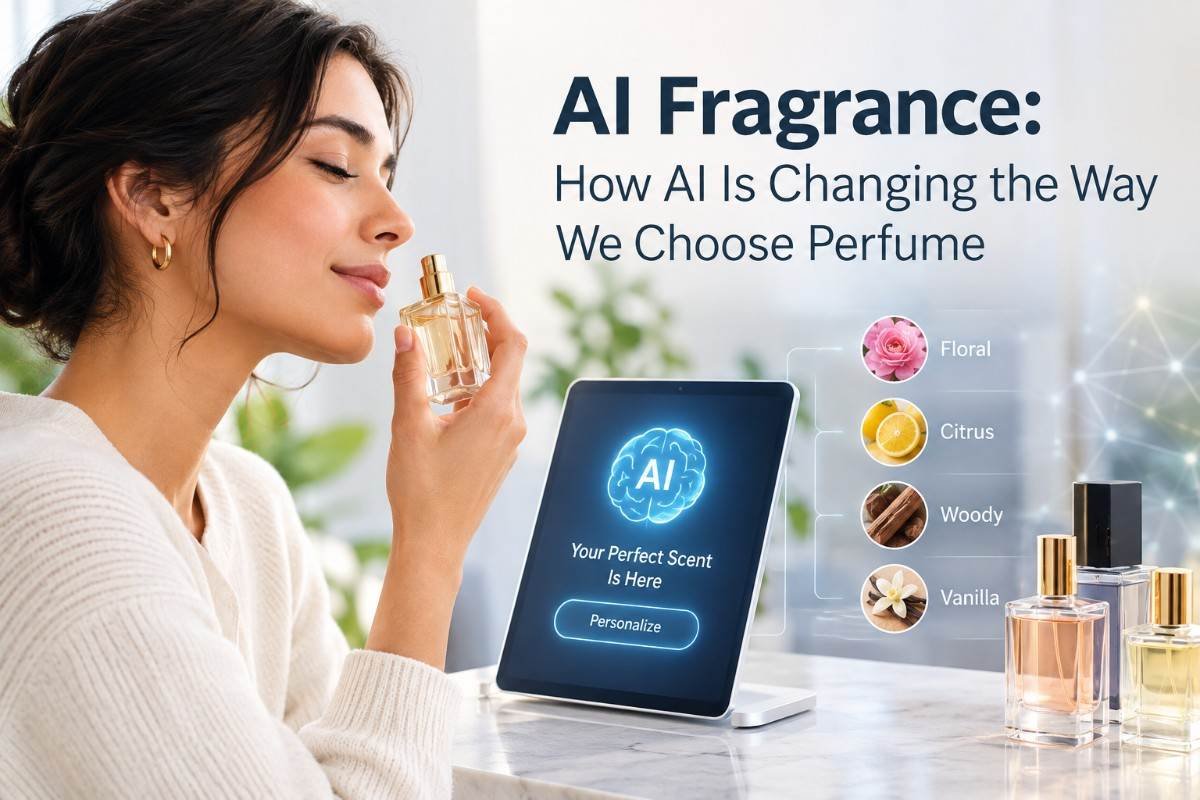
Choosing a perfume used to mean visiting a fragrance counter, testing several bottles, reading scent notes, and hoping you found something that matched your personality.
Now, AI fragrance technology is changing that experience.
Artificial intelligence is increasingly being used to analyze fragrance preferences, understand consumer feedback, suggest scent combinations, support perfumers, and create more personalized fragrance recommendations. Major fragrance companies are already using AI and data-driven tools in parts of the fragrance creation process.
This doesn’t mean artificial intelligence is replacing the traditional art of perfumery. Instead, AI is becoming another tool that can help perfumers, fragrance brands, and consumers navigate an incredibly complex world of scents.
So, what exactly is an AI fragrance, how does the technology work, and could AI eventually help you find a perfume that feels uniquely “you”?
Let’s explore the growing AI fragrance trend.
AI fragrance is part of the wider shift toward personalized beauty, much like AI-Personalized Skincare, where technology is being used to create more individualized beauty recommendations.
What Is AI Fragrance?
AI fragrance refers to the use of artificial intelligence, machine learning, consumer data, neuroscience, and digital tools in fragrance discovery, development, personalization, or recommendation.
AI can be used to identify patterns in fragrance preferences and consumer responses. In professional fragrance development, algorithms can also help analyze ingredients and suggest combinations that a perfumer might explore.
For example, IFF says its digital scent-design tools use consumer and neuroscience data to help perfumers understand ingredient synergies and develop fragrances with greater personalization.
The technology can therefore appear at different stages:
- Choosing a perfume
- Understanding scent preferences
- Recommending fragrance profiles
- Creating fragrance formulas
- Analyzing consumer feedback
- Testing potential scent combinations
- Developing new fragrance concepts
- Personalizing fragrance experiences
In simple terms, AI is helping turn fragrance discovery from a largely trial-and-error process into a more data-informed experience.
Why Is AI Entering the Fragrance Industry?
AI Fragrance: Perfume is unusually difficult to describe.
People might say they want something “fresh,” “clean,” “warm,” “sexy,” “cozy,” or “luxurious,” but these words can mean different things to different people.
There are also thousands of fragrance combinations, ingredients, concentrations, and scent families to consider.
AI can process much larger datasets than an individual consumer could realistically examine.
IFF, for example, says its fragrance work combines AI, data, consumer insights, and creativity to support perfumers.
Givaudan has also developed AI-powered tools including Carto and Myrissi to support fragrance creation and understand consumer responses to scent.
This makes AI particularly interesting for an industry where both science and creativity matter.
How Does AI Fragrance Technology Work?
AI fragrance systems can work in several different ways depending on the technology being used.
1. AI Analyzes Your Preferences
Imagine answering questions such as:
- Do you prefer floral or woody fragrances?
- Do you like sweet scents?
- Do you prefer fresh or warm perfumes?
- Which perfumes have you enjoyed previously?
- Do you want something for daytime or evening?
- Do you prefer subtle or noticeable fragrances?
An AI system can use this information to identify patterns and recommend fragrance profiles.
Some systems can combine preference information with larger datasets to generate more targeted recommendations.
2. AI Studies Consumer Data
Fragrance companies can analyze consumer feedback to understand which scent characteristics people respond positively to.
IFF’s ScentChat, launched in 2025, uses artificial intelligence and natural-language processing to analyze real-time consumer feedback and generate insights for fragrance creators.
This creates a feedback loop:
Consumer feedback → AI analysis → fragrance insights → product development
Instead of relying only on traditional surveys, companies can use digital tools to process consumer language and preferences at scale.
3. AI Helps Perfumers Explore Ingredients
Creating a fragrance can involve enormous numbers of possible ingredient combinations.
AI can help narrow down possibilities and identify combinations worth testing.
Givaudan’s Carto is an AI-powered tool designed to help perfumers explore fragrance formulas and work with ingredients more efficiently. The company describes it as a support tool for perfumers rather than a replacement for their creative role.
This is one of the most important points about AI fragrance technology:
AI can assist the creative process without becoming the creative process itself.
AI Is Not Replacing the Perfumer
AI Fragrance: The idea of a computer completely replacing a perfumer sounds futuristic, but the current industry examples show a more collaborative approach.
Givaudan describes Carto as a digital support system that helps perfumers experiment and handle repetitive tasks while keeping the perfumer’s creative role central.
IFF similarly describes its technology as a combination of AI, data, and creativity.
A fragrance is not simply a mathematical formula.
Scent can be connected to:
- Memory
- Emotion
- Culture
- Personal experiences
- Expectations
- Identity
- Context
Two people can smell the same fragrance and have completely different reactions.
That human element makes the role of the perfumer and consumer especially important.
AI Can Help Personalize Fragrance Choices
One of the most interesting possibilities is personalized perfume discovery.
Instead of recommending a fragrance based only on broad categories such as “floral” or “woody,” AI systems can potentially combine several types of information.
For example:
Your preferences + previous choices + scent characteristics + consumer data = personalized recommendations
The result could be a fragrance-shopping experience that feels more like a personalized recommendation engine than traditional browsing.
L’Oréal has also explored technology that connects fragrance preferences with emotional responses. In a 2022 partnership with Emotiv, L’Oréal described a system combining neurotechnology, scents, and algorithms to personalize fragrance choices.
AI and the Connection Between Scent and Emotion
Fragrance is strongly associated with emotions and memories, which makes personalization particularly interesting.
Givaudan’s Myrissi technology uses AI to connect fragrance perceptions with colors and emotional responses. The company says the system was developed using more than 25,000 consumer tests and academic research involving brain imagery and AI.
This illustrates a broader trend:
Fragrance is increasingly being treated as an experience rather than simply a pleasant smell.
Brands can explore questions such as:
- What does this scent make people feel?
- Which colors do consumers associate with it?
- Which emotional qualities are connected with particular scent profiles?
- How can fragrance communicate a mood or identity?
AI can help organize and analyze these complex relationships.
Fragrance is closely connected to memories and emotions, which is one reason the Nostalgia Trend has become an interesting part of modern lifestyle and beauty culture.
AI Fragrance and the Rise of Mood-Based Perfume
Another potential development is choosing fragrance according to mood or occasion.
Instead of asking:
“What perfume do you like?”
a fragrance recommendation system might ask:
“How do you want to feel today?”
You might want something:
- Energizing
- Calm
- Fresh
- Romantic
- Cozy
- Confident
- Clean
- Mysterious
This approach could make fragrance discovery more intuitive for people who don’t know perfume terminology.
Instead of understanding top notes, middle notes, base notes, and fragrance families, consumers could describe the experience they want.
AI can then help translate those preferences into potential scent profiles.
AI Fragrance Is Also Changing How Perfumes Are Created
The consumer experience is only one side of the trend.
AI is also being used behind the scenes.
IFF says its fragrance-development approach uses AI and data to predict scent preferences, identify ingredient relationships, and streamline the journey from concept to formula.
Givaudan’s Carto similarly allows perfumers to explore formulas and generate fragrance samples more efficiently.
This could potentially help fragrance companies:
- Explore more ideas
- Reduce repetitive work
- Analyze consumer preferences
- Test concepts faster
- Identify promising ingredient combinations
- Develop more personalized products
In 2025, IFF also introduced a smart dosing robot designed to accelerate fragrance sample production, showing how digital technology and automation are becoming part of the broader fragrance-development process.
AI-Powered Fragrance Companies and Innovation
The AI fragrance ecosystem is expanding beyond traditional fragrance houses.
Osmo, for example, launched Generation in 2025 and described it as an AI-powered fragrance house using what it calls “olfactory intelligence” to combine data, formulation tools, ingredients, and market intelligence.
This points toward a broader shift in the industry.
Technology companies and fragrance specialists are increasingly exploring ways to digitize parts of the scent-development process.
The long-term question is how far this technology can go.
Can AI understand why someone loves one perfume but dislikes another?
Can it predict which new fragrance a person will enjoy?
Can it create entirely new scent combinations?
Some of these possibilities are already being researched.
Can AI Actually Smell?
This is where things get especially interesting.
Humans experience scent through the biological olfactory system, but researchers and companies are exploring ways to represent smells using data.
Osmo describes its work as an attempt to digitize scent, while major fragrance companies are using databases, consumer research, neuroscience, and AI to model aspects of fragrance perception.
However, digitizing scent is not the same as giving a computer a human nose.
Smell is complicated.
A fragrance can behave differently depending on:
- Skin chemistry
- Temperature
- Humidity
- Concentration
- Individual perception
- Other products being worn
- Time since application
That means an AI recommendation can be useful, but it cannot guarantee exactly how a perfume will smell on every individual.
What Are the Benefits of AI Fragrance?
AI could offer several advantages for both consumers and fragrance professionals.
More Personalized Recommendations
AI can analyze individual preferences instead of relying entirely on generic fragrance categories.
Faster Fragrance Development
Algorithms and digital tools can help professionals explore formulas and consumer feedback more efficiently.
Easier Fragrance Discovery
People who feel overwhelmed by thousands of perfume choices may benefit from guided recommendations.
More Consumer Feedback
AI can process large amounts of consumer feedback and identify recurring patterns.
More Experimentation
Technology can help perfumers explore ingredient combinations that might otherwise take more time to investigate.
Potentially More Efficient Development
AI-assisted processes may reduce some repetitive work and help companies prioritize promising concepts.
What Are the Limitations of AI Fragrance?
AI fragrance technology is exciting, but it isn’t perfect.
Scent Is Highly Personal
A recommendation that works for one person may not work for another.
Skin Chemistry Matters
A perfume can smell different on different people, making personal testing valuable.
Data Can Have Limitations
AI systems depend on the information they are trained or designed to analyze. Incomplete or biased data can affect recommendations.
Fragrance Is Emotional
A perfume can remind someone of a person, place, holiday, or childhood memory. Those personal associations are difficult to completely capture through data.
AI Doesn’t Experience Scent Like Humans
An algorithm can analyze information about fragrances, but that doesn’t mean it experiences smell in the same subjective way a person does.
Will AI Change How We Buy Perfume?
It already has the potential to change the discovery process.
Imagine shopping for perfume online and being asked:
“Describe your ideal scent.”
You might answer:
“I want something fresh and clean for work, but not too citrusy. I like soft musk and subtle florals.”
An AI system could translate that description into fragrance characteristics and recommend options.
This could make online perfume shopping more interactive.
Instead of scrolling through hundreds of products, consumers could have a conversational discovery experience.
AI Fragrance and the Future of Personalized Beauty
The AI fragrance trend is part of a larger movement toward personalized beauty.
Technology is increasingly being used to help people find products based on individual preferences rather than one-size-fits-all recommendations.
The same broader idea can be seen in AI-powered skincare, personalized haircare, beauty diagnostics, and virtual consultations.
For example, consumers may eventually have a digital beauty profile that combines preferences across skincare, makeup, haircare, and fragrance.
This could create a much more individualized beauty-shopping experience.
How to Choose Perfume in the Age of AI
Even if an AI tool recommends a perfume, you don’t have to accept the recommendation automatically.
Use technology as a starting point rather than the final decision.
1. Know Your Favorite Scent Families
Think about whether you generally prefer:
- Floral
- Citrus
- Woody
- Amber
- Fresh
- Fruity
- Gourmand
- Musk
2. Think About When You’ll Wear It
A fragrance for the office may be different from one you want for an evening event.
3. Describe the Mood You Want
Words such as “fresh,” “cozy,” “clean,” or “warm” can help communicate your preferences to recommendation systems.
4. Test Before Buying When Possible
Digital recommendations can narrow your choices, but smelling a fragrance yourself can still be valuable.
5. Don’t Ignore Your Own Experience
If an AI recommends a fragrance that you don’t enjoy, your personal preference matters more than the algorithm’s prediction.
AI Fragrance vs. Traditional Perfume Discovery
| Traditional Perfume Shopping | AI-Assisted Fragrance Discovery |
|---|---|
| Relies heavily on sampling | Can begin with digital recommendations |
| Often uses fragrance categories | Can analyze multiple preference signals |
| Sales associates may guide choices | Algorithms can provide recommendations |
| Limited by available in-store testing | Can work with large digital catalogs |
| Personal experience remains central | Personal data can influence recommendations |
| Usually requires trial and error | May narrow choices before testing |
The two approaches don’t necessarily need to compete.
A future fragrance experience could combine AI recommendations + expert perfumers + human testing.
Is AI Fragrance Just a Trend?
AI fragrance is more than a simple social media trend because established fragrance companies are already using artificial intelligence and data-driven tools in fragrance creation and consumer research.
IFF describes AI as part of its digital scent-design process, while Givaudan has developed multiple AI-related fragrance technologies.
However, the consumer-facing side of AI perfume discovery is still developing.
That means the biggest changes may still be ahead.
As AI becomes better at interpreting natural language, consumer preferences, and sensory data, fragrance shopping could become increasingly personalized.
The Future of AI Fragrance
The future may not be about choosing between technology and traditional perfumery.
Instead, it could be about combining them.
A perfumer brings creativity, experience, cultural understanding, and artistic judgment.
AI brings data processing, pattern recognition, rapid experimentation, and personalization.
Together, they could create a new approach to fragrance development.
Imagine a future where you describe a memory, mood, favorite place, or even a color—and an AI system helps translate that description into a fragrance concept.
That idea may sound futuristic, but today’s fragrance industry is already experimenting with connections between scent, data, emotion, consumer preferences, and artificial intelligence.
FAQs
What is AI fragrance?
AI fragrance refers to the use of artificial intelligence, machine learning, consumer data, neuroscience, and digital tools in fragrance discovery, personalization, formulation, and development.
Can AI create perfume?
AI can assist with fragrance creation by analyzing data, suggesting ingredient combinations, and helping perfumers explore formulas. Human perfumers still play an important creative role in current AI-assisted fragrance development.
Can AI recommend a perfume for me?
Yes. AI-powered fragrance systems can use information about your preferences, previous choices, desired mood, and scent characteristics to generate recommendations. However, recommendations cannot guarantee that you will personally enjoy a fragrance.
Does AI replace perfumers?
Current industry examples generally position AI as a tool that supports perfumers rather than completely replacing them. Givaudan, for example, describes its Carto technology as a complement to the perfumer’s creative work.
Can AI understand fragrance preferences?
AI can identify patterns in consumer data and feedback and use those patterns to support recommendations or fragrance development. However, individual scent perception remains highly personal.
Why is AI being used in the perfume industry?
AI can help analyze large amounts of consumer and fragrance data, explore ingredient combinations, process feedback, and support more personalized fragrance development.
Will AI make perfume shopping easier?
It could. AI may help consumers narrow down a large number of options based on their preferences before they test or purchase a fragrance.
Conclusion
AI fragrance is changing the relationship between technology, perfumery, and personalization.
From helping perfumers explore new formulas to analyzing consumer preferences and creating more personalized recommendations, artificial intelligence is becoming an increasingly important tool in the fragrance industry.
But perfume is still deeply human.
Our memories, emotions, skin chemistry, culture, and personal experiences all influence how we experience scent. AI can analyze patterns and make suggestions, but the final connection with a fragrance remains personal.
The most interesting future may therefore be a combination of AI intelligence and human creativity—technology helping us discover scents while perfumers continue to bring artistry and emotion to the bottle.
As technology becomes increasingly integrated into beauty routines, some consumers are also exploring Digital Detox Trends and looking for ways to create more intentional offline experiences.
About the Author
Hitasha is a beauty, wellness, and lifestyle writer at Trendyopedia. She explores emerging beauty trends, fragrance innovations, skincare, wellness, and technology to create simple, informative, and easy-to-understand content for readers.
Disclaimer: This article is for informational purposes only. AI fragrance recommendations are not guaranteed to match individual preferences. Fragrance choices are personal, and readers should evaluate products and ingredients according to their own needs and preferences.