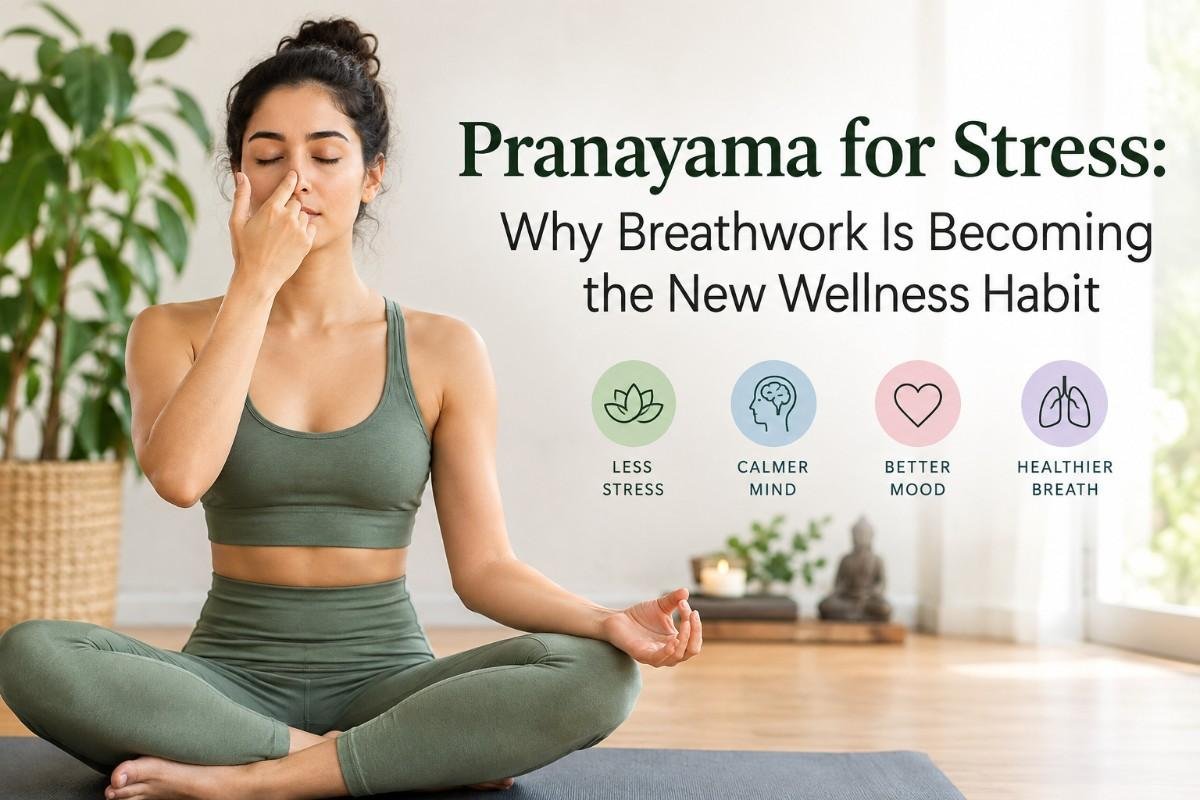
Pranayama for Stress: Stress has become part of everyday life for many people. Busy schedules, work pressure, constant notifications, screen time, and difficulty switching off can make it challenging to slow down.
One wellness practice receiving renewed attention is pranayama for stress. Pranayama refers to traditional yogic breathing practices that involve consciously controlling or observing the breath.
Unlike some complicated wellness routines, breathing practices require little equipment and can often be practiced in a quiet space at home.
Research on breathing and relaxation techniques suggests that slow, controlled breathing may help promote relaxation and reduce perceived stress. However, the evidence varies depending on the technique and the people being studied, so pranayama should be viewed as a complementary wellness practice rather than a replacement for professional care.
If you’re looking for other gentle ways to manage everyday stress, Yoga for Anxiety explores simple yoga practices that can be incorporated into a regular wellness routine.
What Is Pranayama?
Pranayama is a traditional component of yoga involving conscious regulation of breathing.
The word is commonly associated with yogic breath control, and different pranayama techniques use different breathing patterns, speeds, pauses, and levels of concentration.
Some practices emphasize slow breathing, while others use more active or rapid breathing. Because these techniques are not identical, their effects should not automatically be considered the same.
In modern wellness routines, gentle pranayama is often practiced alongside yoga, meditation, stretching, or relaxation exercises.
The National Center for Complementary and Integrative Health (NCCIH) notes that yoga commonly incorporates breathing techniques called pranayama along with physical postures and meditation.
Why Is Pranayama for Stress Trending?
Pranayama for Stress: Breathwork has become increasingly visible in wellness culture because it is simple, portable, and doesn’t require expensive equipment.
People can practice gentle breathing:
- At home
- During a work break
- Before meditation
- After a yoga session
- Before bedtime
- During a quiet morning routine
Another reason is growing interest in nervous-system-focused wellness. Rather than adding another intense workout to the day, some people are looking for slower practices that encourage relaxation and body awareness.
Research is also helping explain why controlled breathing is being studied as a stress-management technique. A systematic review of breathing practices found evidence that several breathing interventions were associated with improvements in stress and anxiety measures, although researchers noted that techniques and study designs varied.
How Can Pranayama Help With Stress?
Pranayama for Stress: Stress activates the body’s normal “fight-or-flight” response. During stressful situations, breathing and heart rate can increase, muscles may tense, and the body becomes more alert.
Relaxation techniques work in the opposite direction by encouraging a calmer physiological state.
NCCIH explains that deep breathing and other relaxation techniques may help produce the relaxation response. It also reports that slow, deep breathing may modestly reduce blood pressure and cortisol levels, although research is still developing.
1. It Encourages Slower Breathing
When people are stressed, their breathing can become faster or shallower.
Gentle, slow breathing gives you an opportunity to deliberately change your breathing pattern and focus attention on the present moment.
2. It Can Promote Relaxation
Breathing exercises are often used as relaxation techniques because they combine controlled breathing with focused attention.
This can create a short break from external distractions.
3. It May Reduce Perceived Stress
Research suggests that certain breathing practices may reduce self-reported stress.
A 2026 study involving moderately stressed students found that five minutes of slow-paced breathing was associated with lower perceived stress compared with control periods in daily life. The researchers also observed changes in heart-rate variability during and after the breathing sessions.
4. It Can Be Practiced Almost Anywhere
One of the biggest advantages of breathing exercises is accessibility.
You don’t need a yoga mat, weights, gym membership, or special clothing. A few quiet minutes may be enough to practice a gentle breathing exercise.
Simple Pranayama for Stress: 5 Beginner-Friendly Practices
Pranayama for Stress: If you’re new to pranayama, start with comfortable, gentle breathing rather than advanced techniques.
1. Diaphragmatic Breathing
Diaphragmatic breathing, sometimes called belly breathing, focuses on allowing the diaphragm to do more of the work during breathing.
How to try it:
- Sit comfortably or lie down.
- Relax your shoulders.
- Place one hand on your chest and another on your abdomen.
- Breathe in gently through your nose.
- Allow your abdomen to expand naturally.
- Exhale slowly without forcing the breath.
- Continue for a few minutes.
You should not force your abdomen outward or try to take unusually large breaths.
NCCIH notes that studies of diaphragmatic breathing provide preliminary evidence that it may help reduce stress.
2. Slow Breathing
Slow-paced breathing is one of the simplest ways to introduce breathwork into your routine.
Try breathing slowly and comfortably while keeping your attention on the sensation of inhaling and exhaling.
There is no need to make the breath extremely slow.
A systematic review of breathing practices found that effective interventions commonly involved sessions lasting at least five minutes and repeated practice, although the ideal approach can vary.
3. Equal Breathing
Equal breathing involves making the inhale and exhale approximately similar in length.
For example:
Inhale gently → exhale gently → repeat.
The goal isn’t to count perfectly. Instead, focus on creating a comfortable, steady rhythm.
If counting makes you uncomfortable, simply return to natural breathing.
4. Alternate-Nostril Breathing
Pranayama for Stress: Alternate-nostril breathing, traditionally known as Nadi Shodhana, is a familiar yogic breathing practice.
A simple version involves gently breathing through one nostril and then the other in an alternating pattern.
Because the technique involves coordinating breathing with the hands, beginners may find it easier to learn from a qualified yoga instructor.
Avoid forcing the breath or holding it for long periods.
5. Gentle Breath Awareness
You don’t always need a complicated pranayama technique.
Sit comfortably and simply notice:
- How the breath feels
- Whether you’re breathing quickly or slowly
- The movement of your abdomen
- The sensation of air entering and leaving your nose
If your mind wanders, gently bring your attention back to your breathing.
This can be a simple starting point for people who find formal breathwork intimidating.
A 5-Minute Pranayama for Stress Routine
Pranayama for Stress: If you’re looking for an easy routine, try this beginner-friendly sequence.
Minute 1: Sit comfortably and notice your natural breathing.
Minute 2: Begin gentle diaphragmatic breathing.
Minute 3: Continue with slow, comfortable breaths.
Minute 4: Try equal, relaxed inhalations and exhalations.
Minute 5: Stop counting and simply observe your natural breathing.
The goal is relaxation—not perfect technique.
If you feel uncomfortable, dizzy, breathless, or anxious, stop and return to normal breathing.
When Is the Best Time to Practice Pranayama?
There isn’t one universally proven “best” time for everyone.
You can experiment with different parts of your day.
Morning
Morning breathwork can become a quiet transition between waking up and starting the day’s activities.
During a Work Break
A few minutes of slow breathing may provide a useful pause between tasks.
After Exercise
Pranayama for Stress: Gentle breathing can help you transition from physical activity into a calmer period.
Before Bed
Slow breathing is also being studied as a possible relaxation practice before sleep. A 2026 systematic review examined slow breathing before bedtime and found that research on sleep outcomes is promising but still limited by the number and quality of studies.
For readers interested in other relaxation practices, Yoga Nidra: The Sleep Trend Everyone Is Talking About can be a useful related topic.
Pranayama vs. Regular Deep Breathing
Pranayama for Stress: These terms are sometimes used interchangeably, but they are not exactly the same.
Deep breathing generally refers to deliberately slowing or deepening the breath as a relaxation technique.
Pranayama is a broader category of traditional yogic breathing practices that can involve different patterns, techniques, and levels of complexity.
Some pranayama practices may involve breath retention or faster breathing, so not every pranayama technique should be treated as a simple relaxation exercise.
For beginners interested specifically in stress reduction, gentle breathing practices are generally a more appropriate starting point than advanced techniques.
Can Pranayama Help With Anxiety?
Pranayama for Stress: Breathing exercises may help some people feel calmer, but they should not be presented as a cure for anxiety disorders.
Research on pranayama and mental health is growing. A 2025 systematic review and meta-analysis found potential short-term benefits of pranayama for symptoms in people with certain mental disorders, but the researchers also highlighted limitations including a small evidence base and concerns about study quality. They specifically concluded that pranayama should not replace standard treatments.
If anxiety is persistent, severe, or interfering with everyday life, speaking with a qualified healthcare professional is more appropriate than relying on breathwork alone.
Is Pranayama Safe for Beginners?
Pranayama for Stress: Gentle breathing exercises are generally considered low-risk for many healthy adults.
However, not every breathing technique is appropriate for everyone.
Some advanced practices involve:
- Rapid breathing
- Long breath holds
- Strong inhalations or exhalations
- Complex breathing ratios
These techniques may cause discomfort or other reactions in some people.
A 2025 systematic review found that adverse events were reported more often with fast breathing techniques than with slow breathing techniques.
If you’re pregnant, have a respiratory or cardiovascular condition, have a medical condition, or experience significant dizziness or breathing difficulty, discuss breathwork with a healthcare professional before trying more intensive techniques.
Common Mistakes Beginners Make
Forcing the Breath
Pranayama for Stress: Breathing should feel comfortable. Bigger or deeper breaths are not automatically better.
Holding the Breath Too Long
Beginners don’t need prolonged breath retention to practice relaxation.
Breathing Too Quickly
Fast breathing can make some people feel lightheaded or uncomfortable.
Trying Too Many Techniques
Start with one simple technique and learn how your body responds.
Expecting Instant Results
Breathing exercises may help with short-term relaxation, but they aren’t a guaranteed solution for chronic stress.
Treating Breathwork as Medical Treatment
Pranayama can complement healthy lifestyle habits, but it should not replace appropriate medical or mental-health care. NCCIH similarly advises against using relaxation techniques as a replacement for conventional medical care.
How Often Should You Practice Pranayama for Stress?
Pranayama for Stress: Consistency may be more useful than trying to practice for a long time once in a while.
You could begin with 5 minutes a day of gentle breathing and gradually adjust according to your comfort.
A 2023 systematic review of breathing practices for stress and anxiety found that several effective interventions involved repeated sessions and at least five minutes of practice, although there was considerable variation among the studies.
Think of pranayama as a small wellness habit rather than another task you have to perfect.
Pranayama and Your Existing Wellness Routine
Pranayama for Stress: Breathwork doesn’t have to exist separately from other healthy habits.
You can combine gentle pranayama with:
- Yoga
- Meditation
- Walking
- Stretching
- Journaling
- A relaxing evening routine
- Regular physical activity
- Adequate sleep
For example, you could spend five minutes practicing gentle breathing before a short yoga session.
If stress management is your primary goal. You can also learn about Nervous System Yoga: What It Means and Why It’s Trending for a broader look at mind-body practices.
What Does the Research Say About Pranayama for Stress?
Pranayama for Stress: The research is encouraging but should be interpreted carefully.
A systematic review published in 2023 examined 58 studies of breathing practices for stress and anxiety. The authors found that many interventions showed positive results, while also identifying differences in breathing techniques, duration, guidance, and study design.
A 2026 meta-analysis specifically examining yoga-based voluntary breathing among medical students also reported reductions in perceived stress and anxiety, but the researchers noted substantial variation between studies and called for more high-quality research.
This means it is reasonable to view gentle pranayama as a potentially useful stress-management tool, but stronger research is still needed to determine which techniques work best, for whom, and under what circumstances.
FAQs About Pranayama for Stress
What is pranayama for stress?
Pranayama for stress refers to gentle yogic breathing practices used to encourage relaxation and mindful awareness. Some research suggests that slow breathing techniques may help reduce perceived stress.
Which pranayama is best for stress?
There isn’t one pranayama technique proven to be best for everyone. Beginners can start with gentle, slow breathing or diaphragmatic breathing rather than advanced or fast techniques.
Can pranayama reduce stress?
Research suggests that some breathing practices may reduce perceived stress, although results vary between studies and techniques. Pranayama should be considered a complementary wellness practice rather than a medical treatment.
How long should I practice pranayama for stress?
A beginner can start with around five minutes of comfortable breathing. Research has examined a range of practice durations, so there is no universal amount that works for everyone.
Can I practice pranayama every day?
Many people incorporate gentle breathing exercises into a daily wellness routine. Start comfortably and avoid forcing your breathing.
Can pranayama help with anxiety?
Breathing exercises may help some people feel calmer, but pranayama should not replace professional treatment for an anxiety disorder.
Is pranayama safe?
Gentle breathing practices are generally considered low-risk for many healthy adults, but more intense techniques can cause discomfort in some people. Beginners should avoid forcing the breath or prolonged breath retention.
Can I practice pranayama before bed?
Gentle slow breathing may be used as part of a relaxing bedtime routine. Research into slow breathing and sleep is developing, and current evidence is not conclusive.
Do I need a yoga teacher to learn pranayama?
Simple breathing awareness and gentle breathing exercises can often be learned independently. More advanced techniques are better learned from a qualified instructor.
Can pranayama replace meditation?
No. Pranayama and meditation are related but different practices. Breathing exercises can be incorporated into meditation, yoga, or a separate relaxation routine.
Conclusion
Pranayama for stress is becoming part of modern wellness routines because it is simple, inexpensive, and easy to practice.
Gentle breathing techniques may encourage relaxation and may help reduce perceived stress for some people. Research supports continued interest in breathing practices, but the evidence is not strong enough to treat pranayama as a cure for stress, anxiety, or other health conditions.
The best approach is to start slowly, choose a comfortable technique, practice consistently, and pay attention to how your body responds.
Rather than treating breathwork as another complicated wellness trend, think of it as a simple opportunity to pause, breathe, and become more aware of the present moment.
As wellness technology continues to evolve, breathing and yoga practices are also becoming more personalized. AI Yoga: How Artificial Intelligence Is Changing Personalized Yoga looks at how technology is being used to create individualized yoga experiences.
Author
Hitasha is a wellness and lifestyle writer at Trendyopedia, creating easy-to-understand content about yoga, fitness, health trends, beauty, and everyday wellness.
Disclaimer
This article (Pranayama for Stress) is for general informational and educational purposes only. It is not medical advice and should not replace guidance from a qualified healthcare professional. If you have a medical condition, breathing difficulties, or concerns about starting a new wellness practice, consult a qualified healthcare professional first.