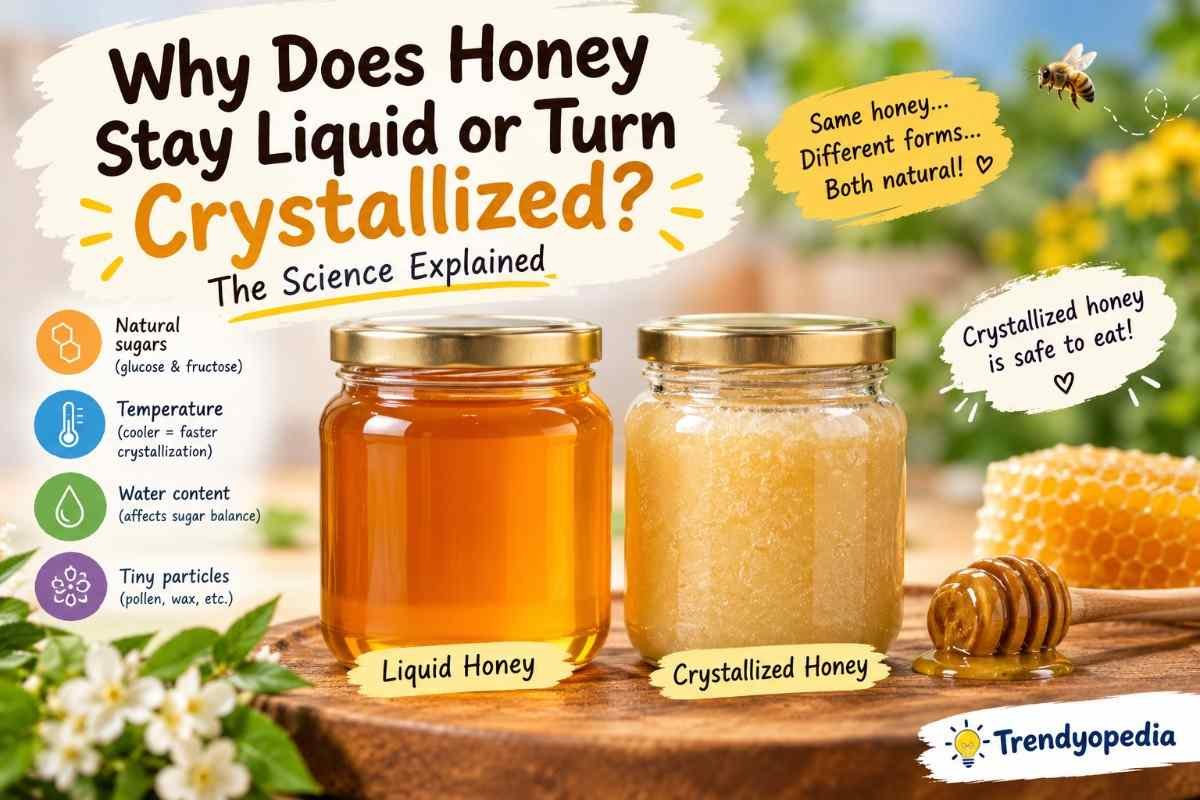
Honey is one of the few natural foods that can look completely different while still being perfectly normal. Some jars remain smooth and liquid for months, while others become thick, grainy, or almost solid. But why does honey stay liquid or turn crystallized?
The answer lies in its natural sugars, water content, temperature, and the tiny particles inside it. Honey crystallization is a natural process that does not automatically mean the honey has spoiled.
In this article, we will explore why honey crystallizes, why some honey stays liquid longer, whether crystallized honey is safe to eat, and how to return it to a smooth consistency.
If you enjoy discovering everyday science, explore our article on why rainbows have seven colors.
Why Does Honey Stay Liquid or Turn Crystallized?
Honey contains two main natural sugars: glucose and fructose. It also contains a small amount of water, along with enzymes, minerals, pollen, and other natural compounds.
Glucose is less soluble in water than fructose. When honey contains more glucose than the available water can keep dissolved, glucose can begin forming tiny crystals. As these crystals grow, the honey becomes cloudy, grainy, thick, or solid.
Fructose dissolves more easily in water, so honey with a higher fructose-to-glucose ratio generally stays liquid for longer.
This is why two jars of honey can behave differently even when both are natural and properly stored.
1. The Sugar Ratio Makes a Big Difference
The balance between glucose and fructose is one of the main reasons honey crystallizes at different rates.
Honey with relatively more glucose tends to crystallize faster. Honey with relatively more fructose tends to remain liquid longer.
For example, some clover and canola honeys crystallize relatively quickly, while many acacia honeys remain liquid for longer. However, crystallization speed varies with the exact floral source, processing, and storage conditions.
This difference is natural and does not necessarily indicate a difference in quality.
2. Temperature Affects Honey Crystallization
Temperature plays an important role in how quickly honey forms crystals.
Honey often crystallizes relatively quickly at cool room temperatures, particularly around 50–60°F (10–16°C). Crystallization may slow at warmer temperatures, although excessive heat can damage honey’s flavor, aroma, and beneficial enzymes.
Refrigeration is generally unnecessary and can encourage faster crystallization. For everyday storage, a tightly sealed jar in a cool, dry cupboard is usually a good choice.
Tip: If you want honey to remain liquid longer, store it at a stable room temperature rather than in the refrigerator.
3. Tiny Particles Can Start Crystal Formation
Natural honey may contain tiny particles of pollen, wax, or other material. These particles can provide surfaces on which glucose crystals begin to form.
Once a few crystals appear, they can encourage more glucose to crystallize. Over time, the entire jar may become thick or grainy.
Filtered honey may crystallize more slowly because some particles have been removed. However, filtration does not guarantee that honey will stay liquid indefinitely.
4. Water Content Also Matters
Honey generally contains relatively little water, which helps make it resistant to many types of microbial growth.
The amount of water also influences crystallization. When glucose is present in excess of what the water can dissolve, it can separate from the solution and form crystals.
However, water content is not the only factor. The glucose-to-fructose ratio, temperature, and presence of crystal-forming particles all affect the result.
Honey with too much moisture may also be more vulnerable to fermentation. This is one reason to keep the lid closed and avoid introducing water into the jar.
5. Why Does Some Honey Become Solid?
Why Does Honey Stay Liquid or Turn Crystallized: When glucose crystals form throughout the honey, they can create a thick structure that makes the entire jar appear solid.
This is often called crystallized or granulated honey. Its texture may range from a few crystals at the bottom of the jar to a smooth, spreadable consistency or a firm, grainy mass.
Crystallized honey can still be used in tea, cooking, baking, and on toast. Some people even prefer its creamy texture because it is easier to spread.
The color may also become lighter or more opaque as crystals form. This change is normal and does not, by itself, mean the honey has gone bad.
6. Is Crystallized Honey Safe to Eat?
Why Does Honey Stay Liquid or Turn Crystallized: Yes, crystallized honey is generally safe to eat if it has been stored properly and shows no signs of spoilage or contamination.
Crystallization is a physical change: glucose separates from the liquid portion and forms crystals. It does not automatically mean that bacteria or mold have grown in the jar.
Honey can remain usable for a long time when sealed and stored correctly. Nevertheless, moisture introduced through a wet spoon or an improperly closed lid can increase the risk of fermentation.
Look out for unusual sour or alcoholic odors, foaming, or other unexpected changes. If you suspect fermentation or contamination, do not taste the honey to test it; discard it.
Important: Honey should never be given to children younger than 12 months because of the risk of infant botulism, whether the honey is liquid or crystallized.
Honey is just one example of how ordinary things can have surprising explanations. Read our guide to why we get hiccups.
7. How to Turn Crystallized Honey Back Into Liquid
Why Does Honey Stay Liquid or Turn Crystallized: If you prefer smooth, pourable honey, you can gently warm it at home.
Follow these simple steps:
- Place the honey jar in a bowl or pot of warm water.
- Make sure the water is warm rather than boiling.
- Leave the jar in the water for several minutes.
- Stir the honey gently if you can do so safely.
- Replace the water if it cools before the crystals dissolve.
- Repeat until the honey reaches your preferred consistency.
Avoid overheating honey or placing a glass jar directly over a hot burner. If the honey is in a plastic container, check the manufacturer’s guidance before warming it.
Gentle heating helps dissolve the glucose crystals. However, honey may crystallize again later because the underlying sugar balance has not changed.
8. Does Crystallized Honey Mean It Is Pure?
Not necessarily. Natural honey commonly crystallizes, but the speed varies widely. Some genuine honey stays liquid for a long time, while other genuine honey crystallizes quickly.
Crystallization alone cannot prove that honey is pure, and a lack of crystallization does not prove that honey has been adulterated.
If you want to evaluate honey quality, consider the producer’s reputation, labeling, traceability, and appropriate laboratory testing rather than relying on appearance alone.
Interesting Facts About Honey Crystallization
Why Does Honey Stay Liquid or Turn Crystallized
- Crystallization is natural: It is a normal process involving glucose separating from honey’s liquid solution.
- Different flowers produce different honey: Floral sources influence the sugar balance and therefore the crystallization rate.
- Cloudiness can be normal: Crystals scatter light, making honey appear pale or opaque.
- Cold storage can speed up crystallization: Refrigeration is usually not needed for properly stored honey.
- Crystallized honey is useful in cooking: It can be measured and used in many recipes, although its texture may differ.
- Honey can crystallize unevenly: Crystals may appear at the bottom, along the sides, or throughout the jar.
- Warming can reverse the texture change: Gentle heat dissolves crystals, but they may form again.
FAQs Why Does Honey Stay Liquid or Turn Crystallized
Why does my honey crystallize so quickly?
Honey with a relatively high glucose content may crystallize quickly. Cooler storage conditions and tiny particles that help crystals form can also speed up the process.
Is liquid honey better than crystallized honey?
Neither form is automatically better. Both can be suitable for eating when the honey has been handled and stored properly. The main difference is texture and convenience.
Should I put honey in the refrigerator?
Refrigeration is generally unnecessary for honey and may encourage crystallization. Keep it tightly sealed in a cool, dry cupboard.
Can I eat honey that has turned white?
Honey that becomes pale or whitish may simply have crystallized. If it smells normal and has been stored properly, this color change alone is not a reason to discard it. Unusual odors, foaming, or suspected contamination require caution.
How can I prevent honey from crystallizing?
You can slow crystallization by keeping honey in a tightly sealed container at a stable room temperature and avoiding unnecessary refrigeration. However, you cannot reliably prevent crystallization forever without affecting the honey’s natural properties.
Does crystallized honey expire?
Crystallization itself is not an expiration sign. Properly stored honey can remain usable for a long time, but moisture, contamination, or fermentation can affect its condition.
Conclusion
Why Does Honey Stay Liquid or Turn Crystallized: So, why does honey stay liquid or turn crystallized? The main explanation is the natural balance of glucose and fructose, combined with temperature, water content, and tiny particles that help crystals form.
Liquid honey and crystallized honey can both be perfectly normal. If your jar becomes thick or grainy, you usually do not need to throw it away. Gentle warming can restore its pourable texture, and proper storage can help maintain its quality.
The next time you notice crystals forming in your honey, remember that this is often simply nature at work.
If you enjoy learning surprising facts, explore our articles on why we get goosebumps.
Author
Written by Hitasha | Trendyopedia
Hitasha is a content writer at Trendyopedia who enjoys exploring interesting facts, everyday science, food, lifestyle, and the fascinating reasons behind common experiences. Her goal is to make informative topics easy to understand and enjoyable for readers.
Disclaimer
This article is for general informational and educational purposes only. It is not a substitute for professional food-safety advice. Never give honey to infants under 12 months of age.
Sources and references
Include these reliable references at the end of your post:
1 thought on “Why Does Honey Stay Liquid or Turn Crystallized? The Science Explained”