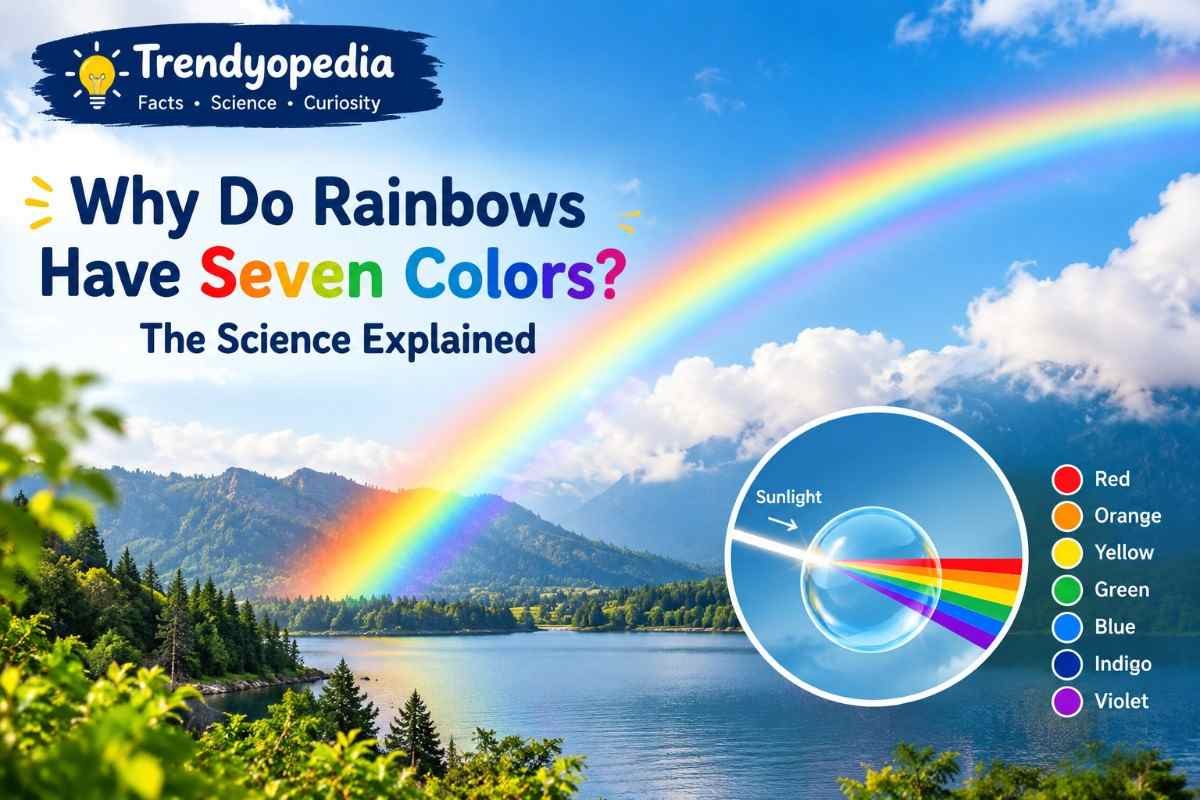
Have you ever looked at a rainbow after the rain and wondered why it has seven colors? Red, orange, yellow, green, blue, indigo, and violet appear in a beautiful sequence across the sky. But why do these colors appear in this particular order? And are there really only seven colors in a rainbow?
The answer is connected to sunlight, water droplets, and the science of light. Although sunlight looks white, it contains a mixture of visible wavelengths that can separate into different colors under the right conditions.
A rainbow is a natural example of this process. In this article, we’ll explore why rainbows are commonly described as having seven colors, how they form, why their colors appear in a particular order, and some fascinating rainbow facts you may not know.
Nature is full of fascinating scientific mysteries, from colorful rainbows to surprising reactions in the human body. For example, have you ever wondered why we sneeze in bright sunlight? This unusual reaction is known as the photic sneeze reflex.
Why Do Rainbows Have Seven Colors?
Rainbows are traditionally described as having seven colors because white sunlight separates into a continuous spectrum of visible light. The familiar seven-color classification is red, orange, yellow, green, blue, indigo, and violet.
These colors are commonly remembered using the abbreviation ROYGBIV:
- R — Red
- O — Orange
- Y — Yellow
- G — Green
- B — Blue
- I — Indigo
- V — Violet
However, a rainbow does not actually have seven sharply separated bands. Its colors blend smoothly into one another, creating many intermediate shades.
For example, the transition from red to orange includes shades that may look reddish-orange or orange-red. These colors are part of the continuous spectrum, even though they do not have separate names in the traditional seven-color list.
So, why do we count seven colors? The number seven is a traditional way of describing the rainbow, popularized by the English scientist Isaac Newton. It is a useful way to teach the color sequence, but nature does not divide the rainbow into exactly seven distinct sections.
How Does a Rainbow Form?
Why Do Rainbows Have Seven Colors: A rainbow forms when sunlight interacts with water droplets suspended in the air. This often happens when rain is falling while the Sun shines from behind the observer.
Three important processes help create the familiar rainbow.
1. Refraction: Light Bends When It Enters a Raindrop
When sunlight travels from air into a water droplet, it changes direction. This bending of light is called refraction.
Different wavelengths of light bend by slightly different amounts. As a result, the colors that make up sunlight begin to separate.
2. Reflection: Light Bounces Inside the Droplet
Some of the light reflects off the inside surface at the back of the water droplet. This reflection redirects the light toward the front of the droplet.
3. Refraction Again: Colors Separate as Light Leaves
When the light exits the droplet, it bends again. Because different wavelengths leave at slightly different angles, the colors become separated enough for us to see a rainbow.
Millions of droplets contribute light toward an observer’s eyes. Together, they create the colorful arc we see in the sky.
What Are the Seven Colors of a Rainbow?
Why Do Rainbows Have Seven Colors: Each color corresponds to a range of wavelengths within visible light. The colors follow a familiar order because different wavelengths bend by different amounts when light passes through water.
1. Red
Red is the outermost color of a typical primary rainbow. It has the longest wavelengths among the seven traditionally named colors of the visible spectrum.
Red light bends less than violet light when passing through a water droplet, helping it appear along the outer edge of the rainbow.
2. Orange
Orange appears just inside the red band. It lies between red and yellow in the traditional sequence.
Its position reflects its wavelengths, which are shorter than red’s and longer than yellow’s.
3. Yellow
Yellow is the third traditionally named color. It is often bright and easy to notice when the rainbow appears against a darker background of clouds.
The yellow band blends into orange on one side and green on the other.
4. Green
Green appears near the middle of the familiar seven-color sequence. It is one of the colors our eyes can often recognize clearly in a vivid rainbow.
Its wavelengths fall between those associated with yellow and blue.
5. Blue
Blue appears between green and indigo in the traditional sequence. Depending on the weather, background, and brightness of the rainbow, the blue region may appear more or less distinct.
6. Indigo
Indigo is traditionally described as a deep blue color between blue and violet. It is included in the familiar seven-color list.
However, indigo can be difficult to distinguish as a separate band in a natural rainbow. The colors blend together, and people may disagree about exactly where blue ends and violet begins.
7. Violet
Why Do Rainbows Have Seven Colors: Violet appears along the inner edge of a typical primary rainbow. It has the shortest wavelengths among the seven traditionally named colors.
Violet light bends more than red light as it enters and leaves water droplets, which helps explain why it appears at the opposite edge of the rainbow.
Light can produce many fascinating effects beyond the colors we see in the sky. Our bodies also respond to different surroundings in surprising ways. One example is why we get goosebumps, an automatic response associated with cold, emotions, and the nervous system.
Why Did Isaac Newton Choose Seven Colors?
Why Do Rainbows Have Seven Colors: The English scientist Isaac Newton studied how white light behaves when it passes through a glass prism in the 17th century.
His experiments showed that a prism separates white light into a spectrum of colors. Newton also demonstrated that these colors could be recombined to produce white light.
Newton popularized the classification of the spectrum into seven principal colors: red, orange, yellow, green, blue, indigo, and violet.
The choice of seven was partly influenced by the cultural importance of the number and Newton’s interest in drawing connections between colors and musical notes. It was not evidence that the spectrum naturally contains exactly seven separate colors.
Today, scientists understand that visible light forms a continuous range of wavelengths. The seven-color model remains useful for education, even though it simplifies a more complex spectrum.
Are There Really Only Seven Colors in a Rainbow?
Why Do Rainbows Have Seven Colors: No. A rainbow contains a continuous range of visible colors rather than seven isolated bands.
Human eyes detect visible light across a range of wavelengths, and our brains interpret different combinations of wavelengths as different colors. The transitions between colors are gradual.
That is why you may see turquoise between blue and green, or shades of pinkish-red and orange near the outer edge. These are not additional, sharply separated rainbow bands; they are part of the spectrum’s continuous appearance.
The number of colors someone identifies may also depend on the brightness of the rainbow, the surrounding sky, and their ability to distinguish subtle differences in color.
The traditional seven-color list is therefore a helpful description, not a strict scientific limit.
Why Do Rainbow Colors Always Appear in the Same Order?
Why Do Rainbows Have Seven Colors: The colors of a primary rainbow appear in the same general order because light of different wavelengths bends by different amounts inside water droplets.
Red light bends less, so it appears on the outer edge. Violet light bends more, so it appears on the inner edge. The remaining colors fall between them.
This consistent behavior explains why primary rainbows generally show red on top and violet on the bottom.
The sequence is not random, and it does not depend on the colors of nearby objects. It comes from the way sunlight interacts with water droplets.
Why Do We Sometimes See a Double Rainbow?
Why Do Rainbows Have Seven Colors: Sometimes a second, fainter rainbow appears above the first one. This is called a secondary rainbow.
A secondary rainbow forms when sunlight reflects twice inside water droplets before leaving them. The extra reflection changes the direction of the outgoing light and produces a second arc.
There is an important difference between the two rainbows:
- The primary rainbow usually has red on the outside and violet on the inside.
- The secondary rainbow has its colors reversed, with violet on the outside and red on the inside.
Secondary rainbows are usually fainter because some of the light is lost during the additional reflection.
When the sky is dark enough, you may also notice a darker area between the two arcs.
Why Does a Rainbow Look Like an Arc?
Why Do Rainbows Have Seven Colors: A rainbow appears as an arc because of the angles at which light from water droplets reaches your eyes.
Each droplet sends particular colors toward an observer at specific angles relative to the direction opposite the Sun. The droplets that send the right light toward your eyes form a circular pattern.
From the ground, the horizon usually hides the lower part of this circle, so we see an arc.
From an airplane or another high viewpoint, it is sometimes possible to see a much larger portion of a rainbow, including a full circle when conditions are suitable.
A rainbow is also specific to the observer’s position. Two people standing in different places may see light from different droplets, even if they appear to be looking at the same rainbow.
7 Fascinating Facts About Rainbows
1. Rainbows Are Not Physical Objects
A rainbow is an optical phenomenon rather than a solid object located at a particular distance. You cannot walk toward it and reach its end.
2. You Need the Right Sun Position
For a typical primary rainbow, the Sun is behind you and rain or water droplets are in front of you. This arrangement allows sunlight to reach the droplets and return toward your eyes.
3. A Rainbow Can Appear in Water Spray
Rain is not the only source of droplets that can create a rainbow. Waterfalls, fountains, garden sprinklers, and ocean spray may also produce rainbows when sunlight hits them at the right angle.
4. The Colors Are Not Separated by Dark Lines
The seven traditional colors blend into one another. The spectrum is continuous, so the boundaries between colors are not exact.
5. Every Observer Sees a Slightly Different Rainbow
Your position affects which droplets send rainbow light into your eyes. Someone standing beside you may see a similar rainbow formed by different droplets.
6. Moonlight Can Create a Rainbow
A moonbow is a rainbow produced by moonlight rather than direct sunlight. Moonbows are usually faint because moonlight is much weaker than sunlight, and some may appear mostly white to the human eye.
7. You Can Make a Small Rainbow at Home
On a sunny day, try using a garden sprinkler to create a fine spray of water with the Sun behind you. You may see a small rainbow in the spray. Never look directly at the Sun while doing this.
FAQs Why Do Rainbows Have Seven Colors
Why do rainbows have seven colors?
Rainbows are traditionally described as having seven colors because Isaac Newton popularized a seven-color classification of the visible spectrum. In reality, rainbow colors blend continuously into many shades.
What are the seven colors of a rainbow in order?
The traditional order is red, orange, yellow, green, blue, indigo, and violet. You can remember the sequence using ROYGBIV.
Why is red on top of a rainbow?
Red light bends less than violet light as it travels through water droplets. This makes red appear on the outer edge, which is the top of a typical primary rainbow.
Why is violet at the bottom of a rainbow?
Violet light bends more than red light inside water droplets. In a primary rainbow, this places violet along the inner edge, which appears at the bottom of the arc.
Did Isaac Newton discover the seven colors of the rainbow?
Newton’s prism experiments helped establish that white light contains a spectrum of colors. He popularized the seven-color classification, but he did not discover that nature contains exactly seven separate colors.
Can a rainbow have more than seven colors?
Yes. The spectrum contains many intermediate shades between the seven traditionally named colors. The exact number of colors people can distinguish depends on perception and viewing conditions.
Why does a double rainbow have reversed colors?
A secondary rainbow forms when sunlight reflects twice inside water droplets rather than once. This changes the direction of the outgoing light and reverses the color order.
Conclusion
Why Do Rainbows Have Seven Colors: Rainbows are beautiful examples of how light behaves in nature. Although they are traditionally described as having seven colors, their spectrum is actually continuous, with countless shades blending from one color into another.
The familiar sequence—red, orange, yellow, green, blue, indigo, and violet—comes from the way different wavelengths of sunlight bend and separate as they pass through water droplets.
The next time you see a rainbow after the rain, remember that you are witnessing a combination of sunlight, water, and the science of optics.
If you enjoy discovering the science behind everyday mysteries, you may also like learning why we get hiccups.
Sources and References
- NOAA — What Causes a Rainbow?
- NASA — Visible Light
- OpenStax — Dispersion: The Rainbow and Prisms
- Met Office — Rainbows: Optical Wonders
Author: Hitasha
Disclaimer: This article is intended for general informational and educational purposes only. The scientific explanations are simplified for general readers.
2 thoughts on “Why Do Rainbows Have Seven Colors? The Science Explained”