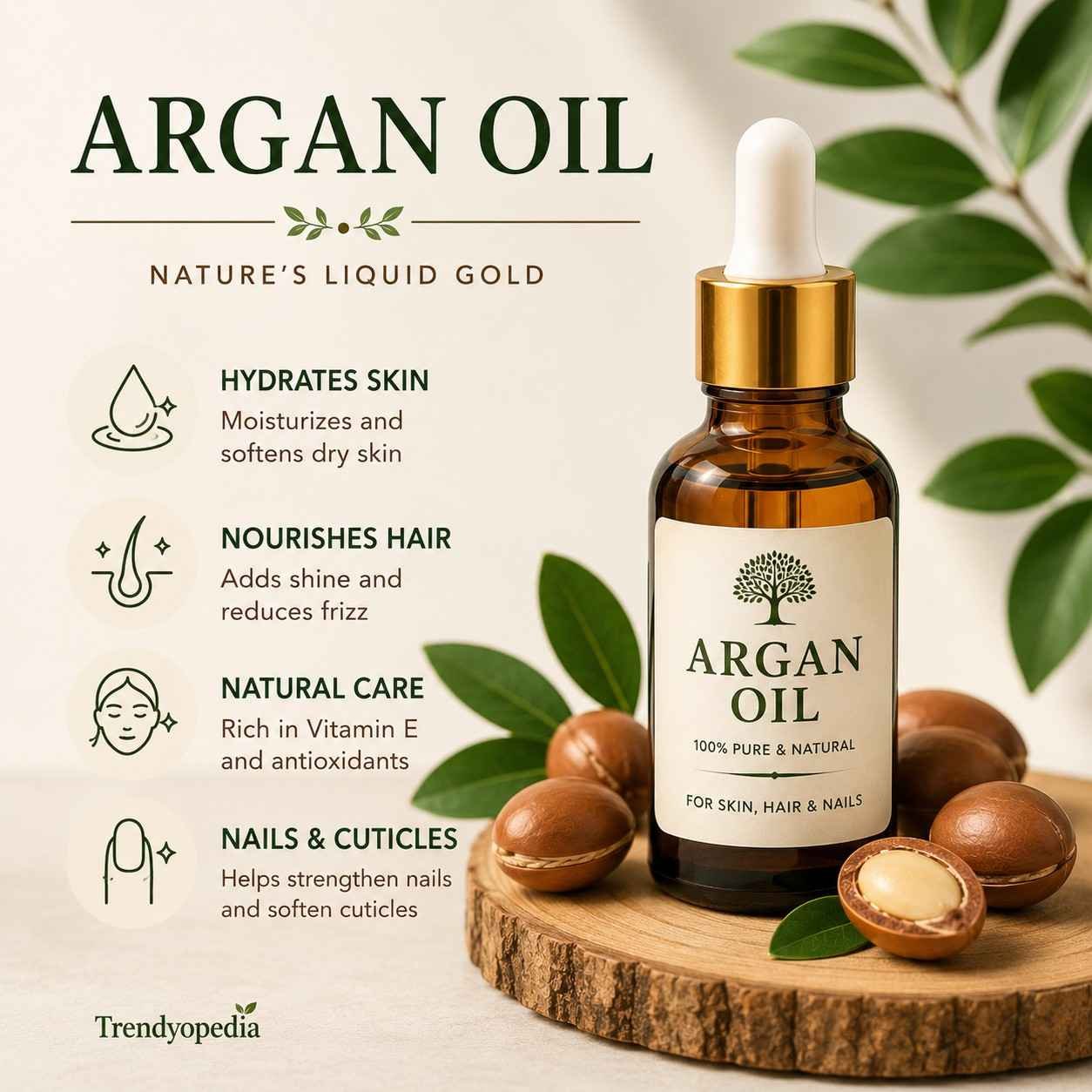
Argan Oil is a popular plant oil made from the kernels of the argan tree, which is native to Morocco. It is widely used in skincare, hair care, and cosmetic products because of its smooth texture and fatty-acid and vitamin E content.
From moisturizing dry skin to conditioning hair, argan oil has become a popular ingredient in beauty routines. However, it’s important to separate well-supported cosmetic uses from stronger health claims that need more research.
If you’re exploring natural oils for your beauty routine, you can also read our guides to Pomegranate Seed Oil and Olive Oil.
What Is Argan Oil?
Argan oil comes from the kernels of the argan tree (Argania spinosa).
It is traditionally produced in Morocco and is available in different forms. Cosmetic argan oil is generally used on the skin and hair, while food-grade argan oil is used in cooking.
This oil contains fatty acids, including oleic and linoleic acids, as well as other naturally occurring compounds.
Argan Oil Benefits
This oil is commonly used for:
- Moisturizing dry-feeling skin
- Softening rough skin
- Conditioning hair
- Adding shine to hair
- Supporting a simple skincare routine
- Massage and body care
- Cosmetic formulations
Research has investigated This oil’s potential dermatological and cosmetic applications, although evidence varies depending on the specific use.
Argan Oil for Skin
This oil can be used as an emollient in skincare.
It may help skin feel:
- Softer
- Smoother
- More comfortable
- Less dry
You can apply a small amount after cleansing or mix it with a moisturizer.
For facial use, start with a small amount and observe how your skin responds. If you want to compare facial oils, read our Face Oil vs Moisturizer guide to understand how oils and moisturizers work differently.
Argan Oil for Dry Skin
If your skin feels dry or rough, This oil can be used as an additional moisturizing step.
Simple routine
Cleanser → Moisturizer → Argan Oil
The moisturizer provides hydration, while the oil can help soften the skin and reduce moisture loss.
Argan Oil for Hair
This oil is especially popular in hair-care products.
It can be used on:
- Dry hair
- Frizzy hair
- Hair ends
- Wavy or curly hair
- Dry-feeling scalp
- Hair masks
Apply a small amount to the mid-lengths and ends of damp or dry hair.
Avoid using too much, especially if your hair is fine, because it can make hair appear greasy.
Argan Oil for Frizzy Hair
This oil can help smooth the appearance of dry or frizzy hair by coating the hair surface.
For a simple application:
- Place a few drops in your palms.
- Rub your hands together.
- Apply lightly to the mid-lengths and ends.
- Avoid applying too much near the roots.
The result will vary depending on your hair type and the product formulation.
Argan Oil for Hair Growth
This oil is sometimes promoted online as a hair-growth treatment.
However, there isn’t enough strong evidence to claim that argan oil directly stimulates hair growth.
It can help condition hair and improve its appearance, but that is different from treating hair loss.
If you’re experiencing significant or persistent hair loss, consider speaking with a dermatologist.
For more natural hair-care options, explore our guides to Amla Oil, Castor Oil, Moringa Oil, and Hibiscus Oil.
Argan Oil for Scalp
A small amount of This oil can be used as part of a scalp-oiling routine if your scalp tolerates it.
However, oil isn’t a treatment for conditions such as dandruff, seborrheic dermatitis, psoriasis, or scalp infections.
If you have persistent itching, redness, scaling, or inflammation, seek professional advice.
Argan Oil for Nails and Cuticles
This oil can also be used as a simple cuticle-care oil.
Massage a tiny amount into:
- Cuticles
- Dry areas around nails
- Fingertips
Its emollient properties can help dry skin feel softer.
Argan Oil vs Jojoba Oil
Both are popular cosmetic oils, but they have different textures and compositions.
| Feature | Argan Oil | Jojoba Oil |
|---|---|---|
| Texture | Smooth, moderately rich | Lightweight |
| Skin use | Dry and normal skin | Many skin types |
| Hair use | Conditioning and smoothing | Lightweight conditioning |
| Facial use | Yes, depending on skin | Yes, depending on skin |
| Popular use | Hair and skin | Skin, hair and cosmetics |
If you prefer a richer-feeling oil, This oil may be appealing. If you prefer a lightweight feel, jojoba oil may be a better option.
Argan Oil vs Almond Oil
Both oils are commonly used in beauty products.
Argan Oil may appeal to people looking for a versatile oil for hair and facial care.
Almond Oil is popular for body care, massage, and moisturizing dry-feeling skin.
If you have an almond or tree-nut allergy, check product labels carefully before using almond-derived products.
How to Use Argan Oil on Your Face
A simple method is:
- Wash your face with a gentle cleanser.
- Apply your usual moisturizer.
- Use 1–3 drops of This oil.
- Gently press or massage it into the skin.
You don’t need a large amount.
If your skin is acne-prone or sensitive, introduce the product gradually.
How to Use Argan Oil on Hair
As a finishing oil
Apply a small amount to the ends after styling.
As a pre-shampoo treatment
Apply a modest amount to the hair, leave it for a suitable period, and shampoo afterward.
As a hair mask
This oil can be combined with other conditioning ingredients for a simple hair treatment.
Avoid excessive amounts because they can weigh hair down.
Is Argan Oil Good for Oily Skin?
Oily skin can still become dehydrated.
However, adding an oil isn’t necessary for everyone with oily skin.
If you want to try This oil, use a very small amount and consider applying it only to areas that feel dry.
If it makes your skin feel greasy or contributes to breakouts, discontinue it.
Is Argan Oil Good for Sensitive Skin?
This oil may work for some people with sensitive skin, but natural doesn’t automatically mean irritation-free.
Choose a simple product without unnecessary fragrance and test a small area before applying it more widely.
Stop using it if you experience:
- Burning
- Redness
- Itching
- Swelling
- Rash
Can You Mix Argan Oil With Other Oils?
Yes. This oil can be incorporated into cosmetic oil blends.
For example, it can be combined with:
- Jojoba Oil
- Almond Oil
- Coconut Oil
- Avocado Oil
However, combining multiple products also increases the number of ingredients your skin is exposed to. Keeping your routine simple can make it easier to identify what works for you.
Argan Oil Safety
This oil is generally used as a cosmetic ingredient, but individual reactions are possible.
Safety tips
- Choose a reputable product.
- Check the ingredient list.
- Patch-test when appropriate.
- Avoid broken or irritated skin.
- Keep oil away from the eyes.
- Stop using it if irritation occurs.
If you have a known allergy to argan products, avoid them.
Common Mistakes When Using Argan Oil
Using Too Much
A few drops can be enough.
Applying It to Dirty Hair
Heavy buildup can make hair look greasy.
Expecting Hair Growth
This oil conditions hair but shouldn’t be marketed as a proven hair-loss treatment.
Replacing Sunscreen
This oil does not replace sunscreen.
Using It on Irritated Skin
Avoid applying cosmetic oils to damaged or inflamed skin unless advised by a healthcare professional.
FAQs
Is argan oil good for your skin?
This oil can help soften and moisturize dry-feeling skin and is widely used in cosmetic formulations.
Is argan oil good for hair?
Yes, it can be useful as a conditioning and smoothing oil for dry or frizzy hair.
Does argan oil grow hair?
There isn’t enough evidence to say that This oil directly promotes hair growth.
Can I use argan oil on my face every day?
Some people can, but it depends on their skin type and the product. Start with a small amount.
Is argan oil good for dry skin?
It can help soften dry-feeling skin and may be used alongside a moisturizer.
Can I use argan oil on oily skin?
You can try a small amount, but it may not be necessary for everyone with oily skin.
Can I use argan oil with moisturizer?
Yes. Many people apply moisturizer first and a small amount of facial oil afterward.
Can argan oil be used on the scalp?
It can be used as a cosmetic conditioning oil, but it shouldn’t be considered a treatment for scalp disorders.
Conclusion
Argan Oil is a versatile natural oil commonly used for skin, hair, nails, and cosmetic care. Its smooth texture makes it particularly popular for dry-feeling skin and frizzy or dry hair.
It can be a useful addition to a simple beauty routine, but it shouldn’t be treated as a cure for hair loss or skin conditions. Start with a small amount, choose a quality product, and pay attention to how your skin and hair respond.
For more natural-oil guides, explore our Avocado Oil, Flaxseed Oil, and Ginger Oil articles on Trendyopedia.
Author
Hitasha is a beauty, nutrition, and wellness writer at Trendyopedia, creating reader-friendly, research-informed content about natural oils, skincare, hair care, nutrition, and healthy lifestyle topics.
Disclaimer
This article is for informational purposes only and does not replace professional medical advice. Natural oils can cause irritation or allergic reactions in some people. Consult a qualified healthcare professional for persistent skin, scalp, or hair concerns.
1 thought on “Argan Oil: Benefits, Uses, Skin & Hair Care Guide”