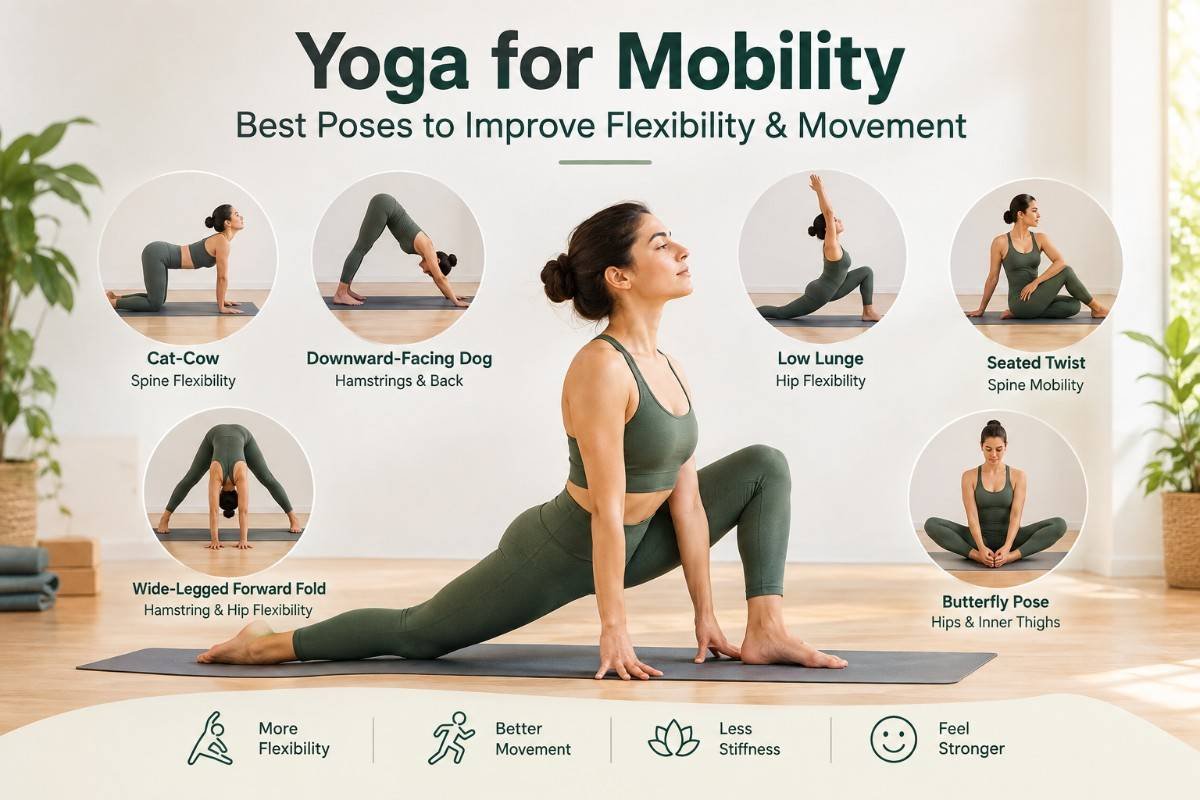
Yoga for Mobility is becoming a popular way to improve flexibility, movement, balance, and body awareness without requiring complicated equipment or intense workouts.
Mobility is more than simply being flexible. It is the ability to move your joints and body comfortably and with control. Good mobility can make everyday activities such as walking, reaching, bending, sitting down, getting up, and climbing stairs feel easier.
Yoga combines movement, stretching, balance, and controlled breathing, making it a useful addition to a mobility-focused fitness routine. Harvard Health notes that mobility involves flexibility, strength, balance, coordination, and range of motion, and that gentle yoga movements can support several of these areas.
But you don’t need to be extremely flexible or experienced to start.
A simple Yoga for Mobility routine can be adapted for beginners and performed at home in just a few minutes.
Yoga for Mobility is part of the growing interest in gentle, functional wellness practices. If you’re also interested in using yoga to support everyday stress management, explore our guide to Yoga for Anxiety, which covers simple poses for everyday stress.
What Is Yoga for Mobility?
Yoga for mobility is a style or approach to yoga that emphasizes comfortable joint movement, flexibility, balance, body control, and functional range of motion.
Instead of trying to achieve advanced poses, mobility-focused yoga encourages you to move through a comfortable range while paying attention to how your body feels.
A mobility routine may include movements for:
- Hips
- Shoulders
- Spine
- Ankles
- Knees
- Hamstrings
- Chest
- Neck
- Core
The goal is not necessarily to become more flexible than everyone else. Instead, it is to help you move more comfortably and confidently.
Mobility vs. Flexibility: What’s the Difference?
Flexibility and mobility are related, but they are not exactly the same.
Flexibility generally refers to how much a muscle or group of muscles can lengthen.
Mobility is broader. It involves your ability to actively control movement through a range of motion.
For example, you may be able to passively stretch your hamstrings quite far but still have difficulty controlling certain movements.
Mobility involves several components, including:
- Range of motion
- Strength
- Balance
- Coordination
- Stability
- Body control
That is why a mobility-focused yoga routine can include both stretching and strengthening movements.
Why Is Yoga for Mobility Trending?
Interest in mobility workouts has grown alongside a broader shift toward sustainable fitness.
Instead of focusing only on high-intensity workouts, many people are looking for ways to move better, recover, and maintain physical function as they get older.
Yoga is especially convenient because it can be practiced at home with little or no equipment.
It can also be adapted to different fitness levels.
A beginner might spend five minutes performing gentle hip and shoulder movements, while someone with more experience may incorporate mobility work into a longer yoga session.
Harvard Health describes mobility as an important part of maintaining independence and notes that gentle movements such as yoga can help support flexibility, balance, and core strength.
Mobility-focused yoga also fits into the growing interest in mind-body practices that emphasize awareness and comfortable movement. Somatic Yoga takes a similar approach by focusing on slow, mindful movements and greater awareness of how the body feels.
Benefits of Yoga for Mobility
1. May Improve Range of Motion
One of the main reasons people use mobility-focused yoga is to work on range of motion.
Regular stretching and controlled movement can help joints move through a more comfortable range.
A 2024 systematic review examining yoga’s effects on spine and shoulder mobility found that yoga interventions had potential to improve spinal flexibility and spine mobility, although the available studies varied in design and size.
This suggests that yoga may be useful for mobility, but it should not be treated as a guaranteed treatment for every mobility problem.
2. Supports Flexibility
Many yoga poses gently lengthen muscles while moving joints through different positions.
Improved flexibility can make certain everyday movements more comfortable.
For example, better hip and hamstring flexibility may make bending, squatting, or sitting on the floor easier.
3. Can Support Balance
Many yoga poses require you to stabilize your body while maintaining a particular position.
Standing poses and one-leg balance exercises can challenge coordination and body awareness.
Balance is an important part of overall mobility, especially as people get older.
4. Helps Build Body Awareness
Yoga encourages you to pay attention to your breathing, posture, muscle tension, and movement.
This awareness can help you recognize when you are pushing too hard or compensating with another part of your body.
5. Supports Functional Movement
Mobility is important for everyday activities.
Getting out of a chair, reaching overhead, turning your body, walking, and climbing stairs all require a combination of mobility, strength, balance, and coordination.
Yoga can complement other forms of exercise that develop these abilities.
6. May Help With General Stiffness
Gentle movement can be especially appealing after long periods of sitting.
A short yoga mobility session can move the spine, hips, shoulders, and legs rather than keeping the body in one position.
If stiffness is persistent, painful, or associated with an injury, however, it is important to identify the underlying cause rather than simply stretching through it.
Best Yoga Poses for Mobility
You don’t need advanced yoga poses to work on mobility.
Here are several beginner-friendly movements that can be incorporated into a mobility routine.
1. Cat-Cow
Cat-Cow is a gentle movement for the spine.
How to do it:
- Start on your hands and knees.
- Place your hands under your shoulders.
- Place your knees under your hips.
- Slowly arch your back as you inhale.
- Gently round your spine as you exhale.
- Continue slowly for several repetitions.
Avoid forcing your spine into an extreme position.
Mobility focus: Spine and shoulders.
2. Child’s Pose
Child’s Pose can provide a gentle stretch through the back, hips, and shoulders.
How to do it:
- Begin on your hands and knees.
- Slowly move your hips toward your heels.
- Extend your arms forward or rest them beside your body.
- Relax your shoulders.
- Breathe slowly.
- Hold for a comfortable amount of time.
If your hips do not comfortably reach your heels, place a cushion or folded blanket underneath you.
Mobility focus: Hips, back, shoulders, and ankles.
3. Low Lunge
Low Lunge can gently work the hips and front of the legs.
How to do it:
- Start in a tabletop position.
- Step one foot forward.
- Place the front foot comfortably between your hands.
- Lower the back knee to the floor.
- Keep your chest upright.
- Gently move your hips forward.
- Switch sides.
Do not force your hips forward.
Mobility focus: Hips and thighs.
4. Downward-Facing Dog
Downward-Facing Dog combines movement through the shoulders, spine, hips, and legs.
How to do it:
- Start on your hands and knees.
- Tuck your toes.
- Slowly lift your hips upward.
- Keep your spine long.
- Bend your knees slightly if necessary.
- Press gently through your hands.
- Hold for several breaths.
Your heels do not need to touch the floor.
Mobility focus: Shoulders, spine, hips, hamstrings, and calves.
5. Standing Forward Fold
This movement gently works the back of the body.
How to do it:
- Stand with your feet comfortable apart.
- Bend your knees slightly.
- Hinge forward from your hips.
- Allow your upper body to relax.
- Keep your knees bent as much as needed.
- Slowly return to standing.
Avoid pulling yourself deeper into the stretch.
Mobility focus: Hamstrings, hips, and spine.
6. Garland Pose
Garland Pose, or Malasana, can challenge hip, ankle, and lower-body mobility.
How to do it:
- Stand with your feet slightly wider than hip-width.
- Slowly lower into a squat.
- Keep your chest lifted.
- Bring your hands together if comfortable.
- Use a yoga block or cushion underneath you if needed.
- Hold for several breaths.
If deep squatting is uncomfortable, do not force the position.
Mobility focus: Hips, ankles, and knees.
7. Seated Spinal Twist
A gentle seated twist can encourage comfortable movement through the torso.
How to do it:
- Sit comfortably on the floor or on a cushion.
- Extend your legs or bend them comfortably.
- Sit tall.
- Slowly rotate your torso to one side.
- Keep the movement gentle.
- Return to center and switch sides.
Avoid forcing the twist.
Mobility focus: Spine and torso.
8. Thread the Needle
This is a gentle shoulder and upper-back mobility movement.
How to do it:
- Begin on your hands and knees.
- Lift one hand.
- Slowly slide that arm underneath the opposite arm.
- Allow your shoulder to move toward the floor as comfortable.
- Pause for a few breaths.
- Return to the starting position.
- Switch sides.
Mobility focus: Shoulders and upper back.
9. Figure-Four Stretch
This movement can gently target the hips and glutes.
How to do it:
- Lie on your back with your knees bent.
- Place one ankle over the opposite thigh.
- Keep the crossed leg relaxed.
- If comfortable, gently draw the supporting leg toward you.
- Hold briefly.
- Switch sides.
Mobility focus: Hips and glutes.
10. Ankle Mobility Movement
Ankle movement is often overlooked, but it can influence activities such as walking and squatting.
How to do it:
- Sit or stand securely.
- Lift one foot slightly.
- Slowly circle the ankle.
- Make controlled circles in both directions.
- Repeat with the other foot.
Keep the movement comfortable.
Mobility focus: Ankles.
A Simple 10-Minute Yoga for Mobility Routine
If you’re new to mobility work, try this simple sequence.
Minute 1: Cat-Cow
Minute 2: Child’s Pose
Minutes 3–4: Low Lunge — both sides
Minutes 5–6: Downward-Facing Dog
Minute 7: Standing Forward Fold
Minute 8: Gentle Spinal Twist
Minute 9: Figure-Four Stretch
Minute 10: Relaxed breathing
Move slowly rather than trying to complete as many poses as possible.
If you prefer shorter yoga sessions, you may also enjoy Yoga Snacking, an approach that breaks yoga into small, manageable sessions throughout the day. It can be an easy way to add movement without committing to a long workout.
Yoga for Hip Mobility
The hips are important for walking, running, squatting, sitting, and many other movements.
Yoga poses commonly used in mobility routines include:
- Low Lunge
- Figure-Four Stretch
- Child’s Pose
- Garland Pose
- Gentle seated movements
- Cat-Cow
If you have hip pain or a diagnosed hip condition, avoid assuming that more stretching is always better.
A physical therapist or healthcare professional can help determine which movements are appropriate.
Yoga for Shoulder Mobility
Modern lifestyles can involve long periods of sitting and screen use.
Gentle yoga movements can help you regularly move the shoulders and upper back.
Try:
- Cat-Cow
- Thread the Needle
- Downward-Facing Dog
- Gentle arm circles
- Seated spinal movements
Focus on smooth movement rather than forcing your shoulders into extreme positions.
Yoga for Spine Mobility
The spine naturally moves through several directions, including flexion, extension, and rotation.
Cat-Cow and gentle spinal twists are commonly used to introduce controlled spinal movement.
If you have back pain, however, the right exercises depend on the cause of the pain.
Yoga should not be used to push through sharp or worsening pain.
How Often Should You Do Yoga for Mobility?
There is no single schedule that works for everyone.
A practical approach is to start with 5–10 minutes several days a week and gradually increase the duration if your body responds well.
You can also use short mobility sessions as a warm-up before exercise or as a gentle movement break after sitting.
Consistency is usually more practical than doing one very long session once in a while.
Yoga for Mobility vs. Traditional Stretching
Traditional stretching usually focuses on lengthening muscles and improving flexibility.
Mobility work often combines stretching with active movement, balance, strength, and control.
Yoga can include elements of both.
For example, a yoga sequence might move your hip through a range of motion while you support your body and control the position.
That combination is one reason yoga can fit well into a broader mobility routine.
Can Beginners Do Yoga for Mobility?
Yes.
You do not need to be flexible to begin.
In fact, beginners can benefit from starting with simple movements and learning how their bodies respond.
You can modify many poses by:
- Bending your knees
- Using a yoga block
- Sitting on a cushion
- Reducing the range of motion
- Supporting yourself against a wall
- Spending less time in a pose
The goal is controlled, comfortable movement rather than achieving the deepest version of a pose.
Common Mistakes to Avoid
Forcing a Stretch
A deeper stretch is not automatically a better stretch.
Pain is a signal to stop or modify the movement.
Comparing Yourself With Flexible People
People naturally have different levels of flexibility because of factors such as anatomy, age, training, and previous activity.
Your mobility routine should focus on your own movement.
Moving Too Quickly
Mobility is about control.
Slow, deliberate movements can help you understand your range of motion better than rushing through poses.
Ignoring Strength
Mobility isn’t just flexibility.
Strength, stability, balance, and coordination also contribute to functional movement.
For overall fitness, combine mobility work with aerobic activity and strength training.
Practicing Through Pain
Mild stretching sensations can occur, but sharp, severe, or worsening pain should not be ignored.
Is Yoga for Mobility Safe?
Yoga is generally considered safe for healthy people when practiced appropriately, but injuries can still occur. Sprains and strains are among the more common yoga-related injuries.
Beginners should avoid forcing advanced poses or extreme ranges of motion.
People who are pregnant, older adults, or those with existing medical conditions or injuries may need modified poses. NCCIH recommends discussing individual needs with a healthcare professional and qualified yoga instructor when appropriate.
If a movement causes pain, stop and modify it rather than trying to push through.
Mobility doesn’t have to be limited to active stretching. If you want to combine gentle movement with deeper relaxation, Yoga Nidra offers a different type of yoga practice that focuses primarily on guided relaxation and rest.
Frequently Asked Questions
1 Is Yoga for Mobility good for beginners?
Yes. Beginners can start with gentle poses such as Cat-Cow, Child’s Pose, Low Lunge, and gentle spinal twists. Poses can be modified using cushions, blocks, or a wall.
2. What are the best yoga poses for mobility?
Some beginner-friendly mobility poses include Cat-Cow, Low Lunge, Child’s Pose, Downward-Facing Dog, Thread the Needle, Figure-Four Stretch, and gentle spinal twists.
3. Can yoga improve flexibility and mobility?
Regular yoga practice may help improve flexibility and aspects of mobility. Mobility also depends on strength, balance, coordination, and joint control.
4. How often should I do Yoga for Mobility?
A practical starting point is 5–10 minutes several days per week. You can gradually increase your practice as your body becomes more comfortable with the movements.
5. Can Yoga for Mobility help stiff hips?
Gentle yoga movements can help move the hips through a comfortable range of motion and may be useful as part of a mobility routine. Persistent or painful hip stiffness should be evaluated by a healthcare professional.
6. What is the difference between flexibility and mobility?
Flexibility generally refers to how much a muscle can lengthen, while mobility involves actively controlling movement through a range of motion. Mobility also involves strength, stability, balance, and coordination.
7. Can I do Yoga for Mobility every day?
Many people can include gentle mobility movements in their daily routine, but the intensity should match their fitness level. Avoid repeatedly forcing painful or extreme ranges of motion.
8. Can Yoga for Mobility improve balance?
Some yoga poses challenge balance, coordination, and body awareness. Balance-focused poses can therefore be included as part of a broader mobility and fitness routine.
9. Is Yoga for Mobility better than stretching?
Yoga and stretching have different purposes. Mobility-focused yoga can combine stretching with active movement, balance, strength, and body control, while traditional stretching may focus more specifically on flexibility.
10. Can Yoga for Mobility help with everyday movement?
Mobility is important for everyday activities such as walking, reaching, bending, sitting, standing, and climbing stairs. Yoga can complement other activities that develop strength and cardiovascular fitness.
11. Is Yoga for Mobility safe?
Yoga is generally considered safe when practiced appropriately, but injuries can occur. Start gradually, avoid forcing poses, and stop if you experience sharp or significant pain. People with injuries or medical conditions should seek appropriate professional guidance.
Conclusion
Yoga for Mobility is a simple way to include flexibility, controlled movement, balance, and body awareness in your fitness routine.
You don’t need to master difficult poses. Simple movements such as Cat-Cow, Low Lunge, Child’s Pose, Downward-Facing Dog, Thread the Needle, and gentle twists can help you regularly move different areas of the body.
Research suggests yoga can support aspects of flexibility and mobility, particularly in areas such as the spine, although more research is needed to understand exactly which yoga practices work best and for whom.
The most useful approach is to practice consistently, move within a comfortable range, and combine yoga with other forms of physical activity such as walking and strength training.
If you’re looking for a gentle way to move better, stretch regularly, and support everyday mobility, yoga can be a practical place to start.
If you’re building a broader mind-body wellness routine, you can also explore Nervous System Yoga, Face Yoga which focuses on gentle movement, breathing, relaxation, and body awareness. Together, these practices can give you different ways to incorporate mindful movement into your routine.
Author
Hitasha is a content writer and wellness enthusiast at Trendyopedia, covering emerging health, fitness, beauty, lifestyle, and wellness topics. Her goal is to make wellness information simple, practical, and easy to understand.
Short Disclaimer
Disclaimer: This article is for informational and educational purposes only and does not replace medical or professional advice. If you have an injury, medical condition, are pregnant, or experience pain during exercise, consult a qualified healthcare professional before starting a new yoga routine.