Getting enough sleep is one of the biggest wellness goals today, but switching off at night isn’t always easy. Between busy schedules, screens, stress, and endless thoughts, many people are looking for simple ways to create a calmer bedtime routine.
That is where Yoga Nidra is getting attention.
Often described as “yogic sleep,” Yoga Nidra is a guided relaxation and meditation practice usually performed while lying down comfortably. Unlike traditional yoga, it generally does not involve flowing through physical poses. Instead, the practice guides your attention through the body, breathing, sensations, and awareness.
Recent research is exploring whether Yoga Nidra may support sleep quality and relaxation. A 2026 systematic review and meta-analysis found potential benefits for sleep disturbances and insomnia, although researchers emphasized that the certainty of the evidence remains very low because of small studies and methodological limitations.
As more people focus on improving their sleep routines, practices such as [Best Tea for Deep Sleep] are also becoming part of relaxing nighttime rituals.
So, what exactly is Yoga Nidra, and why is this relaxing practice becoming part of modern bedtime routines?
What Is Yoga Nidra?
Yoga Nidra is a guided mind-body relaxation practice designed to bring the body into a deeply relaxed state while maintaining some level of awareness.
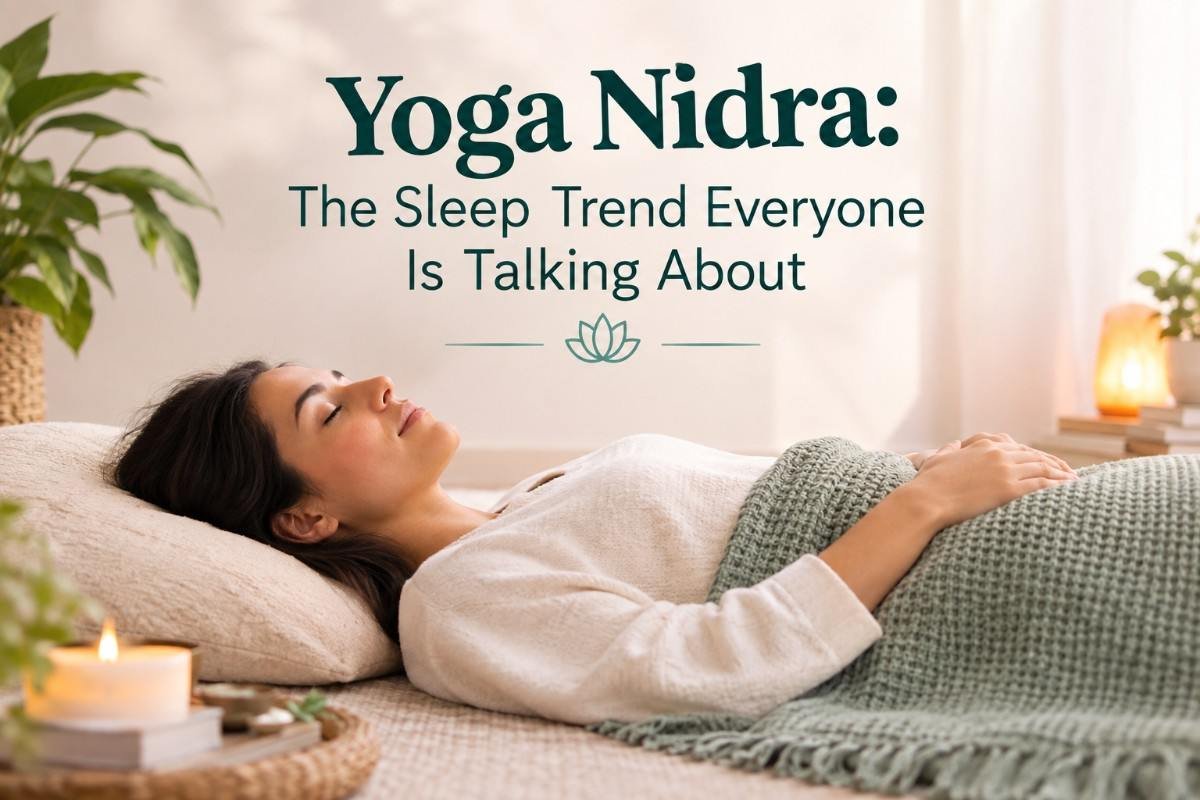
A typical session involves lying comfortably on your back while listening to a guided recording or instructor. You may be asked to notice different parts of your body, observe your breathing, become aware of sensations, and follow a series of mental instructions.
Unlike a traditional yoga class, you usually don’t need to perform challenging poses.
A 2023 integrative review described Yoga Nidra as a form of guided meditation that does not require traditional yoga poses and can be practiced at home.
This makes it especially appealing to people who want a gentle wellness practice rather than another demanding workout.
Yoga Nidra shares some elements of mindful body awareness with [Somatic Yoga], although Yoga Nidra is primarily a guided relaxation practice rather than a movement-based practice.
Why Is Yoga Nidra Trending?
The popularity of Yoga Nidra fits into a larger shift toward rest-focused wellness.
For years, wellness culture often focused on doing more—more workouts, more steps, more productivity, and more tracking. Now, many people are becoming interested in recovery, relaxation, sleep quality, and nervous-system-friendly routines.
Yoga Nidra fits naturally into this shift.
It requires very little equipment, can be practiced at home, and can take place while lying comfortably on a bed, mat, or other supportive surface.
The growing interest in sleep-focused wellness has also encouraged people to explore practices that can make bedtime feel calmer rather than turning sleep into another performance goal.
How Does Yoga Nidra Work?
A Yoga Nidra session commonly involves several stages of guided attention.
The exact structure can vary depending on the teacher or tradition, but a session may include:
- Getting comfortable and remaining still
- Setting an intention
- Bringing attention to the body
- Moving awareness through different body areas
- Observing the breath
- Noticing sensations
- Practicing awareness without judgment
- Gradually returning attention to the surroundings
The goal isn’t necessarily to force yourself to fall asleep.
Instead, the practice encourages deep relaxation and focused awareness.
Some people may fall asleep during a session, while others remain awake but deeply relaxed.
Yoga Nidra vs. Traditional Yoga
Yoga Nidra is quite different from a typical yoga workout.
| Yoga Nidra | Traditional Yoga |
|---|---|
| Usually practiced lying down | Often involves seated or standing poses |
| Focuses on guided relaxation | Can focus on strength, flexibility, balance, and mobility |
| Minimal physical movement | May involve considerable physical movement |
| Often guided by audio or instructor | Can be guided or self-directed |
| Suitable for a bedtime routine | Can be practiced at various times |
| Emphasizes awareness and relaxation | Can combine movement, breathing, and meditation |
This difference is one reason Yoga Nidra can appeal to people who aren’t interested in physically demanding exercise.
If you enjoy gentle mind-body practices, you may also be interested in [Somatic Yoga], another approach that places emphasis on body awareness and mindful movement.
Potential Benefits of Yoga Nidra
Yoga Nidra is often promoted for relaxation, stress management, and sleep. However, it is important to separate potential benefits from proven medical treatments.
1. May Support Sleep Quality
Sleep is one of the areas researchers are currently investigating.
A 2026 systematic review of Yoga Nidra research found possible improvements in sleep-related outcomes, but the authors described the evidence as preliminary because of small sample sizes, differences between studies, and methodological limitations.
Another 2026 systematic review of six randomized controlled trials involving 244 participants reported improvements in several sleep measures in many of the included studies, while also noting moderate-to-high risk of bias and differences between study protocols.
So Yoga Nidra may be worth exploring as a relaxation practice, but it should not be presented as a guaranteed treatment for insomnia.
2. Encourages Relaxation
One of the main purposes of Yoga Nidra is to create a state of physical and mental relaxation.
Instead of actively trying to solve problems at bedtime, you are guided toward noticing your body and breath.
This can make it easier to create a transition between a busy day and a quieter evening.
3. Can Become Part of a Bedtime Routine
A consistent bedtime routine can help create a clear transition into sleep.
Yoga Nidra can be added alongside other relaxing habits such as:
- Lowering the lights
- Putting away stimulating devices
- Reading
- Gentle breathing
- Keeping the bedroom comfortable
- Going to bed at a consistent time
For more ideas about improving nighttime routines, you can also explore [Best Tea for Deep Sleep] as part of your broader sleep and wellness content.
4. Requires Little Equipment
You don’t need weights, machines, or a large space.
A comfortable surface and a guided Yoga Nidra recording may be enough to begin.
Some people use a yoga mat, blanket, pillow, or eye covering for additional comfort.
5. May Help With Stress and Well-Being
Research into Yoga Nidra has also explored stress, mood, psychological well-being, and other outcomes.
A 2026 systematic review and meta-analysis examined 73 studies involving more than 5,000 participants and found that Yoga Nidra research has expanded across several areas, although the authors emphasized that its clinical effectiveness still requires further investigation.
This means Yoga Nidra is an interesting area of research, but it should not be treated as a replacement for professional mental-health care.
How to Practice Yoga Nidra Before Bed
You don’t need to make your first session complicated.
Try this simple approach:
Step 1: Choose a Comfortable Position
Lie on your back somewhere comfortable.
You can place a pillow beneath your head or knees if that helps you relax.
Step 2: Reduce Distractions
Dim the lights and silence unnecessary notifications.
If you are using an audio recording, keep your phone or device at a comfortable distance.
Step 3: Start With Slow Breathing
Take a few comfortable breaths.
Don’t force deep breathing if it feels uncomfortable. Simply notice the natural rhythm of your breath.
Step 4: Follow a Guided Session
For beginners, a guided Yoga Nidra session can be easier than trying to remember a sequence.
Follow the instructor’s directions without worrying about doing everything perfectly.
Step 5: Let Your Body Relax
Notice areas of tension without trying to force them to relax.
Allow your body to become comfortable and still.
Step 6: Return Slowly
When the session ends, give yourself a moment before sitting or standing.
If you’re practicing at bedtime, you may simply transition into sleep.
How Long Should Yoga Nidra Last?
There is no single required duration.
Beginners may prefer a short session of around 10 to 15 minutes, while longer guided practices can last 20, 30, or even 40 minutes.
The best duration is one that feels realistic for your routine.
Starting with a shorter session may make it easier to practice consistently rather than turning Yoga Nidra into another task on your wellness checklist.
Can Yoga Nidra Replace Sleep?
No.
This is an important distinction.
Yoga Nidra is a relaxation and meditation practice. It is not a replacement for adequate sleep.
Even if you feel deeply rested after a session, your body still needs regular sleep.
Think of this yoga as something that may complement a healthy sleep routine rather than something that replaces sleep itself.
Yoga Nidra vs. Meditation
Yoga Nidra and meditation can overlap, but they aren’t exactly the same.
Meditation can involve many different techniques, including breath awareness, mindfulness, visualization, or focused attention.
this yoga generally follows a more structured guided relaxation process.
For someone who finds traditional meditation difficult because sitting still and focusing feels challenging, lying down and following guided instructions may feel more accessible.
Is Yoga Nidra Good for Beginners?
Yoga Nidra can be beginner-friendly because it usually does not require advanced physical flexibility or complicated poses.
You don’t need to be able to touch your toes or perform difficult yoga positions.
The bigger challenge may simply be learning to stay comfortable and follow the instructions without worrying about whether you’re doing it correctly.
If you fall asleep during the session, that’s also not unusual.
What Is the Best Time to Practice Yoga Nidra?
There isn’t one universally correct time.
You might try this yoga:
Before bed:
This is a popular option for people who want a relaxing transition into nighttime.
After work:
A short session can create a boundary between work and personal time.
During an afternoon break:
A guided relaxation session can provide a quiet pause during a busy day.
After exercise:
Some people may enjoy Yoga Nidra as part of a recovery-focused routine.
The important factor is finding a time when you can practice without constantly checking the clock.
Yoga Nidra and Modern Sleep Wellness
The popularity of Yoga Nidra reflects a larger change in the way people think about wellness.
Instead of viewing health only through exercise and productivity, many people are paying more attention to recovery and rest.
This is also why trends such as sleep tracking, digital detox routines, and mindful movement continue to attract attention.
However, more tracking isn’t always better.
A wellness routine should ideally help you feel supported rather than making you anxious about achieving perfect numbers.
This yoga takes almost the opposite approach: instead of measuring every minute, it encourages you to pause and notice what is happening in your body.
Sleep wellness isn’t only about tracking numbers. Our article on [Sleep Tracking vs. Sleep Quality] explores why the quality of your sleep may matter more than simply collecting sleep data.
Can Yoga Nidra Help With Insomnia?
This is where it’s important to be careful.
Early research is encouraging, but this yoga has not been established as a replacement for evidence-based insomnia treatment.
The latest 2026 systematic review found potential benefits but rated the certainty of evidence as very low.
The National Center for Complementary and Integrative Health also notes that yoga may improve sleep quality in some groups, but evidence for treating insomnia specifically remains limited.
For chronic insomnia, cognitive behavioral therapy for insomnia (CBT-I) is strongly recommended by sleep-medicine guidelines.
If persistent sleep problems are affecting your daily life, talking with a qualified healthcare professional is more appropriate than relying on Yoga Nidra alone.
Is Yoga Nidra Safe?
This yoga is generally a gentle practice because it involves little physical movement.
However, individual circumstances matter.
If you have a medical condition, are pregnant, have significant sleep problems, or have concerns about meditation or relaxation practices, consider discussing your plans with a healthcare professional.
Also remember that falling asleep during a guided session isn’t the same as treating an underlying sleep disorder.
Simple Yoga Nidra Bedtime Routine
If you want to experiment with Yoga Nidra, keep your routine simple:
30 minutes before bed: Reduce bright lights and stimulating activities.
20 minutes before bed: Prepare your bedroom and get comfortable.
10–15 minutes before bed: Try a beginner-friendly guided Yoga Nidra session.
After the session: Avoid immediately returning to social media or other stimulating activities.
FAQs
What is Yoga Nidra?
Yoga Nidra is a guided relaxation and meditation practice, often performed while lying down comfortably. It is sometimes called “yogic sleep” and generally does not require traditional yoga poses.
Is Yoga Nidra the same as sleeping?
No. Yoga Nidra is a guided relaxation practice, although some people may fall asleep during a session.
Can Yoga Nidra help you sleep better?
Early research suggests this yoga may improve some sleep-related outcomes, but current evidence is still limited and researchers have called for larger, better-designed studies.
How long should I practice Yoga Nidra?
Beginners can start with around 10–15 minutes and gradually experiment with longer sessions if comfortable.
Can beginners practice Yoga Nidra?
Yes. this yoga generally requires little physical movement and does not require advanced yoga flexibility or experience.
Can Yoga Nidra replace sleep?
No. this yoga should be viewed as a relaxation practice that may complement healthy sleep habits, not as a substitute for sleep.
Can I practice Yoga Nidra in bed?
Yes. Many people practice it lying down, and bedtime can be a convenient time. If your intention is to remain awake during the practice, however, a comfortable mat or floor setup may make that easier.
Is Yoga Nidra good for insomnia?
Research is promising but still preliminary. It should not replace established treatments for chronic insomnia, such as cognitive behavioral therapy for insomnia (CBT-I).
Conclusion
Over time, you can decide whether the practice fits naturally into your evening.
Yoga Nidra is a gentle guided relaxation practice that is attracting attention as part of the modern sleep and wellness movement.
Unlike traditional yoga, it generally doesn’t require physical poses. Instead, it uses guided awareness, breathing, body scanning, and relaxation while you remain comfortably still.
Research published in 2026 suggests Yoga Nidra may have potential for improving sleep-related outcomes, but researchers also emphasize that the current evidence has important limitations.
That makes this Yoga an interesting wellness practice to explore—but not a guaranteed cure for insomnia.
For many people, its biggest appeal may simply be the opportunity to stop, slow down, and create a few quiet minutes at the end of a busy day.
If you’re interested in gentle wellness practices, you can also explore Yoga Snacking and Walking Yoga for other ways to incorporate mindful movement into your routine.
About the Author
Hitasha is a lifestyle and wellness writer at Trendyopedia, creating easy-to-understand content about wellness trends, healthy habits, fitness, beauty, and everyday lifestyle. Her goal is to make wellness information practical, engaging, and easy to understand.
Disclaimer
This article is for informational and educational purposes only and is not medical advice. Yoga Nidra may support relaxation and sleep as part of a healthy routine, but it should not replace professional medical care or treatment for sleep disorders. If you have a health condition, persistent sleep problems, or concerns about starting a new wellness practice, consult a qualified healthcare professional.
Sources & References