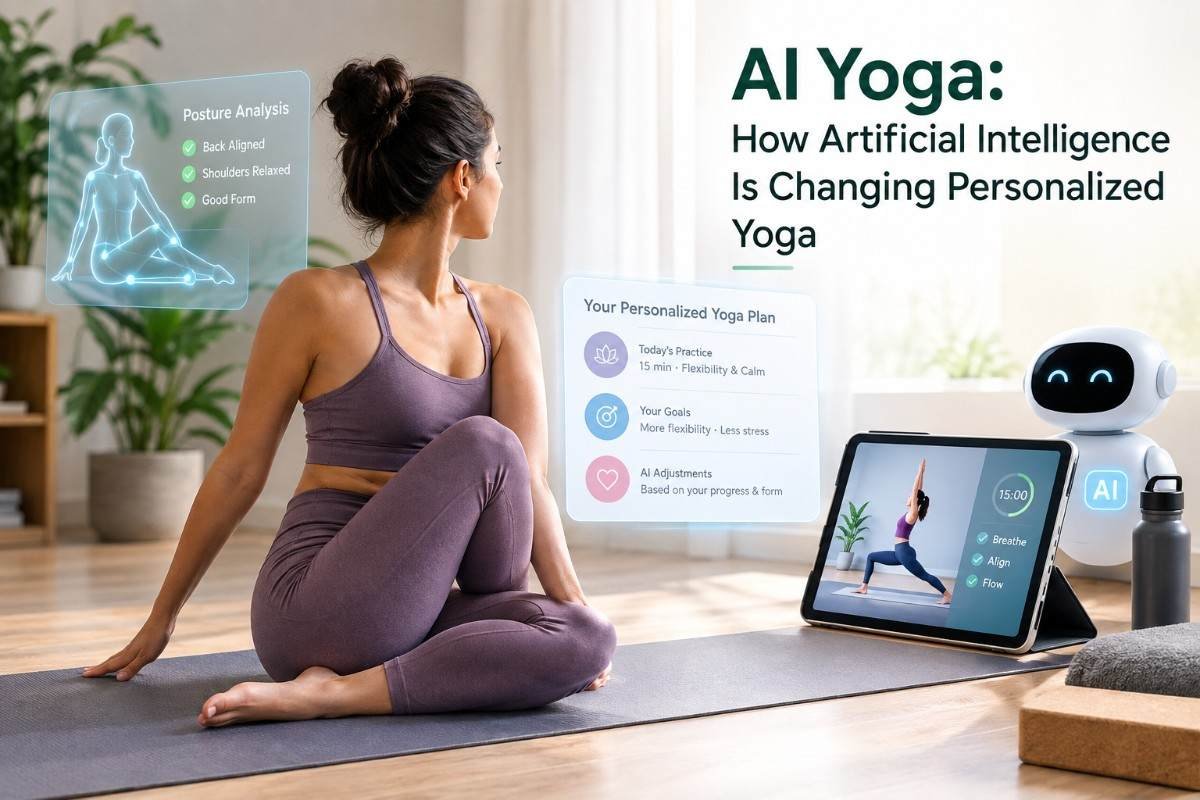
AI Yoga is an emerging wellness trend that combines traditional yoga practices with artificial intelligence, digital fitness technology, and personalized recommendations.
Instead of following exactly the same yoga routine every day, AI-powered platforms can use information such as your fitness goals, experience level, available time, and feedback to suggest different practices.
Some technologies are also exploring computer vision and movement analysis to provide feedback on body positioning during exercises.
This creates a new question for modern yoga: Can artificial intelligence make yoga more personalized?
The answer is potentially yes—but AI Yoga is still an evolving area, and technology should complement rather than replace qualified yoga instruction or professional healthcare advice.
For people using yoga to manage everyday stress, personalized digital routines can make practice easier to fit into a busy schedule. You can also explore Yoga for Anxiety for gentle practices designed around relaxation and stress management.
What Is AI Yoga?
AI Yoga refers to yoga experiences that use artificial intelligence to personalize, recommend, analyze, or adapt yoga practices.
Depending on the technology, an AI-powered yoga platform may help users:
- Choose yoga sessions based on their goals
- Create personalized routines
- Adjust workout duration
- Recommend beginner or advanced practices
- Track activity and progress
- Provide movement feedback
- Suggest modifications
- Combine yoga with other fitness activities
- Adapt recommendations based on previous sessions
The exact capabilities vary between apps and devices.
AI Yoga is therefore less about creating a completely new type of yoga and more about using technology to personalize the way people practice yoga.
Why Is AI Yoga Trending?
People are increasingly using technology to personalize different areas of their wellness routines.
Fitness apps can already track workouts, steps, sleep, heart rate, and other information. AI adds another layer by analyzing information and generating recommendations.
Yoga is a natural area for experimentation because it can be practiced at different levels and for different goals.
A beginner may want a 10-minute introduction to basic poses, while another person may want a longer mobility-focused session.
An AI-powered platform could potentially organize these experiences differently based on user preferences.
The broader growth of AI in health and wellness also explains why personalized digital fitness is receiving attention. WHO notes that AI has significant potential in health but emphasizes the importance of safety, transparency, accountability, equity, and appropriate oversight.
How Does AI Personalize Yoga?
AI personalization can work in several ways.
1. Personalizing by Experience Level
A beginner and an experienced yoga practitioner should not necessarily receive the same routine.
An AI system may ask about your experience and then recommend:
- Beginner yoga
- Intermediate sequences
- Advanced practices
- Gentle stretching
- Mobility-focused yoga
- Relaxation sessions
This can make digital yoga easier to navigate.
2. Personalizing by Time
One of the biggest barriers to exercise is finding enough time.
Instead of requiring a 60-minute session, an AI-powered system could generate or recommend shorter sessions.
For example:
5 minutes: breathing and gentle stretching
10 minutes: morning mobility
20 minutes: full-body yoga
30 minutes: strength and flexibility-focused practice
This approach can make yoga easier to fit into a busy schedule.
3. Personalizing by Goals
Your yoga routine may depend on what you want to achieve.
Someone interested in flexibility might receive more stretching-based sessions.
Someone interested in balance could receive more standing and balance poses.
Someone looking for relaxation might be directed toward slower practices.
Potential goals include:
- Flexibility
- Mobility
- Balance
- Relaxation
- General fitness
- Body awareness
- Stress management
- Sleep routines
AI can help organize these different goals into personalized recommendations.
AI Yoga and Movement Tracking
One of the more interesting developments is the use of cameras and computer vision to analyze movement.
Depending on the system, a camera may identify body positions and compare them with a reference pose.
For example, technology may attempt to recognize whether your arms, legs, or torso are positioned in a particular way.
This could potentially provide real-time prompts such as:
- Straighten your back
- Adjust your arm position
- Move more slowly
- Keep your knee aligned
- Return to a comfortable position
However, these systems should not be assumed to understand every individual’s anatomy or physical limitations.
A computer can identify visual patterns, but that is not the same thing as having a qualified yoga teacher observe the complete context of a person’s movement.
Personalized yoga can also overlap with slower, body-focused practices. Somatic Yoga explains how mindful movement and greater body awareness are becoming part of modern wellness routines.
Can AI Yoga Replace a Yoga Teacher?
AI Yoga is unlikely to replace the full role of an experienced yoga teacher.
A qualified instructor can observe more than just body position.
They may consider:
- Individual limitations
- Previous injuries
- Breathing
- Comfort
- Movement quality
- Modifications
- Personal goals
- Questions from the student
AI systems may provide useful digital guidance, but they do not automatically provide the same level of human judgment.
For beginners, people with injuries, or anyone dealing with a medical condition, professional guidance can be particularly important.
Benefits of AI Yoga
Personalized Practice
One of the biggest potential advantages is personalization.
Instead of searching through hundreds of yoga videos, users may receive recommendations based on their preferences.
Convenience
AI-powered yoga can be available at home, making it easier for people who cannot attend regular classes.
Flexible Session Length
Short personalized routines may help people maintain consistency when they have limited time.
Progress Tracking
Some platforms can track completed sessions and other activity data.
This may help users understand their exercise habits and stay consistent.
Variety
AI systems can potentially recommend different sessions so that users don’t repeat exactly the same routine.
Beginner-Friendly Guidance
Personalized recommendations may help beginners identify appropriate starting points rather than randomly choosing advanced yoga videos.
Potential Problems With AI Yoga
AI Yoga also comes with limitations.
1. AI Can Make Mistakes
Artificial intelligence is not automatically accurate.
WHO has warned that AI systems used for health-related purposes can produce incorrect or misleading information and therefore require careful evaluation and oversight.
A yoga recommendation generated by an AI system should therefore not be treated as medical advice.
2. Privacy Concerns
Some AI-powered fitness technologies may use personal information to create recommendations.
Camera-based systems can also involve visual data.
Before using an AI fitness or yoga platform, check:
- What data it collects
- Whether camera access is required
- How information is stored
- Whether data is shared
- How you can delete your information
Privacy becomes especially important when technology collects health-related or biometric information.
3. One Algorithm Can’t Understand Everyone
Human bodies differ.
Two people may look similar while having very different mobility, strength, previous injuries, or physical limitations.
An algorithm may not always understand these differences.
4. Too Much Dependence on Technology
Yoga traditionally emphasizes awareness, breathing, movement, and connection with the body.
Constantly watching a screen or worrying about scores could potentially distract from that experience.
Technology should ideally support the practice rather than become the entire practice.
Not everyone has time for a full yoga session every day. For readers who prefer shorter practices, Yoga Snacking explores how small yoga sessions can be incorporated throughout the day.
AI Yoga vs. Traditional Yoga
AI Yoga and traditional yoga don’t have to compete.
They can serve different purposes.
| AI Yoga | Traditional Yoga |
|---|---|
| Personalized digital recommendations | Teacher-guided or self-guided practice |
| Available through technology | Can be practiced with minimal technology |
| May track activity | Often emphasizes awareness and experience |
| Can provide automated feedback | Teacher can provide human feedback |
| Convenient at home | Can be practiced in studios or groups |
| Technology-dependent | Doesn’t require an app or device |
The choice depends on the person’s goals, preferences, access, and experience.
AI Yoga for Beginners
AI-powered yoga may be particularly convenient for beginners because a system can help organize different levels and session lengths.
If you’re new to yoga, consider starting with:
- Beginner poses
- Short sessions
- Gentle mobility
- Basic breathing exercises
- Simple balance work
- Relaxation-focused practices
Don’t begin with advanced poses simply because an algorithm recommends them.
If something causes pain, stop the movement rather than trying to complete the session.
AI Yoga for Mobility
AI personalization could also be useful for mobility-focused routines.
For example, someone who spends many hours sitting might prefer sessions involving:
- Hip mobility
- Shoulder movement
- Spine mobility
- Gentle stretching
- Posture-focused movements
This connects naturally with Yoga for Mobility, where the focus is on comfortable movement, flexibility, balance, and range of motion.
However, personalized recommendations should not be confused with an individualized physical therapy program.
AI Yoga and Stress Management
Some AI Yoga platforms may recommend slower practices based on a user’s selected goal of relaxation or stress management.
These sessions might include:
- Gentle yoga
- Breathing exercises
- Slow movement
- Restorative poses
- Meditation
AI may help people find these practices more easily, but technology cannot guarantee a particular mental or emotional outcome.
For persistent anxiety, depression, or other mental-health concerns, professional support is more appropriate than relying on an AI fitness application.
AI Yoga and Sleep
Another possible use is creating evening routines.
An AI-powered system could recommend shorter, slower practices based on the user’s preferred bedtime routine.
For example:
5-minute routine: gentle breathing
10-minute routine: light stretching
20-minute routine: slow yoga and relaxation
This could complement a broader nighttime routine.
If you enjoy sleep-focused yoga, you can also explore Yoga Nidra, which is a guided relaxation practice often used as part of rest and nighttime wellness routines.
Is AI Yoga Safe?
AI Yoga can be useful as a fitness and wellness tool, but it should be approached carefully.
AI-generated recommendations should not be treated as a diagnosis or personalized medical treatment.
WHO’s current work on AI and health emphasizes the need for ethical safeguards, transparency, accountability, privacy, and evidence-based oversight as AI technologies develop.
If you have an injury, chronic condition, are pregnant, or have been advised to avoid certain movements, speak with an appropriate healthcare professional before following an AI-generated exercise program.
How to Use AI Yoga Responsibly
You don’t need to avoid technology to practice yoga safely.
Instead, use it thoughtfully.
Check the Source
Choose established platforms with clear information about their instructors, methods, and privacy practices.
Don’t Follow Painful Instructions
Pain is not something you need to push through just because an app recommends a movement.
Keep Human Guidance When Needed
AI can supplement instruction, but qualified teachers and healthcare professionals remain important when individualized expertise is required.
Protect Your Data
Read the privacy policy before allowing an app to access cameras, health information, location, or other sensitive data.
Keep Some Practices Screen-Free
You can use technology to build your routine and then practice some sessions without looking at a screen.
This can help preserve the mindful aspect of yoga.
The Future of AI Yoga
The future of AI Yoga may involve increasingly personalized digital experiences.
Potential developments include:
- More adaptive yoga programs
- Real-time movement feedback
- Voice-guided sessions
- Personalized mobility routines
- Integration with wearable devices
- Adaptive session lengths
- Personalized recovery recommendations
- AI-generated yoga schedules
- Better movement recognition
However, technological capability does not automatically mean that every feature is accurate or beneficial.
As AI becomes more involved in health and wellness, independent testing, privacy protection, transparency, and human oversight will remain important.
FAQs
1. What is AI Yoga?
AI Yoga combines traditional yoga practices with artificial intelligence to provide personalized recommendations, routines, movement feedback, and digital guidance.
2. How does AI personalize yoga?
AI-powered yoga platforms may use information such as your experience level, goals, available time, preferences, and previous activity to recommend suitable yoga sessions.
3. Can AI create a personalized yoga routine?
Yes. Some AI-powered platforms can generate or recommend routines based on factors such as flexibility goals, mobility, relaxation, fitness level, and session duration.
4. Can AI Yoga replace a yoga teacher?
AI can provide convenient digital guidance, but it does not fully replace a qualified yoga teacher. A human instructor can consider individual limitations, movement quality, injuries, and modifications in ways an automated system may not.
5. Is AI Yoga suitable for beginners?
AI Yoga can be convenient for beginners because it can help organize practices according to experience level. Beginners should start with simple movements and avoid advanced poses without appropriate instruction.
6. Can AI Yoga track body movements?
Some AI-powered fitness technologies use cameras and computer vision to analyze body positioning and provide automated movement feedback. The accuracy and capabilities vary between platforms.
7. Is AI Yoga safe?
AI Yoga can be used as a general wellness tool, but AI recommendations should not be treated as medical advice. Stop if a movement causes pain and seek professional guidance if you have an injury or medical condition.
8. Can AI Yoga help with flexibility and mobility?
AI can recommend yoga sessions focused on stretching and mobility, but the technology itself does not guarantee improved flexibility or mobility. Results depend on consistent practice and individual factors.
9. Can AI Yoga help with stress?
AI may help users find gentle yoga, breathing, or relaxation sessions designed around stress-management goals. However, it should not replace professional mental-health care when it is needed.
10. What are the disadvantages of AI Yoga?
Potential concerns include inaccurate recommendations, privacy issues, overdependence on technology, limited understanding of individual physical differences, and the absence of human judgment.
11. Does AI Yoga require a camera?
Not always. Some platforms only use information entered by the user, while movement-tracking systems may use a smartphone or other camera to analyze poses.
12. What is the future of AI Yoga?
AI Yoga may become more personalized through adaptive routines, movement tracking, wearable-device integration, voice guidance, and recommendations based on individual preferences and activity data.
Conclusion
AI Yoga is changing how people can discover and personalize yoga practices.
Artificial intelligence may make it easier to select routines based on experience, available time, goals, and preferences. Movement-tracking technologies may also provide automated feedback and create more interactive home workouts.
But AI Yoga is still an evolving area.
It should be viewed as a digital tool that can support a yoga practice, rather than a replacement for experienced instructors, professional healthcare advice, or personal body awareness.
The most useful approach may be a balanced one: use technology when it makes yoga more accessible and personalized, but keep the core principles of yoga—awareness, breathing, movement, and mindful practice—at the center.
AI Yoga can make yoga more personalized and accessible, but technology works best when it supports—not replaces—mindful practice. For another approach focused on stress regulation and relaxation, explore Nervous System Yoga: What It Means and Why It’s Trending.
About the Author
Hitasha is a wellness and lifestyle writer at Trendyopedia, creating easy-to-understand content about health trends, fitness, yoga, beauty, and everyday wellness. Her goal is to make trending topics simple, practical, and informative for readers.
Disclaimer
This article is for general informational and educational purposes only. It is not medical advice and should not replace guidance from a qualified healthcare professional or certified yoga instructor. If you have a health condition, injury, or concerns about starting yoga, consult a healthcare professional before beginning a new practice.
Sources & References
- World Health Organization — Artificial Intelligence for Health
- World Health Organization — Ethics and Governance of AI for Health
- World Health Organization — AI and Health: Ethics & Governance
- WHO — Artificial Intelligence-related Health Research: Ethics Review and Oversight
- WHO — Safe and Ethical AI for Health