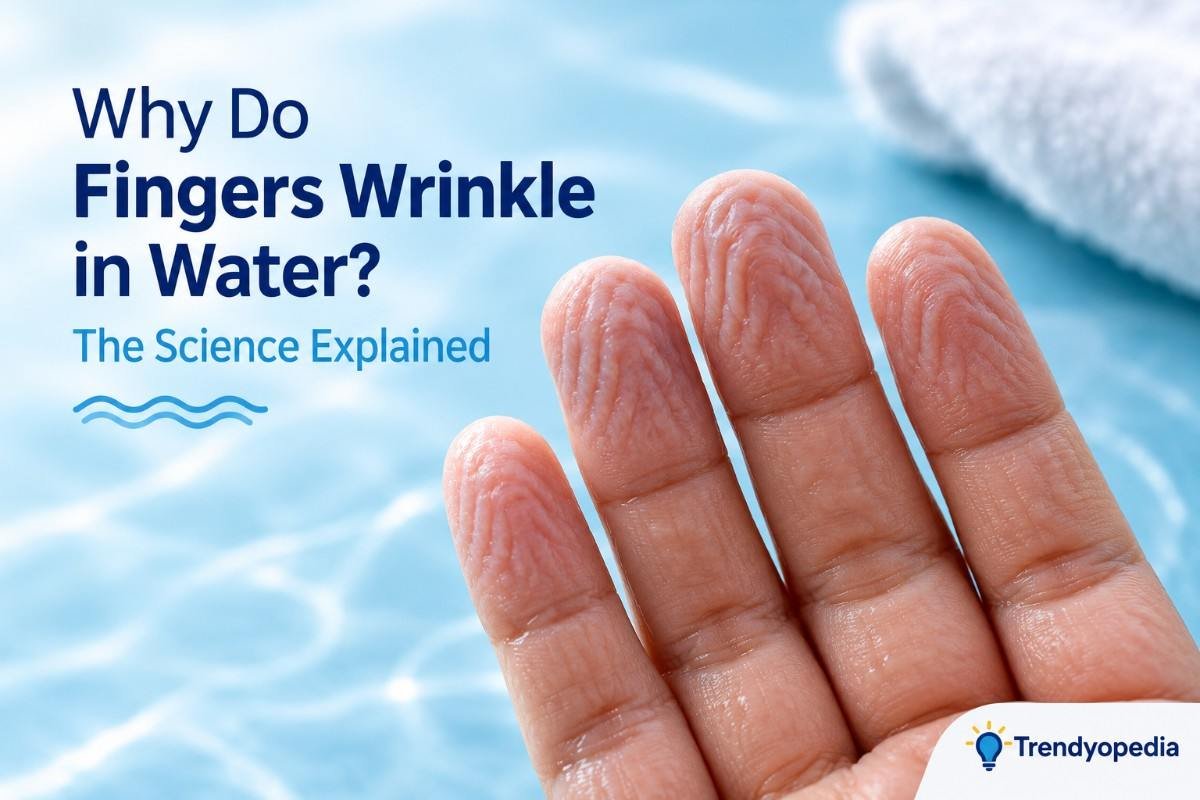
Have you ever noticed your fingers becoming wrinkled after taking a bath, swimming in a pool, or washing dishes? Your fingertips may look like tiny prunes, even when the rest of your skin looks completely normal. This common experience raises an interesting question: why do fingers wrinkle in water?
For a long time, people believed that fingers became wrinkled simply because the skin absorbed water and swelled. However, scientists have discovered that the process is more complicated. Your nervous system and the tiny blood vessels beneath your skin play an important role.
In this article, we will explore why fingers wrinkle in water, how long the process takes, whether it serves a purpose, and when wrinkled skin might deserve medical attention.
Our bodies have many fascinating reactions that we rarely think about. For example, have you ever wondered why do we get goosebumps? This is another interesting example of how the human body responds to different situations.
Why Do Fingers Wrinkle in Water?
Fingers wrinkle in water because immersion triggers changes beneath the skin, including the narrowing of small blood vessels in the fingertips. This process is called vasoconstriction.
Your autonomic nervous system helps control this response. It regulates many automatic body functions, including heart rate, digestion, and the activity of certain blood vessels.
When your hands remain underwater for a while, the skin on your fingertips gradually develops visible folds and grooves. These wrinkles are not simply the result of your skin soaking up water like a sponge.
Research has shown that water-induced finger wrinkling depends on the nervous system and changes in blood flow. Scientists have also investigated whether these wrinkles help people handle wet objects more efficiently.
According to research published in the journal Biology Letters, people with wrinkled fingers were able to handle submerged objects more quickly in certain experiments than people with unwrinkled fingers. Later research published in PLOS ONE also found that wrinkled fingers could improve grip efficiency when handling wet objects.
These findings suggest that water-induced wrinkles may help our hands function in wet environments, although scientists continue to investigate their exact purpose.
What Happens to Your Skin When It Gets Wet?
Why Do Fingers Wrinkle in Water: To understand why fingers wrinkle in water, it helps to know a little about the structure of your skin.
Your skin has several layers. The outermost layer, called the epidermis, acts as a protective barrier. The fingertips also contain specialized skin with many sweat glands and sensory nerves.
When your fingers stay submerged in water, several processes take place.
1. Your Nervous System Responds
The autonomic nervous system plays an important role in water-induced wrinkling. It helps regulate the activity of blood vessels beneath your skin.
This is why the process is considered an active physiological response rather than just passive water absorption.
2. Tiny Blood Vessels Narrow
The small blood vessels in your fingertips constrict, reducing the volume of tissue beneath the skin.
As the shape and volume of the fingertip change, the overlying skin develops ridges and valleys.
3. Wrinkles Become Visible
The changes beneath the skin create the familiar wrinkled appearance. The effect is especially noticeable on the fingertips, palms, and soles of the feet.
Once you leave the water and your skin returns to its usual condition, these wrinkles gradually disappear.
Why Do Fingers Wrinkle but Other Parts of the Body Do Not?
Why Do Fingers Wrinkle in Water: You might notice that your fingertips become wrinkled after a bath while your arms, legs, and stomach do not develop the same pattern.
The main reason is that the skin on your hands and feet has different characteristics from skin on many other parts of your body.
The palms of your hands and the soles of your feet have thick, hairless skin known as glabrous skin. These areas contain many sweat glands and have specialized structures that support grip and sensation.
Your fingertips also have a high concentration of sensory receptors that help you feel textures, pressure, and movement.
Although other parts of your body can become softer or temporarily swollen after prolonged exposure to water, the distinctive pruning effect is most noticeable on your fingers and toes.
This difference makes water-induced wrinkling an interesting example of how the body responds differently to its environment.
How Long Does It Take for Fingers to Wrinkle in Water?
Why Do Fingers Wrinkle in Water: There is no exact time that applies to everyone. Your fingers may begin to show visible wrinkles after several minutes of immersion, although the timing varies with water temperature, individual physiology, and other factors.
Here is a general guide:
- A few minutes: You may notice the first subtle changes in your fingertips.
- Around 10–20 minutes: Wrinkles may become more noticeable in some people.
- Longer exposure: The wrinkles may become more pronounced, depending on the conditions.
These are approximate examples, not fixed medical thresholds. You do not need to keep your hands underwater to test how quickly they wrinkle.
The good news is that ordinary water-induced finger wrinkles are temporary. Your skin generally returns to its normal appearance after you leave the water and dry your hands.
Do Wrinkled Fingers Help You Grip Wet Objects?
Why Do Fingers Wrinkle in Water: One of the most interesting explanations for wrinkled fingers is that they may help you grip objects in wet conditions.
Think about picking up a slippery bar of soap, holding a wet glass, or collecting smooth stones from a stream. Water between your fingertips and an object can make handling it more difficult.
Researchers have proposed that the grooves on wrinkled fingertips may help channel water away from the contact area, somewhat like drainage channels on a tire.
A study published in Biology Letters found that participants handled submerged objects more quickly with wrinkled fingers than with unwrinkled fingers in a laboratory task.
Another study, published in PLOS ONE in 2021, found that wrinkled fingers reduced the grip force needed to hold wet objects under the tested conditions.
However, the findings are not completely consistent. Other research has not found a clear improvement in every measure of dexterity or touch.
Therefore, the best conclusion is that wrinkled fingers may improve grip efficiency in some wet conditions, but scientists have not established every detail of their function.
Is It Normal for Fingers to Wrinkle in Water?
Why Do Fingers Wrinkle in Water: Yes. For most people, wrinkled fingers after swimming, bathing, or washing dishes are completely normal.
The wrinkles are temporary, and they generally disappear after you have been out of the water for a while.
You usually do not need special treatment for ordinary water-induced wrinkles.
However, prolonged exposure to water can affect your skin in other ways. Hot water, soap, detergents, and pool chemicals may remove natural oils or irritate the skin, potentially causing dryness, itching, or cracking.
To help protect your hands:
- Use warm rather than very hot water when washing.
- Apply a moisturizer after bathing or washing your hands.
- Wear appropriate protective gloves when handling cleaning products.
- Dry your hands gently rather than rubbing them aggressively.
These habits can help maintain your skin barrier, especially if you frequently wash dishes, swim, or work with water.
Wrinkled fingers are just one of many everyday mysteries worth exploring. You can also discover why do we sneeze in bright sunlight? to learn about another unusual reaction of the human body.
Can Fingers Wrinkle Without Water?
Why Do Fingers Wrinkle in Water:
Yes. Fingers can sometimes appear wrinkled even when you have not recently been in water.
Dryness, aging, and certain skin conditions can change the appearance of your hands. In some cases, persistent or unusual wrinkling may be associated with an underlying medical issue.
For example, some people develop unusual fingertip changes in connection with conditions affecting the skin, circulation, or nervous system. Certain disorders can also cause rapid or excessive wrinkling after water exposure.
Consider speaking with a healthcare professional if your fingers remain unusually wrinkled, the change occurs repeatedly without an obvious reason, or you also experience pain, numbness, swelling, discoloration, or significant skin irritation.
Seek prompt medical attention for sudden changes accompanied by severe pain, a blue or pale finger, or loss of sensation.
Wrinkling alone does not establish that you have a medical condition. A healthcare professional can assess persistent symptoms in the context of your overall health.
5 Interesting Facts About Wrinkled Fingers
Why Do Fingers Wrinkle in Water
1. Your Nervous System Is Involved
Water-induced finger wrinkling is an active physiological response involving the autonomic nervous system.
2. Your Toes Can Wrinkle Too
The same type of response can occur on your toes after prolonged water exposure.
3. Water Absorption Is Not the Whole Explanation
Although water interacts with the outer layer of your skin, changes in the small blood vessels beneath the skin are central to the familiar pruning effect.
4. Scientists Have Tested the Grip Theory
Studies have examined whether wrinkled fingertips help people manipulate wet objects. Some findings support improved grip efficiency in particular tasks.
5. The Wrinkles Usually Disappear
Once you leave the water, your fingertips generally return to their usual appearance without any special treatment.
The human body has several automatic responses that help it react to everyday situations. Another example is why do we get hiccups?, a common body reaction that scientists have studied to understand how our nerves and muscles work together.
FAQs Why Do Fingers Wrinkle in Water
1. Why do fingers wrinkle in water?
Fingers wrinkle in water because immersion triggers a response involving the autonomic nervous system and narrowing of small blood vessels in the fingertips. These changes create the folds and grooves visible on the skin.
2. Is it normal for fingers to wrinkle after a shower?
Yes. It is normal for fingers to wrinkle after a shower, bath, or swim. The wrinkles are generally harmless and temporary.
3. Do fingers wrinkle because they absorb water?
Water interacts with the outer layer of the skin, but simple swelling does not fully explain the process. Research shows that changes in blood flow and nervous system activity play an important role.
4. How long does it take for fingers to wrinkle?
Finger wrinkling may begin after several minutes in water. The timing varies according to water temperature, exposure time, and individual differences.
5. Why do only my fingertips wrinkle?
The fingertips, palms, and soles have specialized hairless skin and distinctive physiological features. This helps explain why the pruning effect is most noticeable in these areas.
6. Do wrinkled fingers help you grip things?
Some research suggests that wrinkled fingers can improve grip efficiency when handling wet objects. However, the effect depends on the task, and the exact function of the wrinkles is still being studied.
7. Why are my fingers wrinkled when they are dry?
Dry skin, aging, and certain medical conditions can affect the appearance of your fingers. If the wrinkling is persistent, unexplained, or accompanied by other symptoms, consult a healthcare professional.
8. How can I stop my fingers from wrinkling in water?
You generally do not need to prevent normal water-induced wrinkling. If your skin becomes dry or irritated, avoid unnecessarily long exposure to hot water and use a moisturizer after washing.
Conclusion
Why Do Fingers Wrinkle in Water: So, why do fingers wrinkle in water? The answer involves more than water soaking into your skin. Your autonomic nervous system and tiny blood vessels help produce the familiar folds and grooves that appear after a bath or swim.
Scientists have also found evidence that these wrinkles may help people handle wet objects more efficiently, although the precise purpose is still being investigated.
For most people, wrinkled fingers are a normal part of everyday life and disappear after leaving the water. If your fingers remain wrinkled without water exposure or develop other unusual symptoms, consider seeking medical advice.
The human body is full of fascinating responses like this. Even something as ordinary as wrinkled fingertips can reveal surprising details about how our skin, nerves, and blood vessels work together.
If you enjoy learning about everyday science, explore more fascinating explanations on Trendyopedia, including why do cats purr? and the science behind this familiar animal behavior.
Author
Hitasha is a contributor to Trendyopedia, sharing accessible articles about science, everyday curiosities, lifestyle, and interesting facts.
Disclaimer
This article is for informational and educational purposes only. It is not a substitute for professional medical advice, diagnosis, or treatment. Consult a qualified healthcare professional if you have persistent or concerning symptoms.
1 thought on “Why Do Fingers Wrinkle in Water? The Science Explained”