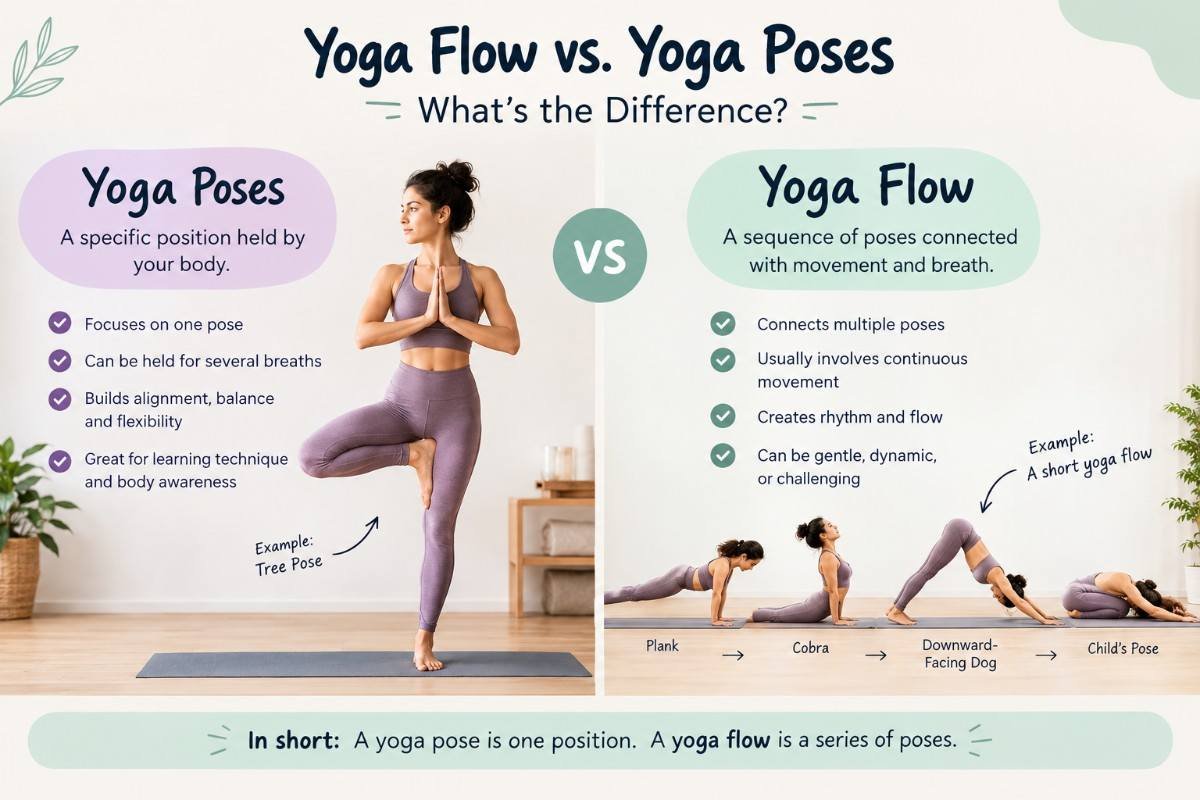
Yoga Flow vs. Yoga Poses can sound like two completely different types of yoga, but they are actually closely connected. A yoga pose is a specific body position, while a yoga flow is a sequence of poses linked together with movement and, often, the breath.
If you are new to yoga, understanding the difference can make it easier to choose a practice that matches your goals, fitness level, and daily routine.
In this guide, we’ll explain yoga flow vs. yoga poses, how they work, the benefits of each, and how beginners can start practicing safely at home.
“If you’re looking for a gentle practice to manage everyday stress, Yoga for Anxiety can be a useful place to start.”
What Is a Yoga Pose?
A yoga pose, also called an asana, is a specific position held by the body during yoga practice.
Some familiar yoga poses include:
- Downward-Facing Dog
- Child’s Pose
- Cat-Cow
- Warrior I
- Warrior II
- Tree Pose
- Cobra Pose
- Bridge Pose
- Seated Forward Fold
- Mountain Pose
A yoga pose can be held for several breaths or longer, depending on the type of practice.
For example, you might move into Child’s Pose and stay there for five slow breaths. You are practicing an individual yoga pose rather than continuously moving through a sequence.
Why Practice Individual Yoga Poses?
Yoga Flow vs. Yoga Poses: Practicing individual poses can help you focus on:
- Body alignment
- Balance
- Flexibility
- Mobility
- Breathing
- Body awareness
- Proper technique
This can be particularly useful for beginners who are still learning how different poses feel.
“Beginners who prefer slower, body-awareness-focused movement can also explore Somatic Yoga.”
What Is Yoga Flow?
Yoga flow refers to a sequence of yoga poses performed one after another.
Instead of staying in one position for a long time, you move from one pose to another. In many styles of flow yoga, movement is coordinated with breathing.
One of the best-known examples is Vinyasa yoga, where poses are connected through continuous movement.
A simple yoga flow might look like:
Mountain Pose → Forward Fold → Half Lift → Plank → Cobra → Downward-Facing Dog
The sequence can then repeat or continue into additional poses.
Yoga flow doesn’t necessarily mean fast or intense movement. A flow can be slow, gentle, restorative, or physically challenging.
Yoga Flow vs. Yoga Poses: The Main Difference
The simplest way to understand the difference is:
A yoga pose is one position. A yoga flow is a sequence of positions connected together.
| Yoga Poses | Yoga Flow |
|---|---|
| Focuses on individual positions | Connects multiple poses |
| May involve holding a pose | Usually involves continuous movement |
| Can emphasize alignment | Often emphasizes movement and transitions |
| Good for learning technique | Can create a rhythmic practice |
| Can be static | Usually more dynamic |
| Can be practiced independently | Uses several poses in sequence |
Neither approach is automatically better. They simply offer different ways to practice yoga.
What Are the Benefits of Yoga Poses?
Yoga Flow vs. Yoga Poses: Individual yoga poses can be useful when you want to slow down and concentrate on your body.
1. Better Body Awareness
Holding a pose gives you time to notice how your body feels.
You may become more aware of areas that feel tight, unstable, or comfortable.
2. Flexibility Practice
Certain poses can gently challenge your range of motion.
For example, seated forward folds may involve the hamstrings, while certain hip-opening poses focus on movement around the hips.
Flexibility varies considerably from person to person, so poses should be adapted rather than forced.
“If improving flexibility and movement is your main goal, Yoga for Mobility offers poses specifically focused on mobility.”
3. Balance Practice
Standing poses such as Tree Pose can challenge balance and concentration.
Using a wall or another stable support can make balance-focused poses more accessible for beginners.
4. Alignment Practice
Slowing down makes it easier to pay attention to how your feet, knees, hips, shoulders, and spine are positioned.
This can be especially helpful when learning a new pose.
5. Relaxation
Gentle poses such as Child’s Pose or Legs-Up-the-Wall can be incorporated into slower yoga routines.
A calm environment and slow breathing can make the practice feel more restorative.
What Are the Benefits of Yoga Flow?
Yoga Flow vs. Yoga Poses: Yoga flow adds movement between poses, which can create a completely different experience.
1. Encourages Continuous Movement
Instead of stopping after every pose, you transition from one movement to the next.
This can make a yoga session feel more fluid.
2. Can Increase Physical Activity
Depending on the sequence and pace, a yoga flow can provide a more physically active workout than simply holding gentle poses.
The intensity varies widely between different yoga styles.
3. Improves Movement Coordination
Moving between poses requires coordination.
You may need to coordinate your hands, feet, spine, balance, and breathing at the same time.
4. Can Build Strength
Some flows include poses such as Plank, Chaturanga, Warrior variations, and Chair Pose.
Repeated transitions can challenge different muscle groups.
5. Can Make Practice Feel More Dynamic
Some people enjoy the rhythm of moving continuously through a sequence.
This can make yoga feel more like a moving meditation rather than a series of separate exercises.
Yoga Flow vs. Yoga Poses for Beginners
Yoga Flow vs. Yoga Poses: If you’re completely new to yoga, individual poses can be a useful starting point because they allow you to learn the basic positions before adding complicated transitions.
For example, you might first learn:
- Mountain Pose
- Cat-Cow
- Child’s Pose
- Downward-Facing Dog
- Cobra Pose
- Warrior I
Once you become comfortable with the positions, you can start connecting them into a simple flow.
However, beginners can also participate in gentle beginner-friendly flows. The key is choosing a pace that allows you to understand each movement.
A Simple Beginner Yoga Flow
Yoga Flow vs. Yoga Poses: You don’t need a complicated sequence to experience yoga flow.
Try this gentle sequence:
Step 1: Mountain Pose
Stand comfortably with your feet grounded.
Take several slow breaths and notice your posture.
Step 2: Forward Fold
Bend your knees slightly if necessary and gently fold forward.
Avoid forcing your hands toward the floor.
Step 3: Half Lift
Lengthen your spine and bring your chest forward.
Keep the movement comfortable.
Step 4: Downward-Facing Dog
Move into Downward-Facing Dog if it feels comfortable.
You can keep your knees bent rather than trying to straighten your legs.
Step 5: Child’s Pose
Lower your body into Child’s Pose and take several relaxed breaths.
Step 6: Repeat
Move through the sequence again at a comfortable pace.
As you become more familiar with the movements, you can gradually make the transitions smoother.
Yoga Flow Doesn’t Have to Be Fast
Yoga Flow vs. Yoga Poses: One common misconception is that yoga flow means moving quickly.
That’s not necessarily true.
A slow yoga flow can involve holding each position for several breaths before moving to the next one.
For example:
Mountain Pose → Warrior I → Warrior II → Triangle Pose → Child’s Pose
You can move slowly between each position while maintaining steady breathing.
The goal isn’t necessarily speed. It’s coordinated movement and awareness.
Is Yoga Flow Better for Flexibility?
Yoga Flow vs. Yoga Poses: Yoga flow can include movements that challenge flexibility, but individual poses can also be useful for flexibility practice.
If your primary goal is improving flexibility, spending time in appropriate poses may allow you to focus more carefully on your range of motion.
A combination of both approaches can work well.
For example:
Warm-up flow → Individual mobility poses → Relaxation
This allows movement at the beginning while giving you time to focus on specific areas afterward.
Is Yoga Flow Better for Strength?
Yoga Flow vs. Yoga Poses: Some forms of yoga flow can be physically demanding.
Sequences that repeatedly use Plank, Chair Pose, Warrior poses, and other weight-bearing positions can challenge muscular endurance.
However, not every yoga flow is designed as a strength workout.
A gentle restorative flow will feel very different from a vigorous Vinyasa class.
If strength is your goal, consider the style, duration, and intensity of the yoga session rather than simply choosing something labeled “flow.”
Yoga Poses You Can Add to a Flow
Yoga Flow vs. Yoga Poses: You can create many different sequences using individual yoga poses.
Some beginner-friendly options include:
Mountain Pose
Useful as a starting or resting position.
Cat-Cow
A gentle movement sequence often used during warm-ups.
Child’s Pose
A commonly used resting position.
Downward-Facing Dog
Often used as a transition between other poses.
Warrior II
A standing pose that can add strength and stability work.
Tree Pose
A balance-focused standing pose.
Cobra Pose
A back-extension pose commonly included in yoga sequences.
Bridge Pose
A floor-based pose that can be incorporated into slower practices.
The best sequence depends on your experience, mobility, and goals.
Yoga Flow vs. Yoga Poses for Stress Relief
Yoga Flow vs. Yoga Poses: Both approaches can be included in a stress-management routine.
A slower flow can provide gentle movement while encouraging attention to breathing.
Individual poses can provide opportunities to pause and settle.
For example, a relaxing evening routine might combine:
Cat-Cow → Child’s Pose → Low Lunge → Seated Forward Fold → Legs-Up-the-Wall
You don’t have to perform a long session. Even a short, consistent practice can become part of a relaxing daily routine.
“For a slower mind-body approach, Nervous System Yoga is another practice worth exploring.”
Can You Combine Yoga Flow and Individual Poses?
Absolutely.
Yoga Flow vs. Yoga Poses: In fact, combining them can create a balanced yoga session.
For example:
5 minutes: Gentle warm-up flow
10 minutes: Individual poses
5 minutes: Relaxing poses and breathing
This approach lets you enjoy movement while still having time to focus on specific positions.
You can also build a session around a particular goal.
Yoga Flow vs. Yoga Poses: Which Should You Choose?
Yoga Flow vs. Yoga Poses: There isn’t one option that works for everyone.
Your choice can depend on what you want from your practice.
Choose individual yoga poses if you want to:
- Learn basic alignment
- Focus on one area of the body
- Practice balance
- Work on flexibility
- Slow down your session
- Become more familiar with yoga positions
Choose yoga flow if you want to:
- Connect multiple poses
- Practice continuous movement
- Make your session more dynamic
- Combine movement with breathing
- Build a flowing routine
You can also alternate between the two.
For example, you could practice yoga flow on some days and use individual poses for mobility or relaxation on others.
How Long Should a Yoga Flow Be?
Yoga Flow vs. Yoga Poses: There is no universal required length.
A beginner might start with 5 to 10 minutes, while someone with more experience may practice for 20, 30, 45, or more minutes.
Consistency can be more practical than trying to complete a long session every day.
A short sequence that fits comfortably into your routine may be easier to maintain than an ambitious routine that feels difficult to continue.
Tips for Practicing Yoga Safely
Yoga Flow vs. Yoga Poses: Whether you’re practicing individual poses or a flow, keep safety in mind.
- Start slowly.
- Don’t force your body into a position.
- Pay attention to pain rather than trying to push through it.
- Modify poses when needed.
- Use props or support if appropriate.
- Keep your breathing comfortable.
- Choose beginner-friendly instruction if you’re new to yoga.
- Give yourself time to learn transitions before increasing speed.
If you have an injury or a medical condition, consider speaking with an appropriate healthcare professional before beginning a new exercise routine.
FAQs for Yoga Flow vs. Yoga Poses
Is yoga flow the same as yoga poses?
No. A yoga pose is an individual body position, while yoga flow is a sequence of poses connected through movement.
Is yoga flow good for beginners?
Yes. Beginners can practice gentle yoga flows, provided the sequence matches their experience and they learn the individual movements first.
Can I practice yoga poses without doing a flow?
Yes. You can practice individual yoga poses without connecting them into a continuous sequence.
Is yoga flow harder than regular yoga poses?
Not necessarily. The difficulty depends on the poses, pace, duration, and style of practice. A gentle flow can be very accessible, while a vigorous flow can be challenging.
Can yoga flow improve flexibility?
Yoga flow can include movements that challenge flexibility, while individual poses can provide more time to focus on specific areas of mobility and range of motion.
How long should a beginner yoga flow be?
A beginner can start with a short 5- to 10-minute sequence and gradually increase the duration as they become more comfortable.
Can yoga poses help with relaxation?
Yes. Gentle poses combined with slow breathing can be incorporated into relaxation-focused yoga routines.
Conclusion
The difference between yoga flow vs. yoga poses is mainly about how movement is organized.
A yoga pose is an individual position. A yoga flow connects several poses into a continuous sequence.
You don’t have to choose one permanently. Individual poses can help you understand alignment, flexibility, balance, and body awareness, while yoga flows can add movement, rhythm, and variety to your practice.
For many people, combining both approaches is a practical way to build a balanced yoga routine.
Whether you prefer a slow evening sequence, a short morning flow, or individual poses focused on mobility, the most useful practice is one that feels comfortable, sustainable, and appropriate for your experience level.
“You can also combine gentle yoga movements with Pranayama for Stress to make breathing a more intentional part of your routine.”
About the Author
Hitasha is the author and wellness content creator at Trendyopedia, writing about yoga, wellness, beauty, lifestyle, and emerging health trends. Her goal is to make trending topics simple, practical, and easy to understand.
Disclaimer: This article is for general informational purposes only and is not a substitute for professional medical or fitness advice. Always practice within your comfort level and consult a qualified professional if you have health concerns or an injury.